586 posters, 8 topics, 23 sessions, 1,077 authors, 622 institutions
ePostersLive by SciGen Technologies S.A. All rights reserved.
ISQua's 40th International Conference 2024
24th - 27th September 2024 | Istanbul, Türkiye

P028
The effect of intelligent management interventions in intensive care units to reduce false alarms: An integrative review
Poster Presenter
Authors
Bingyu LI, Liqing Yue, Huiyu Nie, Ziwei Cao, Xiaoya Chai, Bin Peng, Tiange Zhang, Weihong Huang
Affiliations
Teaching and Research Section of Clinical Nursing, Xiangya Hospital of Central South University, Changsha, Hunan, China, Xiangya School of Nursing, Central South University, Changsha, Hunan, China, “Mobile Health” Ministry of Education - China Mobile Joint Laboratory, Xiangya Hospital of Central South University, Changsha, Hunan, China
Part of Topic
Patient Safety & Quality Improvement
The effect of intelligent management interventions in intensive care units to reduce false alarms: An integrative review
B. Li1, L. Yue1, H. Nie1, Z. Cao1, X. Chai2, B. Peng2, T. Zhang2, W. Huang3
1 Teaching and Research Section of Clinical Nursing, Xiangya Hospital of Central South University, Changsha, Hunan, China 2 Xiangya School of Nursing, Central South University, Changsha, Hunan, China 3 “Mobile Health” Ministry of Education - China Mobile Joint Laboratory, Xiangya Hospital of Central South University, Changsha, Hunan, China
INTRODUCTION
Frequent false alarms from medical devices in Intensive Care Units (ICUs) can lead to alarm fatigue among nurses, potentially causing delays in patient monitoring and increasing the risk of adverse events. With advances in medical device technologies, the volume of alarm data in ICUs is growing, providing a basis for using internet technologies to improve alarm management. While intelligent alarm management interventions are being explored, there is no guideline or consensus that any intervention can consistently reduce alarm overload. Therefore, effective strategies to manage alarms, reduce unnecessary alarms, alleviate nurse fatigue, and improve response times to critical alarms are urgently needed to enhance ICU care quality.
AIM
The aim of this integrative review is to systematically evaluate the effectiveness of intelligent management interventions designed to reduce false alarms in ICUs. Specifically, the study focuses on how these interventions impact the total number and duration of alarms, improve nurses' response times to critical alarms, and enhance the overall safety and quality of patient care. By synthesizing existing research evidence, this review aims to identify the most effective strategies for intelligent alarm management to help hospitals better manage alarm challenges in ICUs.
METHOD
Following the framework of Whitmore and Knafl, the reviewers systematically searched six databases: PubMed, EMBASE, CINAHL, OVID, Cochrane Library, and Scopus, and studies included intelligent management of clinical alarms published in the English or Chinese language from the inception of each database to December 2022 were retrieved. The researchers used the PICOS framework to formulate the search strategy, developed keywords, screened literature, and assessed the studies’ quality using the Joanna Briggs Institute-Meta-Analysis of Statistics, Assessment, and Review Instrument (JBI-MAStARI). The review was preregistered on PROSPERO (CRD42023411552).
RESULTS
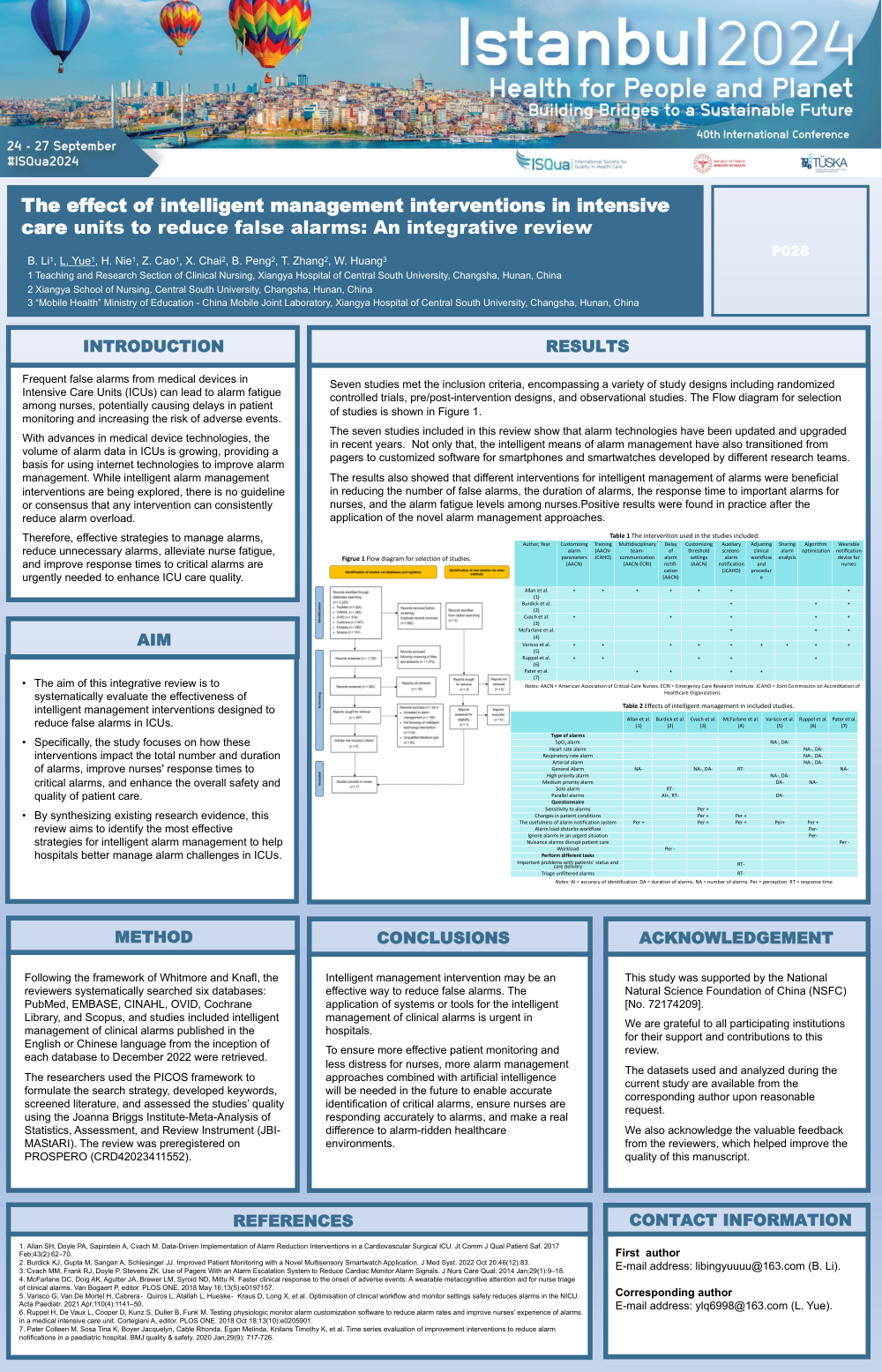
Seven studies met the inclusion criteria, encompassing a variety of study designs including randomized controlled trials, pre/post-intervention designs, and observational studies. The Flow diagram for selection of studies is shown in Figure 1. The seven studies included in this review show that alarm technologies have been updated and upgraded in recent years. Not only that, the intelligent means of alarm management have also transitioned from pagers to customized software for smartphones and smartwatches developed by different research teams. The results also showed that different interventions for intelligent management of alarms were beneficial in reducing the number of false alarms, the duration of alarms, the response time to important alarms for nurses, and the alarm fatigue levels among nurses.Positive results were found in practice after the application of the novel alarm management approaches.
CONCLUSIONS
Intelligent management intervention may be an effective way to reduce false alarms. The application of systems or tools for the intelligent management of clinical alarms is urgent in hospitals. To ensure more effective patient monitoring and less distress for nurses, more alarm management approaches combined with artificial intelligence will be needed in the future to enable accurate identification of critical alarms, ensure nurses are responding accurately to alarms, and make a real difference to alarm-ridden healthcare environments.
ACKNOWLEDGEMENT
This study was supported by the National Natural Science Foundation of China (NSFC) [No. 72174209]. We are grateful to all participating institutions for their support and contributions to this review. The datasets used and analyzed during the current study are available from the corresponding author upon reasonable request. We also acknowledge the valuable feedback from the reviewers, which helped improve the quality of this manuscript.
CONTACT INFORMATION
First author E-mail address: libingyuuuu@163.com (B. Li). Corresponding author E-mail address: ylq6998@163.com (L. Yue).