586 posters, 8 topics, 23 sessions, 1,077 authors, 622 institutions
ePostersLive by SciGen Technologies S.A. All rights reserved.
ISQua's 40th International Conference 2024
24th - 27th September 2024 | Istanbul, Türkiye

P049
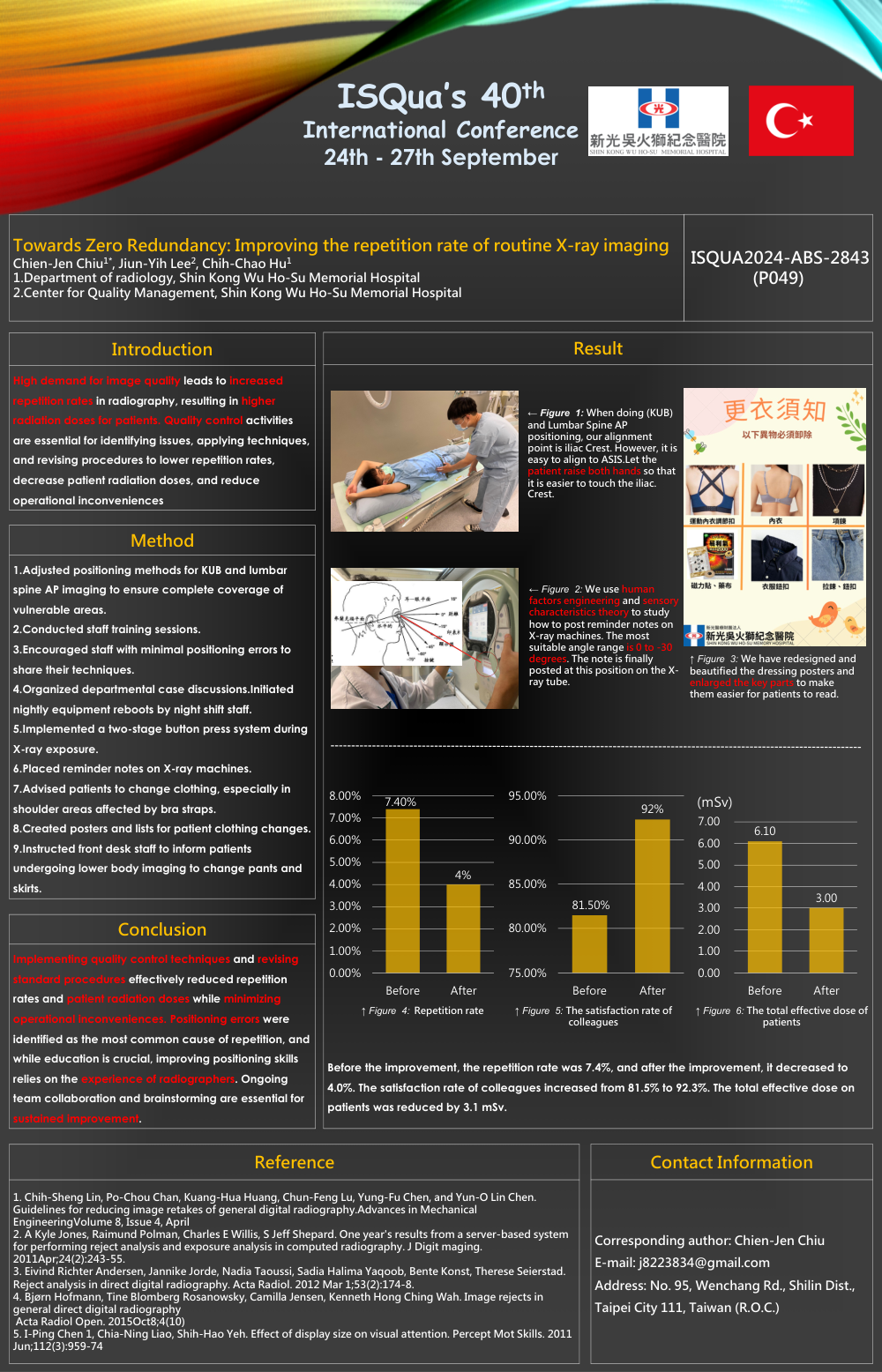
Towards Zero Redundancy: Improving the repetition rate of routine X-ray imaging
Poster Presenter
Authors
Affiliations
Part of Topic
Patient Safety & Quality Improvement
ISQua’s 40th
International Conference
24th - 27th September
|
Towards Zero Redundancy: Improving the repetition rate of routine X-ray imaging Chien-Jen Chiu1*, Jiun-Yih Lee2, Chih-Chao Hu1 |
ISQUA2024-ABS-2843 (P049) |
|
Result |
|
← Figure 1: When doing (KUB) and Lumbar Spine AP positioning, our alignment point is iliac Crest. However, it is easy to align to ASIS.Let the patient raise both hands so that it is easier to touch the iliac. Crest. ← Figure 2: We use human factors engineering and sensory characteristics theory to study how to post reminder notes on X-ray machines. The most suitable angle range is 0 to -30 degrees. The note is finally posted at this position on the X- ray tube. ↑ Figure 3: We have redesigned and beautified the dressing posters and enlarged the key parts to make them easier for patients to read. (mSv) 7.00 6.00 5.00 4.00 3.00 2.00 1.00 0.00 8.00% 7.00% 6.00% 5.00% 4.00% 3.00% 2.00% 1.00% 0.00% 7.40% Before 4% After 95.00% 90.00% 85.00% 80.00% 75.00% 81.50% Before 92% After 6.10 Before 3.00 After ↑ Figure 4: Repetition rate ↑ Figure 5: The satisfaction rate of colleagues ↑ Figure 6: The total effective dose of patients Before the improvement, the repetition rate was 7.4%, and after the improvement, it decreased to 4.0%. The satisfaction rate of colleagues increased from 81.5% to 92.3%. The total effective dose on patients was reduced by 3.1 mSv. |
|
Introduction |
|
High demand for image quality leads to increased repetition rates in radiography, resulting in higher radiation doses for patients. Quality control activities are essential for identifying issues, applying techniques, and revising procedures to lower repetition rates, decrease patient radiation doses, and reduce operational inconveniences |
|
Method |
|
1.Adjusted positioning methods for KUB and lumbar spine AP imaging to ensure complete coverage of vulnerable areas. 3.Encouraged staff with minimal positioning errors to share their techniques. 6.Placed reminder notes on X-ray machines. |
|
Conclusion |
|
Implementing quality control techniques and revising standard procedures effectively reduced repetition rates and patient radiation doses while minimizing operational inconveniences. Positioning errors were identified as the most common cause of repetition, and while education is crucial, improving positioning skills relies on the experience of radiographers. Ongoing team collaboration and brainstorming are essential for sustained improvement. |
|
Contact Information |
|
Corresponding author: Chien-Jen Chiu E-mail: j8223834@gmail.com |
|
Reference |
|
1. Chih-Sheng Lin, Po-Chou Chan, Kuang-Hua Huang, Chun-Feng Lu, Yung-Fu Chen, and Yun-O Lin Chen. Guidelines for reducing image retakes of general digital radiography.Advances in Mechanical EngineeringVolume 8, Issue 4, April 3. Eivind Richter Andersen, Jannike Jorde, Nadia Taoussi, Sadia Halima Yaqoob, Bente Konst, Therese Seierstad. Reject analysis in direct digital radiography. Acta Radiol. 2012 Mar 1;53(2):174-8. Acta Radiol Open. 2015Oct8;4(10) |