586 posters, 8 topics, 23 sessions, 1,077 authors, 622 institutions
ePostersLive by SciGen Technologies S.A. All rights reserved.
ISQua's 40th International Conference 2024
24th - 27th September 2024 | Istanbul, Türkiye

ISQUA2024-ABS-2063
Prevention of Lower Limb Deep Venous Thromboembolism and Pulmonary Embolism: Early Ambulation 24 Hours Post-Cesarean Section
Part of Topic
Patient Safety & Quality Improvement
Prevention of Lower Limb Deep Venous Thromboembolism and Pulmonary Embolism: Early Ambulation 24 HoursPost-Cesarean Section
Introduction: According to the analysis of the Taiwan Annual Report on Obstetric Accidents, venous thromboembolism (VTE) accounted for 16.1% of all maternal deaths in 2020, making it the fourth leading cause of death related to pregnancy (Ministry of Health and Welfare, 2021). Middleton et al reported a higher risk of VTE in cesarean sections in 2021. Soon after, the Taiwan Society of Obstetrics and Gynecology newly classified prolonged postoperative bed rest in cesarean section patients in 2022 as a general risk for VTE, recommending early ambulation within 24 hours postsurgery. However, delays in ambulation often occur due to factors such as pregnancy-related lower limb swelling, postoperative discomfort and pain, and inconvenience caused by catheterization, leading to an increased risk of VTE. A review of our hospital's practice for cesarean section patients revealed in February 2023, the average time for the first ambulation post-surgery was 28.6 hours, with an ambulation rate within 24 hours of 17.4%.
Methods: The proposed intervention plan outlines strategies to enhance venous thromboembolism (VTE) prevention in post-cesarean section patients through educational training and evidence-based practices. The educational training component involves continuing education courses for nursing staff to improve their ability to identify and respond to emergencies promptly. Additionally, staff is educated on performing Homan's test and assessing the symmetry of lower limb circumference and dorsalis pedis pulse. The evidence-based obstetric risk prevention measures include searching relevant literature for VTE prevention strategies and introducing intermittent pneumatic compression systems.
Obstetricians are informed to revise routine orders to encourage early ambulation, adjust postoperative analgesics based on patient conditions, and teach joint exercises for bedridden patients. Revise routine orders to encourage early ambulation by changing the Foley catheter removal time. Instead of keeping the Foley for 24 hours, it should be removed the following morning. This adjustment aims to facilitate earlier ambulation and improve postoperative recovery. For high-risk individuals, the recommendation includes wearing elastic stockings or using elastic bandages, emphasized during shift handovers. Maternal information is addressed through group health education sessions, comprehensive informed consent for intermittent pneumatic compression systems, and nursing guidance on preventing lower limb VTE through exercise in postpartum education handbooks. This multifaceted approach aims to improve early ambulation rates and reduce VTE risks in post-cesarean section patients.
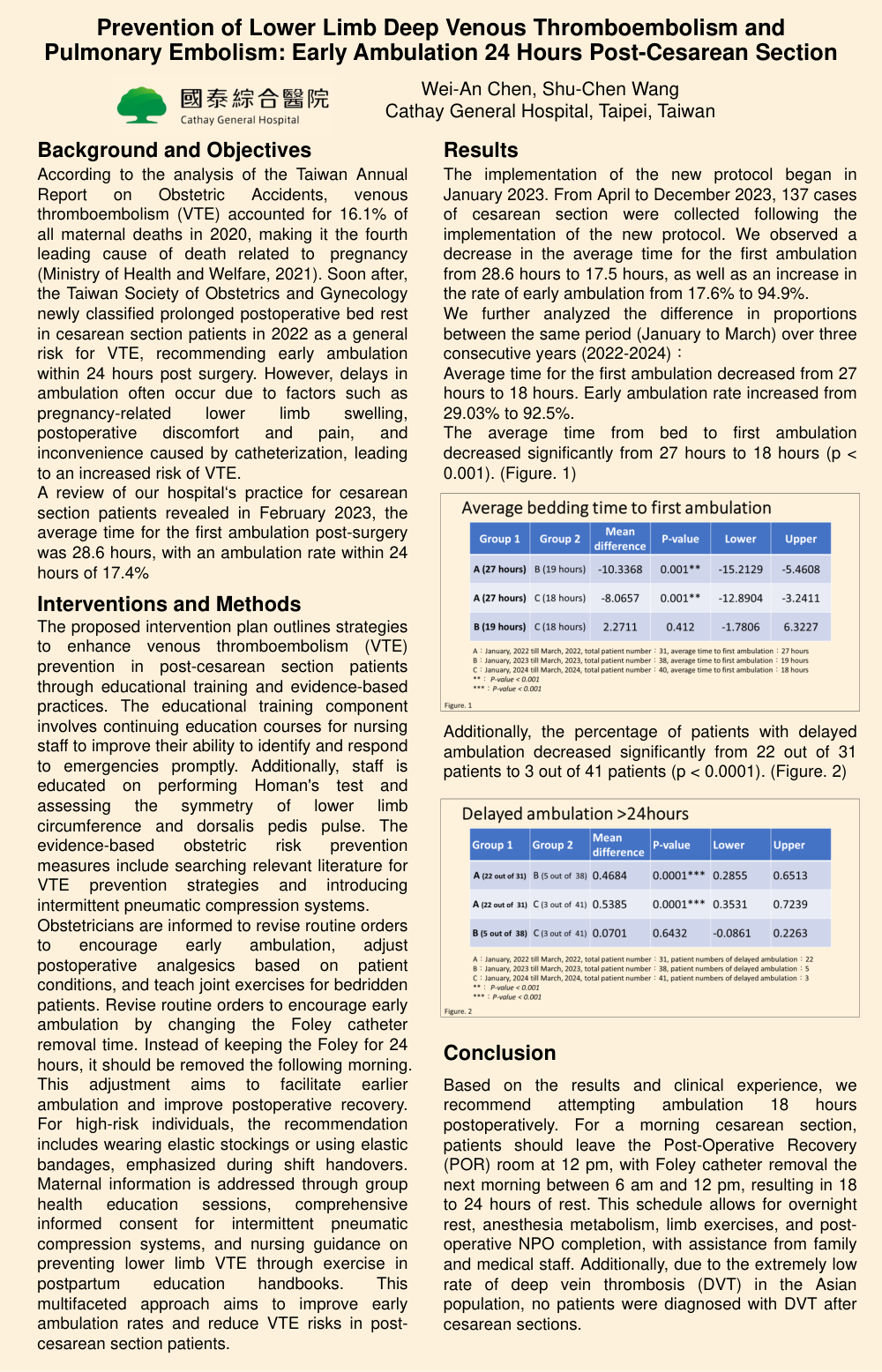
Results: The implementation of the new protocol began in January 2023. From April to December 2023, 137 cases of cesarean section were collected following the implementation of the new protocol. We observed a decrease in the average time for the first ambulation from 28.6 hours to 17.5 hours, as well as an increase in the rate of early ambulation from 17.6% to 94.9%. We further analyzed the difference in proportions between the same period (January to March) over three consecutive years (2022-2024):Average time for the first ambulation decreased from 27 hours to 18 hours. Early ambulation rate increased from 29.03% to 92.5%. The average time from bed to first ambulation decreased significantly from 27 hours to 18 hours (p < 0.001) . (Figure. 1)
Additionally, the percentage of patients with delayed ambulation decreased significantly from 22 out of 31 patients to 3 out of 41 patients (p < 0.0001). (Figure. 2)
Conclusion: Based on the results and clinical experience, we recommend attempting ambulation 18 hours postoperatively. For a morning cesarean section, patients should leave the Post-Operative Recovery (POR) room at 12 pm, with Foley catheter removal the next morning between 6 am and 12 pm, resulting in 18 to 24 hours of rest. This schedule allows for overnight rest, anesthesia metabolism, limb exercises, and post-operative NPO completion, with assistance from family and medical staff. Additionally, due to the extremely low rate of deep vein thrombosis (DVT) in the Asian population, no patients were diagnosed with DVT after cesarean sections.