586 posters, 8 topics, 23 sessions, 1,077 authors, 622 institutions
ePostersLive by SciGen Technologies S.A. All rights reserved.
ISQua's 40th International Conference 2024
24th - 27th September 2024 | Istanbul, Türkiye

P337
Early Warning Scoring System Improves Patient Safety and Clinical Outcomes at a Tertiary Care Multispecialty Hospital in India
Poster Presenter
Authors
Affiliations
Part of Topic
Patient Safety & Quality Improvement
Modified Early Warning Scoring System Improves Patient Safety and Clinical Outcomes at a Tertiary Care Multispecialty Hospital in India
Thilagavathy Vasudevan1, Leena Chandrasekaran2, Palaniyammal P3
Mehta Multi Speciality Hospitals India Pvt Ltd, Chennai, Tamilnadu, India
INTRODUCTION:
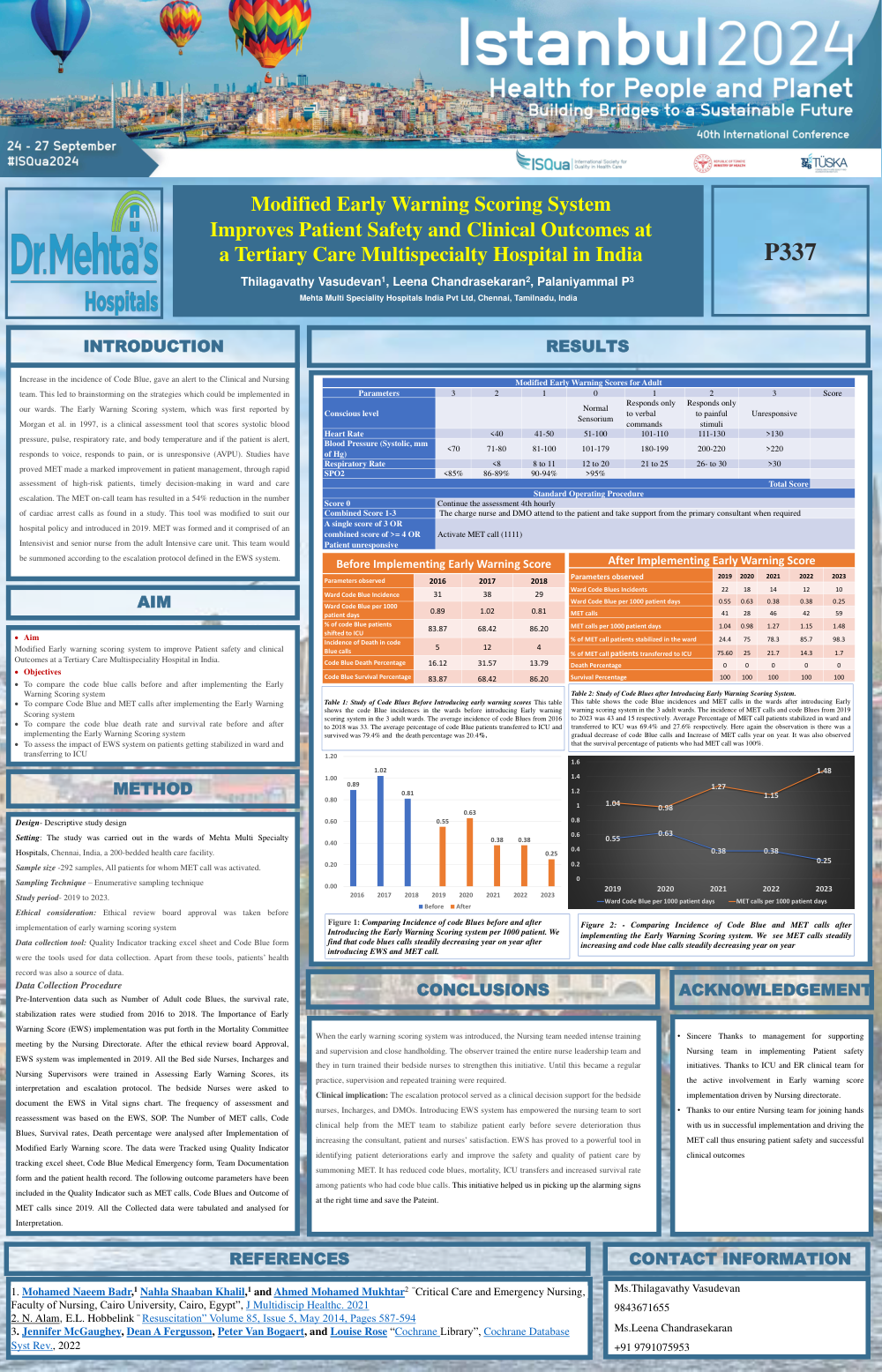
Increase in the incidence of Code Blue, gave an alert to the Clinical and Nursing team. This led to brainstorming on the strategies which could be implemented in our wards. The Early Warning Scoring system, which was first reported by Morgan et al. in 1997, is a clinical assessment tool that scores systolic blood pressure, pulse, respiratory rate, and body temperature and if the patient is alert, responds to voice, responds to pain, or is unresponsive (AVPU). Studies have proved MET made a marked improvement in patient management, through rapid assessment of high-risk patients, timely decision-making in ward and care escalation. The MET on-call team has resulted in a 54% reduction in the number of cardiac arrest calls as found in a study. This tool was modified to suit our hospital policy and introduced in 2019. MET was formed and it comprised of an Intensivist and senior nurse from the adult Intensive care unit. This team would be summoned according to the escalation protocol defined in the EWS system.
AIM
Modified Early warning scoring system to improve Patient safety and clinical Outcomes at a Tertiary Care Multispeciality Hospital in India.
METHOD
Design- Descriptive study design
Setting: The study was carried out in the wards of Mehta Multi Specialty Hospitals, Chennai, India, a 200-bedded health care facility.
Sample size -292 samples, All patients for whom MET call was activated.
Sampling Technique – Enumerative sampling technique
Study period- 2019 to 2023.
Ethical consideration: Ethical review board approval was taken before implementation of early warning scoring system
Data collection tool: Quality Indicator tracking excel sheet and Code Blue form were the tools used for data collection. Apart from these tools, patients’ health record was also a source of data.
Data Collection Procedure
Pre-Intervention data such as Number of Adult code Blues, the survival rate, stabilization rates were studied from 2016 to 2018. The Importance of Early Warning Score (EWS) implementation was put forth in the Mortality Committee meeting by the Nursing Directorate. After the ethical review board Approval, EWS system was implemented in 2019. All the Bed side Nurses, Incharges and Nursing Supervisors were trained in Assessing Early Warning Scores, its interpretation and escalation protocol. The bedside Nurses were asked to document the EWS in Vital signs chart. The frequency of assessment and reassessment was based on the EWS, SOP. The Number of MET calls, Code Blues, Survival rates, Death percentage were analysed after Implementation of Modified Early Warning score. The data were Tracked using Quality Indicator tracking excel sheet, Code Blue Medical Emergency form, Team Documentation form and the patient health record. The following outcome parameters have been included in the Quality Indicator such as MET calls, Code Blues and Outcome of MET calls since 2019. All the Collected data were tabulated and analysed for Interpretation.
CONCLUSIONS
When the early warning scoring system was introduced, the Nursing team needed intense training and supervision and close handholding. The observer trained the entire nurse leadership team and they in turn trained their bedside nurses to strengthen this initiative. Until this became a regular practice, supervision and repeated training were required.
Clinical implication: The escalation protocol served as a clinical decision support for the bedside nurses, Incharges, and DMOs. Introducing EWS system has empowered the nursing team to sort clinical help from the MET team to stabilize patient early before severe deterioration thus increasing the consultant, patient and nurses’ satisfaction. EWS has proved to a powerful tool in identifying patient deteriorations early and improve the safety and quality of patient care by summoning MET. It has reduced code blues, mortality, ICU transfers and increased survival rate among patients who had code blue calls. This initiative helped us in picking up the alarming signs at the right time and save the Pateint.