586 posters, 8 topics, 23 sessions, 1,077 authors, 622 institutions
ePostersLive by SciGen Technologies S.A. All rights reserved.
ISQua's 40th International Conference 2024
24th - 27th September 2024 | Istanbul, Türkiye

ISQUA2024-ABS-2050
ELECTRONIC WITNESS SYSTEM IN FERTILITY CENTER: STAFF AND PATIENTS PERSPECTIVES
Poster Presenter
Authors
Affiliations
Part of Topic
Patient Safety & Quality Improvement
ELECTRONIC WITNESS SYSTEM IN FERTILITY CENTER: STAFF AND PATIENTS PERSPECTIVES
Huy Pham1, Hien Bui1, Quyen Dang1, Anh Le1, Tuong Ho2
1IVFMD Phu Nhuan, My Duc Phu Nhuan Hospital, Ho Chi Minh City, Vietnam
2IVFMD, My Duc Hospital, Ho Chi Minh City, Vietnam
Keywords: Electronic witness system, Fertility center, Patient Identification, Radio frequency identification
Introduction
In a fertility clinic, biological sample identification, processing, and traceability are extremely important for in-vitro fertilization (IVF) procedures. A mix-up of gametes and embryos has the highest grade of severity. Electronic witnessing systems (EWS) have been introduced as a safeguarding measure to address these critical considerations. These systems are vital in reducing the risk of biological sample mix-ups, particularly human error.
Aim
The study aimed to explore the staff’s perceptions and patients’ experiences at an IVF clinic operated with an EWS.
Methods
EWS using radio frequency identification (RI WitnessTM, Cooper Surgical, Denmark) was applied in our fertility clinic. To evaluate the influence of EWS on the viewpoints of staff and patients, a survey was conducted from December 1, 2023, to January 31, 2024. The study engaged embryologists/operation managers and patients at IVFMD, My Duc Phu Nhuan Hospital, Ho Chi Minh City, Vietnam. Participants were administered a Likert scale questionnaire (1 to 5) to assess their perceptions and experiences with EWS.
Results
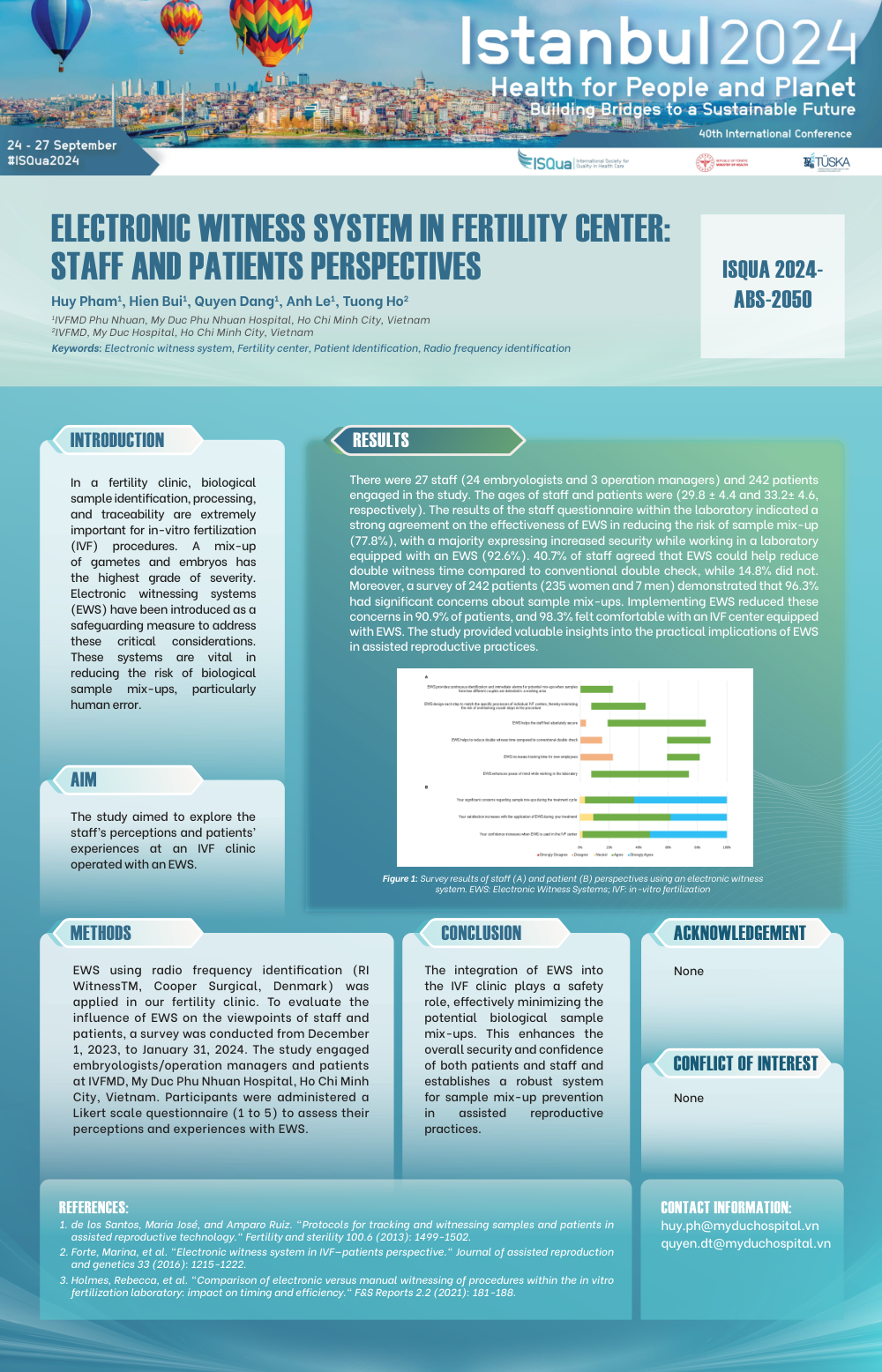
There were 27 staff (24 embryologists and 3 operation managers) and 242 patients engaged in the study. The ages of staff and patients were (29.8 ± 4.4 and 33.2± 4.6, respectively). The results of the staff questionnaire within the laboratory indicated a strong agreement on the effectiveness of EWS in reducing the risk of sample mix-up (77.8%), with a majority expressing increased security while working in a laboratory equipped with an EWS (92.6%). 40.7% of staff agreed that EWS could help reduce double witness time compared to conventional double check, while 14.8% did not. Moreover, a survey of 242 patients (235 women and 7 men) demonstrated that 96.3% had significant concerns about sample mix-ups. Implementing EWS reduced these concerns in 90.9% of patients, and 98.3% felt comfortable with an IVF center equipped with EWS. The study provided valuable insights into the practical implications of EWS in assisted reproductive practices.
Conclusion
The integration of EWS into the IVF clinic plays a safety role, effectively minimizing the potential biological sample mix-ups. This enhances the overall security and confidence of both patients and staff and establishes a robust system for sample mix-up prevention in assisted reproductive practices.
Conflict of Interest: None
Acknowledgement: None
References:
1. de los Santos, Maria José, and Amparo Ruiz. "Protocols for tracking and witnessing samples and patients in assisted reproductive technology." Fertility and sterility 100.6 (2013): 1499-1502.
2. Forte, Marina, et al. "Electronic witness system in IVF—patients perspective." Journal of assisted reproduction and genetics 33 (2016): 1215-1222.
3. Holmes, Rebecca, et al. "Comparison of electronic versus manual witnessing of procedures within the in vitro fertilization laboratory: impact on timing and efficiency." F&S Reports 2.2 (2021): 181-188.