586 posters, 8 topics, 23 sessions, 1,077 authors, 622 institutions
ePostersLive by SciGen Technologies S.A. All rights reserved.
ISQua's 40th International Conference 2024
24th - 27th September 2024 | Istanbul, Türkiye

P365
the establishment of a quick outpatient appointment system in Seoul National University Hospital (to activate timely treatment for severe/acute/rare/refractory/incurable first-visit patients)
Poster Presenter
Authors
Affiliations
Part of Topic
Patient Safety & Quality Improvement
The establishment of a quick outpatient appointment system in Seoul National University Hospital (SNUH)
- To activate timely treatment for severe/acute/rare/refractory/incurable first-visit patients
There is the phenomenon of Patient concentraion in the Seoul metropolitan area's tertiary general hospital due to the rapid development of public transportation such as KTX(high speed train), the expansion of road networks, and policies to strengthen health insurance coverage. The general public expects large-scale, state-of-the-art equipment, rapid introduction of new technologies, and many famous doctors to provide high-quality medical services, and as if shopping, they choose two of more hospitals to receive duplicate appointments and over-treatment. As patients are increasingly concentrated in the upper level, metropolitan area, and large hospitals, the number of waiting days for outpatient treatment at Seoul National University Hospital is increasing, which makes it difficult for patients with severe/acute/rare/refractory/incurable conditions to get timely treatment.
The average waiting days for new outpatients at SNUH is more than 40 days. Due to the delay, many new patients may miss the right time to treat them.
- A quick outpatient appointment system for severe, rare, refractory and incurable patients through patient classification based on the medical assessment is needed.
-In Korea, patients with difficult and complex severe diseases according to the patient classification can receive timely and appropriate treatment at higher general hospitals and keep them more safe and healthy.
-To contribute to the promotion of national health as a national, global and central hospital.
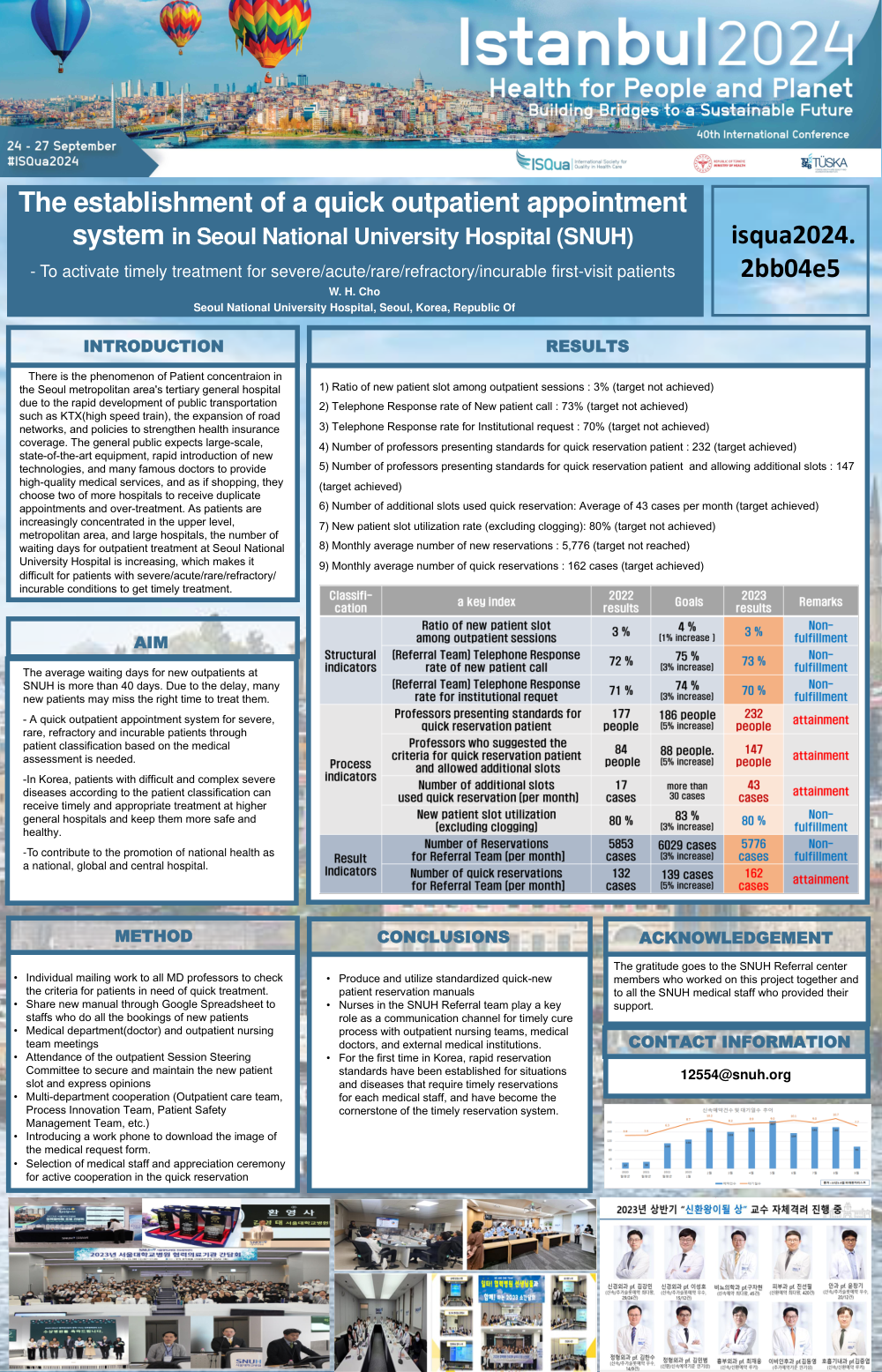
Results
1) Ratio of new patient slot among outpatient sessions : 3% (target not achieved)
2) Telephone Response rate of New patient call : 73% (target not achieved)
3) Telephone Response rate for Institutional request : 70% (target not achieved)
4) Number of professors presenting standards for quick reservation patient : 232 (target achieved)
5) Number of professors presenting standards for quick reservation patient and allowing additional slots : 147 (target achieved)
6) Number of additional slots used quick reservation: Average of 43 cases per month (target achieved)
7) New patient slot utilization rate (excluding clogging): 80% (target not achieved)
8) Monthly average number of new reservations : 5,776 (target not reached)
9) Monthly average number of quick reservations : 162 cases (target achieved)