586 posters, 8 topics, 23 sessions, 1,077 authors, 622 institutions
ePostersLive by SciGen Technologies S.A. All rights reserved.
ISQua's 40th International Conference 2024
24th - 27th September 2024 | Istanbul, Türkiye

P194
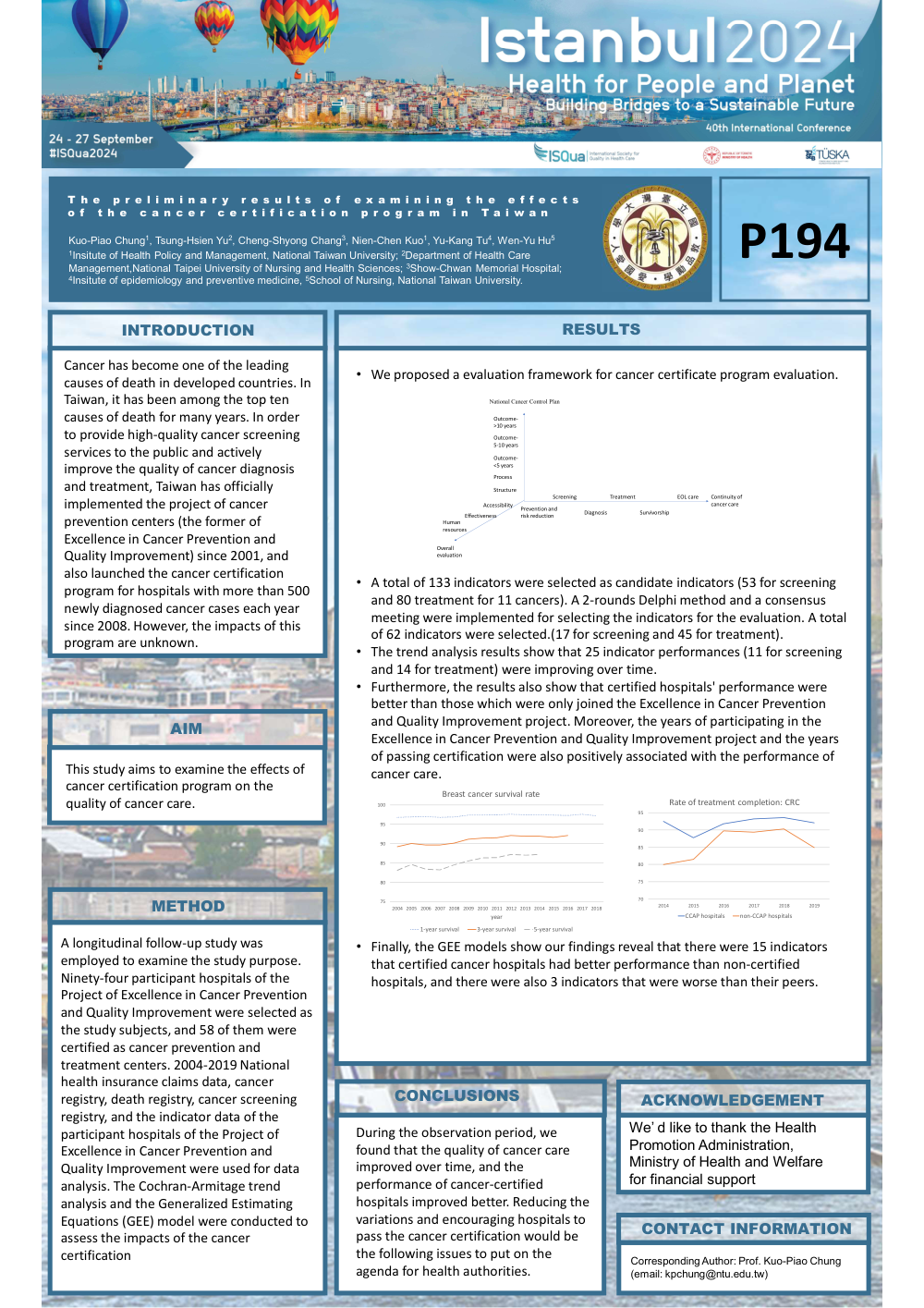
The preliminary results of examining the effects of the cancer certification program in Taiwan
Part of Topic
Patient Safety & Quality Improvement
The preliminary results of examining the effects of the cancer certification program in Taiwan
Introduction: Cancer has become one of the leading causes of death in developed countries. In Taiwan, it has been among the top ten causes of death for many years. In order to provide high-quality cancer screening services to the public and actively improve the quality of cancer diagnosis and treatment, Taiwan has officially implemented the project of cancer prevention centers (the former of Excellence in Cancer Prevention and Quality Improvement) since 2001, and also launched the cancer certification program for hospitals with more than 500 newly diagnosed cancer cases each year since 2008. However, the impacts of this program are unknown. Therefore, this study aims to examine the effects of cancer certification program on the quality of cancer care.
Methods: A longitudinal follow-up study was employed to examine the study purpose. Ninety-four participant hospitals of the Project of Excellence in Cancer Prevention and Quality Improvement were selected as the study subjects, and 58 of them were certified as cancer prevention and treatment centers. 2004-2019 National health insurance claims data, cancer registry, death registry, cancer screening registry, and the indicator data of the participant hospitals of the Project of Excellence in Cancer Prevention and Quality Improvement were used for data analysis. A 2-rounds Delphi method and a consensus meeting were implemented for selecting the indicators for the evaluation. The Cochran-Armitage trend analysis and the Generalized Estimating Equations (GEE) model were conducted to assess the impacts of the cancer certification program after adjusting the hospital’s accreditation level, ownership, and geographic location.
Results: A total of 62 indicators from the indicator data of the participant hospitals of the Project of Excellence in Cancer Prevention and Quality Improvement were selected for evaluation by experts. The trend analysis results show that 25 indicator performances (11 for screening and 14 for treatment) were improving over time. However, variations existed among various accreditation levels and regions. Furthermore, the results also show that certified hospitals' performance was better than those who only joined the Excellence in Cancer Prevention and Quality Improvement project. Moreover, the years of participating in the Excellence in Cancer Prevention and Quality Improvement project and the years of passing certification were also positively associated with the performance of cancer care. Finally, the GEE models show our findings reveal that there were 15 indicators that certified cancer hospitals had better performance than non-certified hospitals, and there were also 3 indicators that were worse than their peers.
Conclusion: During the observation period, we found that the quality of cancer care improved over time, and the performance of cancer-certified hospitals improved better. Reducing the variations and encouraging hospitals to pass the cancer certification would be the following issues to put on the agenda for health authorities.