586 posters, 8 topics, 23 sessions, 1,077 authors, 622 institutions
ePostersLive by SciGen Technologies S.A. All rights reserved.
ISQua's 40th International Conference 2024
24th - 27th September 2024 | Istanbul, Türkiye

P515
The Effect of Health Promotion Activities on the Active Aging of the Elderly in the Service Bases of the Active Aging Centers
Poster Presenter
Authors
Affiliations
Part of Topic
Integrated Care Communities
The Effect of Health Promotion Activities on the Active Aging of the Elderly in the Service Bases of the Active Aging Centers
Background: Promoting a healthy lifestyle is crucial for improving the life satisfaction, health, social participation, and safety of older adults. It forms the foundation of active aging policies, which should cater to all older adults in society, including those who are healthy, frail, or disabled. A study was conducted using a database of 12-week health promotion activities with five design elements (vitality, health, cognitive abilities, physical fitness, and social engagement) provided by local individuals at Senior Health and Vitality Centers established through charitable funding in various locations across Taiwan. The study aimed to assess the longitudinal effectiveness of these activities.
Purpose: The purpose of this study was to explore the trajectory of changes in physical, psychological, emotional, social, and spiritual outcomes of the elderly who participated in the health promotion program at the active aging centers as well as compare the differences in physical, psychological, emotional, social, and spiritual outcomes of the elderly who participated in the health promotion program in different active aging centers.
Methods: This study conducted a longitudinal analysis using secondary data. The participants were registered Taiwanese citizens aged 60 years and above who had attended activities at nine different elderly vitality centers nationwide. Only those who had participated in at least 10 pre- and post-test sessions were included. The research utilized the Elderly Vitality Center Assessment Scale, which consisted of various assessments related to sociodemographic information, health status, healthcare utilization, social functioning, daily life, life satisfaction, geriatric depression, and physical measurements. The data were analyzed using descriptive statistics, chi-square tests, Fisher's exact tests, one-way ANOVA, and generalized estimating equations.
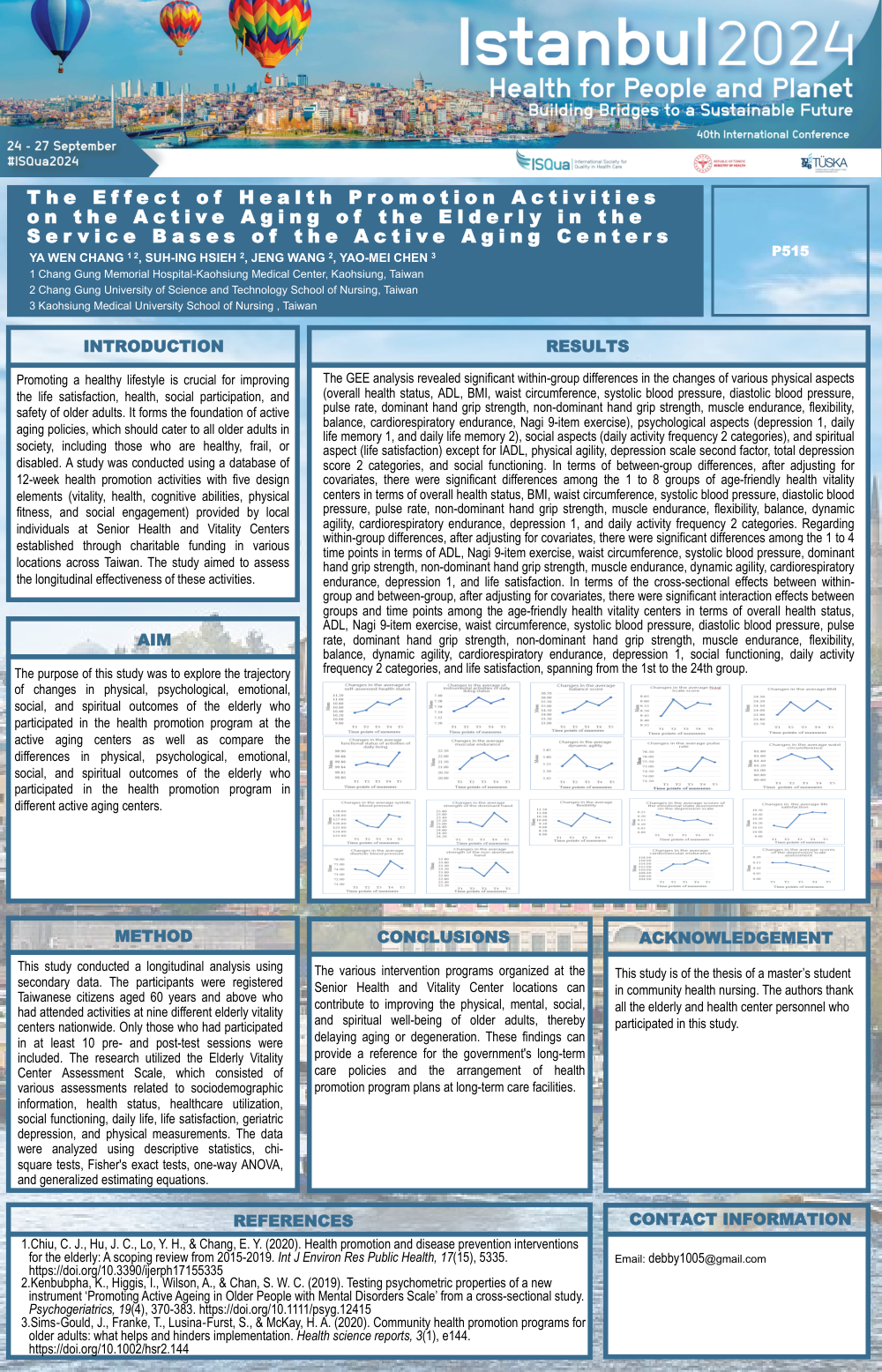
Result: The GEE analysis revealed significant within-group differences in the changes of various physical aspects (overall health status, ADL, BMI, waist circumference, systolic blood pressure, diastolic blood pressure, pulse rate, dominant hand grip strength, non-dominant hand grip strength, muscle endurance, flexibility, balance, cardiorespiratory endurance, Nagi 9-item exercise), psychological aspects (depression 1, daily life memory 1, and daily life memory 2), social aspects (daily activity frequency 2 categories), and spiritual aspect (life satisfaction) except for IADL, physical agility, depression scale second factor, total depression score 2 categories, and social functioning. In terms of between-group differences, after adjusting for covariates, there were significant differences among the 1 to 8 groups of age-friendly health vitality centers in terms of overall health status, BMI, waist circumference, systolic blood pressure, diastolic blood pressure, pulse rate, non-dominant hand grip strength, muscle endurance, flexibility, balance, dynamic agility, cardiorespiratory endurance, depression 1, and daily activity frequency 2 categories. Regarding within-group differences, after adjusting for covariates, there were significant differences among the 1 to 4 time points in terms of ADL, Nagi 9-item exercise, waist circumference, systolic blood pressure, dominant hand grip strength, non-dominant hand grip strength, muscle endurance, dynamic agility, cardiorespiratory endurance, depression 1, and life satisfaction. In terms of the cross-sectional effects between within-group and between-group, after adjusting for covariates, there were significant interaction effects between groups and time points among the age-friendly health vitality centers in terms of overall health status, ADL, Nagi 9-item exercise, waist circumference, systolic blood pressure, diastolic blood pressure, pulse rate, dominant hand grip strength, non-dominant hand grip strength, muscle endurance, flexibility, balance, dynamic agility, cardiorespiratory endurance, depression 1, social functioning, daily activity frequency 2 categories, and life satisfaction, spanning from the 1st to the 24th group.
Conclusions and implications: The various intervention programs organized at the Senior Health and Vitality Center locations can contribute to improving the physical, mental, social, and spiritual well-being of older adults, thereby delaying aging or degeneration. These findings can provide a reference for the government's long-term care policies and the arrangement of health promotion program plans at long-term care facilities.