586 posters, 8 topics, 23 sessions, 1,077 authors, 622 institutions
ePostersLive by SciGen Technologies S.A. All rights reserved.
ISQua's 40th International Conference 2024
24th - 27th September 2024 | Istanbul, Türkiye

P321
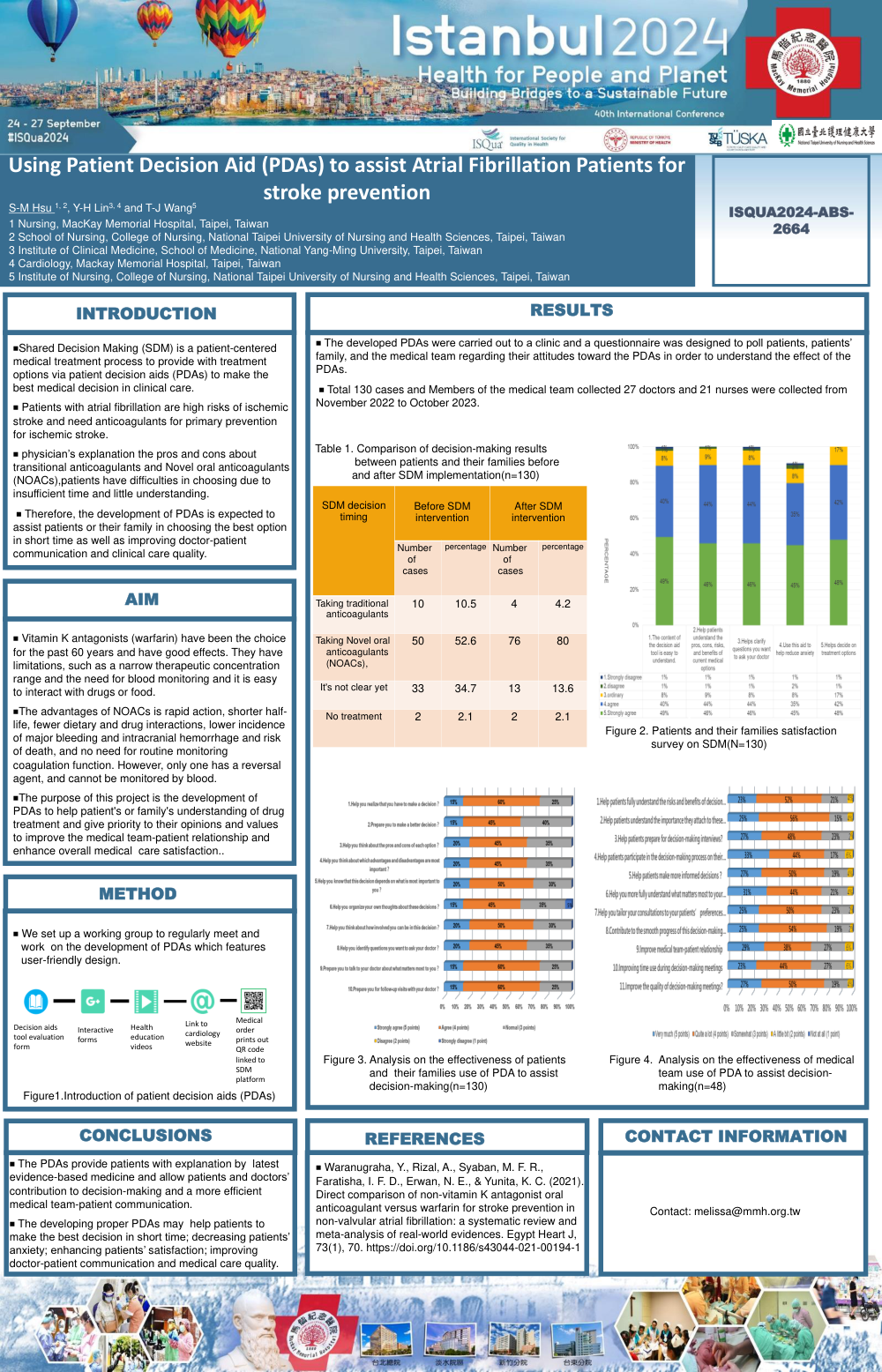
Using Patient Decision Aid (PDAs) to assist Atrial Fibrillation Patients for stroke prevention
Poster Presenter
Part of Topic
Patient Safety & Quality Improvement
Introduction:
Shared Decision Making (SDM) is a patient-centered medical treatment process in which patients are provided with treatment options via patient decision aids (PDAs) and work with physicians to make the best medical decision in clinical care. Patients with atrial fibrillation are high risks of ischemic stroke and need anticoagulants for primary prevention for ischemic stroke. In spite of the physician’s explanation on stent kinds and the pros and cons about transitional anticoagulants and Novel oral anticoagulants (NOACs), patients have difficulties in choosing due to insufficient time and little understanding. Therefore, the development of PDAs is expected to assist patients or their family in choosing the best option in short time as well as improving doctor-patient communication and clinical care quality.
Methods:
We set up a working group to regularly meet and work on the development of PDAs which features user-friendly design. The PDAs consisted of four objects as follows: Health education videos: videos were made both in Mandarin and Taiwanese. Images and word narrations provided patients with a quick understanding of the coming treatment. PDAs evaluation: every treatment option with its pros and cons was listed on the PDAs evaluation form by means of carefully reviewing relevant literature and convincing proof; interactive form: a QR code on the treatment consent allowed patients link to online health education videos and the PDAs evaluation form to fill in; After the PDAs accomplished, 10 patients, 5 cardiology specialist and 5 nurses were first assigned to test patients and medical staff understanding towards the PDAs contents and its usability. The test result prepared the ground for further modification. Then physicians and coah used the PDAs at outpatient clinic and hospitalization.
Results:
The developed PDAs were carried out to a clinic and a questionnaire was designed to poll patients, patients’ family, and the medical team regarding their attitudes toward the PDAs in order to understand the effect of the PDAs. Total 130 cases were collected from November 2022 to October 2023. The results showed that patients and their families lay between strongly agree and agree,The results showed that the overall average score of the patient or family consent was 4.06 points, while the Members of the medical team collected 27 doctors and 21 nurses respectively lay between agree and neutral. The results showed that the overall average score of the patient or family consent was 3.87 points. Among them, the most agreeable tool is the one that can help patients make the most suitable choice. “PDAs help patients make the best decision, PDAs shorten the time and reduce the burden of explanation from medical staff.
Conclusion:
PDAs are particularly designed for patients and can assist patients understand the disease, realizing the meaning of treatment option and outcomes, and clarifying personal values. By using interactive tools, PDAs provide patients with explanation supported by latest evidence-based medicine and allow patients and doctors’ contribution to decision-making as well as a more efficient doctor-patient communication. The study suggests that developing proper PDAs may contribute to helping patients make the best decision in short time; decreasing patients’ anxiety; enhancing patients’ satisfaction on medical staff; reducing the burden of information preparation; improving doctor-patient communication and nursing care quality.