586 posters, 8 topics, 23 sessions, 1,077 authors, 622 institutions
ePostersLive by SciGen Technologies S.A. All rights reserved.
ISQua's 40th International Conference 2024
24th - 27th September 2024 | Istanbul, Türkiye

ISQUA2024-ABS-2007
NON-CLINICAL SPECIFIC INTERVENTIONS TO IMPROVE PATIENT SAFETY IN PERIOPERATIVE CARE PROCESS: AN UMBRELLA REVIEW
Poster Presenter
Part of Topic
Patient Safety & Quality Improvement
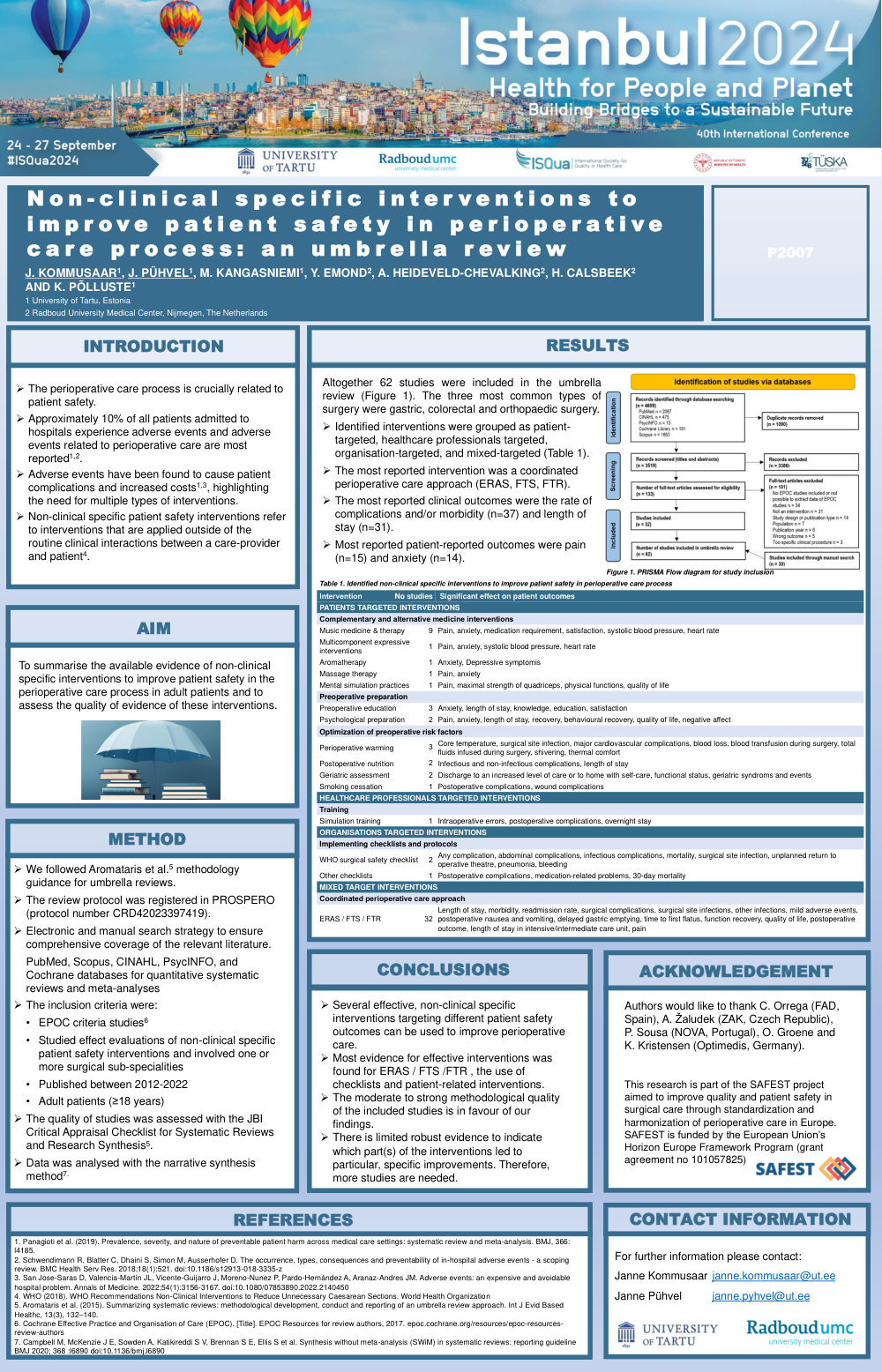
Title. Non-clinical specific interventions to improve patient safety in perioperative care process: an umbrella review
Introduction. The perioperative care process is crucially related to patient safety. Approximately 10% of all patients admitted to hospitals experience adverse events and adverse events related to perioperative care are most reported (1,2). Adverse events have been found to cause patient complications and increased costs (1,3), highlighting the need for multiple types of interventions. Non-clinical specific patient safety interventions refer to interventions that are applied outside of the routine clinical interactions between a care-provider and patient (4).
Aim. To summarise the available evidence of non-clinical specific interventions to improve patient safety in the perioperative care process in adult patients and to assess the quality of evidence of these interventions.
Method. We followed Aromataris et al. (5) methodology guidance for umbrella reviews. The review protocol was registered in PROSPERO (protocol number CRD42023397419). Electronic and manual search strategy to ensure comprehensive coverage of the relevant literature. PubMed, Scopus, CINAHL, PsycINFO, and Cochrane databases for quantitative systematic reviews and meta-analyses. The inclusion criteria were: 1) EPOC criteria studies (6), 2) Studied effect evaluations of non-clinical specific patient safety interventions and involved one or more surgical sub-specialities, 3) Published between 2012-2022, 4) Adult patients (≥18 years). The quality of studies was assessed with the JBI Critical Appraisal Checklist for Systematic Reviews and Research Synthesis (5). Data was analysed with the narrative synthesis method (7).
Results. Altogether 62 studies were included in the umbrella review (Figure 1). The three most common types of surgery were gastric, colorectal and orthopaedic surgery. Identified interventions were grouped as patient-targeted, healthcare professionals targeted, organisation-targeted, and mixed-targeted (Table 1). The most reported intervention was a coordinated perioperative care approach (ERAS, FTS, FTR). The most reported clinical outcomes were the rate of complications and/or morbidity (n=37) and length of stay (n=31). Most reported patient-reported outcomes were pain (n=15) and anxiety (n=14).
Conclusions. Several effective, non-clinical specific interventions targeting different patient safety outcomes can be used to improve perioperative care. Most evidence for effective interventions was found for ERAS / FTS /FTR , the use of checklists and patient-related interventions. The moderate to strong methodological quality of the included studies is in favour of our findings. There is limited robust evidence to indicate which part(s) of the interventions led to particular, specific improvements. Therefore, more studies are needed.
Acknowledgement. Authors would like to thank C.Orrega (FAD, Spain), A.Žaludek (ZAK, Czech Republic), P. Sousa (NOVA, Portugal), O. Groene and K. Kristensen (Optimedis, Germany). This research is part of the SAFEST project aimed to improve quality and patient safety in surgical care through standardization and harmonization of perioperative care in Europe. SAFEST is funded by the European Union’s Horizon Europe Framework Program (grant agreement no 101057825)
References.
1. Panagioti et al. (2019). Prevalence, severity, and nature of preventable patient harm across medical care settings: systematic review and meta-analysis. BMJ, 366: l4185.
2. Schwendimann R, Blatter C, Dhaini S, Simon M, Ausserhofer D. The occurrence, types, consequences and preventability of in-hospital adverse events - a scoping review. BMC Health Serv Res. 2018;18(1):521. doi:10.1186/s12913-018-3335-z
3. San Jose-Saras D, Valencia-Martín JL, Vicente-Guijarro J, Moreno-Nunez P, Pardo-Hernández A, Aranaz-Andres JM. Adverse events: an expensive and avoidable hospital problem. Annals of Medicine. 2022;54(1):3156-3167. doi:10.1080/07853890.2022.2140450
4. WHO (2018). WHO Recommendations Non-Clinical Interventions to Reduce Unnecessary Caesarean Sections. World Health Organization
5. Aromataris et al. (2015). Summarizing systematic reviews: methodological development, conduct and reporting of an umbrella review approach. Int J Evid Based Healthc, 13(3), 132–140.
6. Cochrane Effective Practice and Organisation of Care (EPOC). [Title]. EPOC Resources for review authors, 2017. epoc.cochrane.org/resources/epoc-resources-review-authors
7. Campbell M, McKenzie J E, Sowden A, Katikireddi S V, Brennan S E, Ellis S et al. Synthesis without meta-analysis (SWiM) in systematic reviews: reporting guideline BMJ 2020; 368 :l6890 doi:10.1136/bmj.l6890
Contact information.
For further information, please contact: Janne Kommusaar janne.kommusaar@ut.ee or Janne Pühvel janne.pyhvel@ut.ee