586 posters, 8 topics, 23 sessions, 1,077 authors, 622 institutions
ePostersLive by SciGen Technologies S.A. All rights reserved.
ISQua's 40th International Conference 2024
24th - 27th September 2024 | Istanbul, Türkiye

P374
Employing Automated Data Engineering to Improve Timeliness in Managing Reportable Patient Safety Incidents
Poster Presenter
Part of Topic
Patient Safety & Quality Improvement
Introduction: Despite utilizing an electronic reporting system endowed with the capacity for follow-up, our hospital faces
challenges with unstructured data fields. Consequently, data need to be exported to Excel for manual analysis.
Processes such as transforming incident occurrence times into various shift categories (night, overnight, and day) and
consolidating multiple causative factors are labor-intensive and impede timely analysis. Patient safety personnel are
required to perform analysis post-quarterly, a process extending an additional ten working days. Similarly, manual
analysis of data exported to Excel is requisite for each department, underscoring the need to expedite incident analysis.
This study primarily explores the implementation of automated data engineering, which entails streaming data into an AI-
enhanced big data warehouse and utilizing Power BI for dynamic, interactive analysis. We aim to generate transparent,
user-friendly infographics, leveraging the extensive database to improve weakness analysis and anomaly management.
Methods:In November 2022, the Information Office and our team delineated 13 critical data categories. We proceeded to
design and enact a Structured Query Language (SQL) framework for efficient data management. This entailed the
specification of 47 common and 2899 unique fields, leading to the creation of 13 tailored SQL tables within our database
for systematic data organization. Subsequent to the establishment of the SQL tables, a programmed reporting system
agent was deployed to update the SQL tables daily at 02:30 AM, facilitating automatic data migration into the AI big data
repository. Between January and April 2023, we engaged in weekly deliberations with the AI Center to refine the
analytical parameters of these 13 categories. This involved employing formulas for the auto-categorization and
conversion of data, coupled with rigorous validation of data accuracy. In April 2023, Power BI-trained personnel
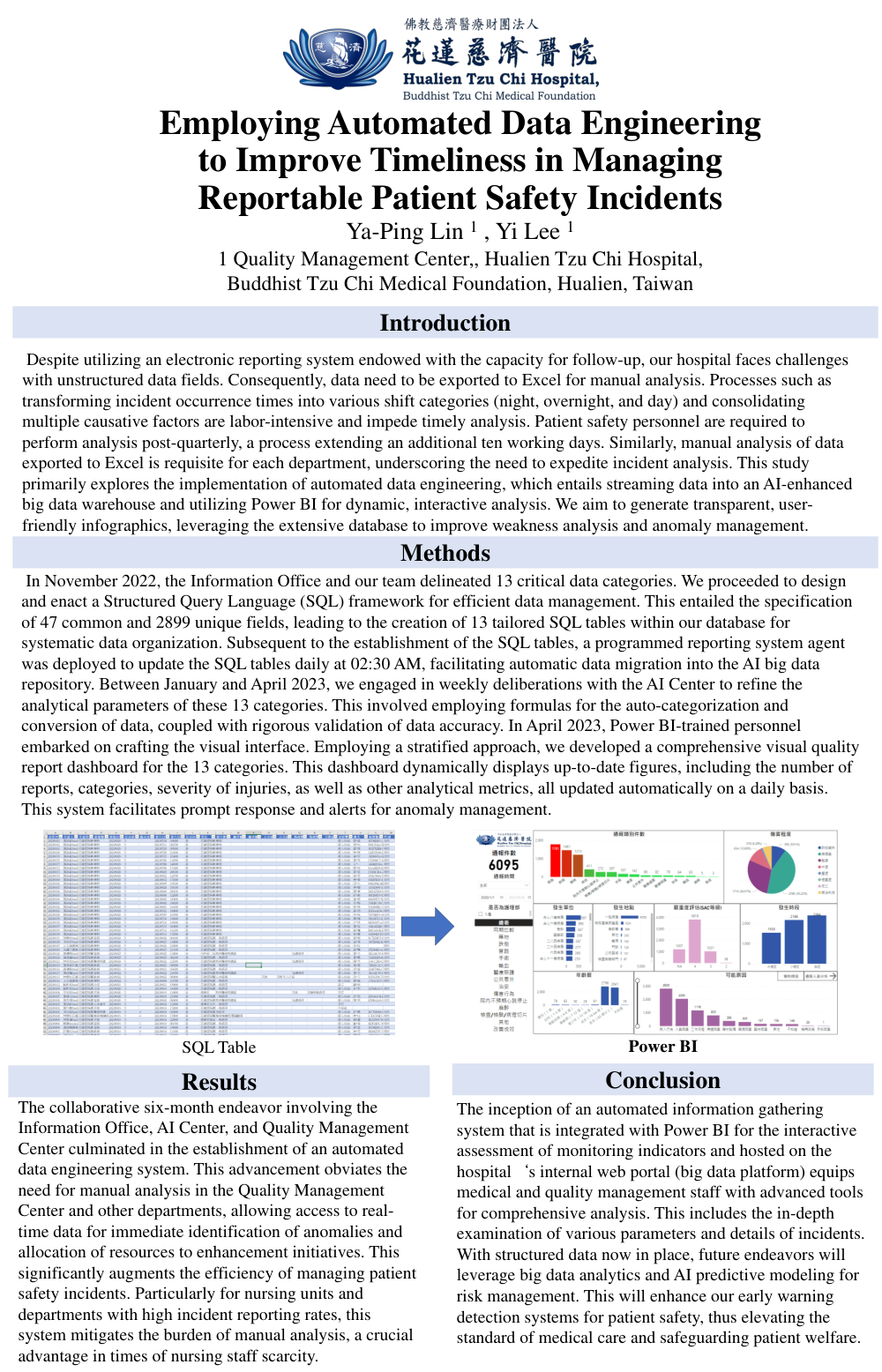
embarked on crafting the visual interface. Employing a stratified approach, we developed a comprehensive visual quality
report dashboard for the 13 categories. This dashboard dynamically displays up-to-date figures, including the number of
reports, categories, severity of injuries, as well as other analytical metrics, all updated automatically on a daily basis. This
system facilitates prompt response and alerts for anomaly management.
Results: The collaborative six-month endeavor involving the Information Office, AI Center, and Quality Management
Center culminated in the establishment of an automated data engineering system. This advancement obviates the need
for manual analysis in the Quality Management Center and other departments, allowing access to real-time data for
immediate identification of anomalies and allocation of resources to enhancement initiatives. This significantly augments
the efficiency of managing patient safety incidents. Particularly for nursing units and departments with high incident
reporting rates, this system mitigates the burden of manual analysis, a crucial advantage in times of nursing staff scarcity.
Conclusion: The inception of an automated information gathering system that is integrated with Power BI for the
interactive assessment of monitoring indicators and hosted on the hospital's internal web portal (big data platform) equips
medical and quality management staff with advanced tools for comprehensive analysis. This includes the in-depth
examination of various parameters and details of incidents. With structured data now in place, future endeavors will
leverage big data analytics and AI predictive modeling for risk management. This will enhance our early warning
detection systems for patient safety, thus elevating the standard of medical care and safeguarding patient welfare.