586 posters, 8 topics, 23 sessions, 1,077 authors, 622 institutions
ePostersLive by SciGen Technologies S.A. All rights reserved.
ISQua's 40th International Conference 2024
24th - 27th September 2024 | Istanbul, Türkiye

ISQUA2024-ABS-1997
The impact of a consensus process on implementation of interventions into healthcare settings: A qualitative study
Poster Presenter
Authors
Lisa Pagano, Janet C. Long, Emilie Francis-Auton, Jeffrey Braithwaite, Gaston Arnolda, Andrew Hirschhorn, Mitchell N. Sarkies
Affiliations
Macquarie University, Australian Institute of Health Innovation, Macquarie University, Sydney, Australia, MQ Health, Macquarie University, Sydney, Australia, Sydney School of Health Sciences, Faculty of Medicine and Health, University of Sydney, Sydney, Australia
Part of Topic
Patient Safety & Quality Improvement
The impact of a consensus process on implementation of interventions into healthcare settings: A qualitative study
INTRODUCTION
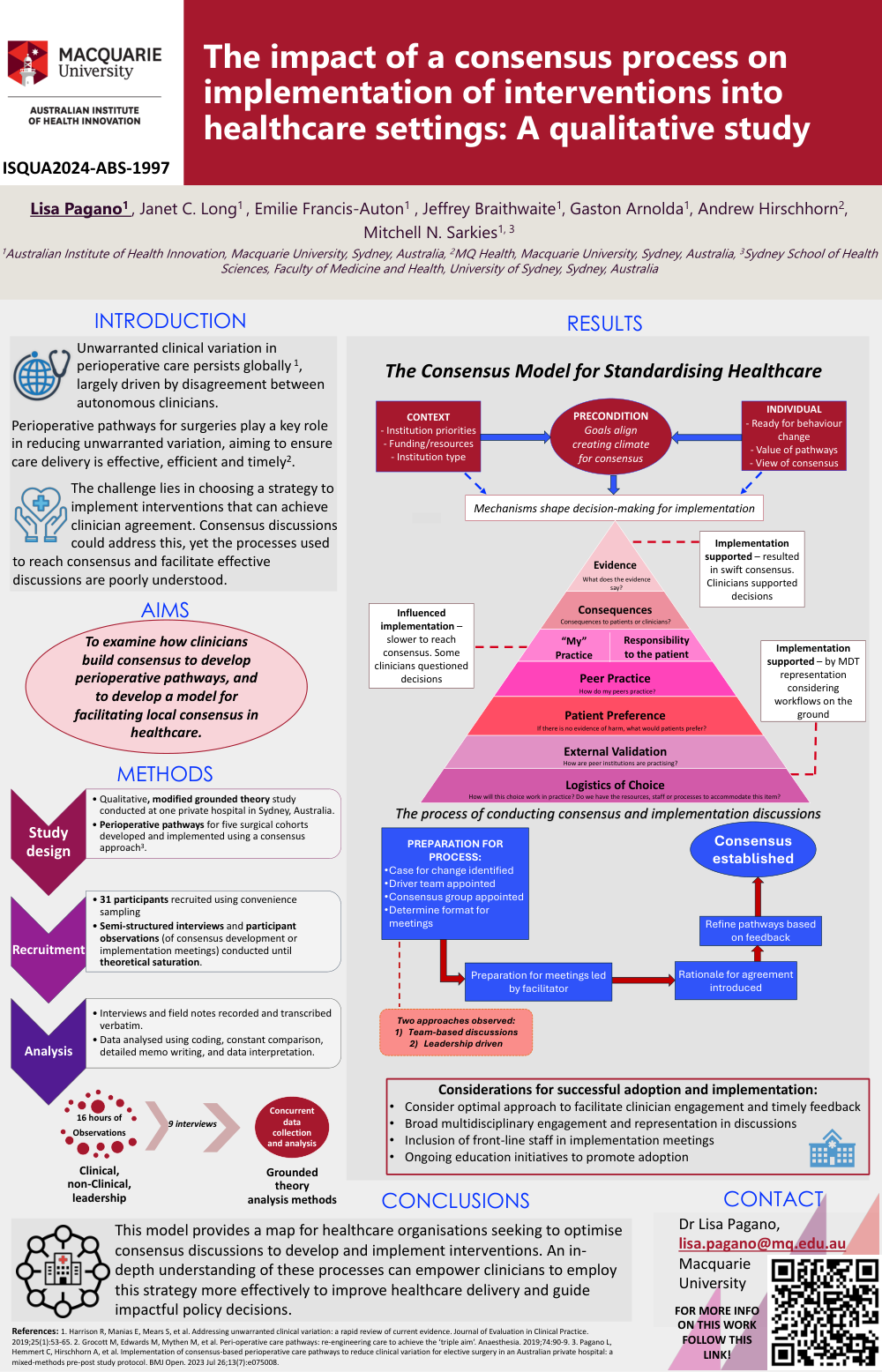
Unwarranted clinical variation in perioperative care persists globally, largely driven by disagreement between autonomous clinicians. Perioperative pathways for surgeries play a key role in reducing unwarranted variation, aiming to ensure care delivery is effective, efficient and timely. The challenge lies in choosing a strategy to implement interventions that can achieve clinician agreement. Consensus discussions could address this, yet the processes used to reach consensus and facilitate effective discussions are poorly understood.
AIMS
To examine how clinicians build consensus to develop perioperative pathways, and to develop a model for facilitating local consensus in healthcare.
METHODS:
Study design:
RESULTS:
The Consensus Model for Standardising Healthcare
CONTEXT
- Institution priorities
- Funding/resources
- Institution type
INDIVIDUAL
- Ready for behaviour change
- Value of pathways
- View of consensus
PRECONDITION:Goals align creating climate for consensus
Mechanisms shape decision-making for implementation
Evidence: What does the evidence say?
Consequences: Consequences to patients or clinicians?
"My practice" / Responsibility to the patient
Peer practice: How do my peers practice?
Patient preference: If there is no evidence of harm, what would patients prefer?
External validation: How are peer institutions are practising?
Logistics of choice: How will this choice work in practice? Do we have the resources, staff or processes to accommodate this item?
The process of conducting consensus and implementation discussions
PREPARATION FOR PROCESS:
Two approaches observed:
Preparation for meetings led by facilitator
Rationale for agreement introduced
Refine pathways based on feedback
Consensus established
Considerations for successful adoption and implementation:
This model provides a map for healthcare organisations seeking to optimise consensus discussions to develop and implement interventions. An in-depth understanding of these processes can empower clinicians to employ this strategy more effectively to improve healthcare delivery and guide impactful policy decisions.
References: 1. Harrison R, Manias E, Mears S, et al. Addressing unwarranted clinical variation: a rapid review of current evidence. Journal of Evaluation in Clinical Practice. 2019;25(1):53-65. 2. Grocott M, Edwards M, Mythen M, et al. Peri‐operative care pathways: re‐engineering care to achieve the ‘triple aim’. Anaesthesia. 2019;74:90-9. 3. Pagano L, Hemmert C, Hirschhorn A, et al. Implementation of consensus-based perioperative care pathways to reduce clinical variation for elective surgery in an Australian private hospital: a mixed-methods pre-post study protocol. BMJ Open. 2023 Jul 26;13(7):e075008.
Contact:
Dr Lisa Pagano, lisa.pagano@mq.edu.au
Macquarie
University