586 posters, 8 topics, 23 sessions, 1,077 authors, 622 institutions
ePostersLive by SciGen Technologies S.A. All rights reserved.
ISQua's 40th International Conference 2024
24th - 27th September 2024 | Istanbul, Türkiye

P369
Promoting Health Literacy-An Experieue of Regional Teaching Hospital in Taiwan
Poster Presenter
Authors
Affiliations
Part of Topic
Patient Safety & Quality Improvement
Promoting Health Literacy-An Experieue of Regional Teaching Hospital in Taiwan
Ya Feng Chen* 1
National Taiwan University Hospital Hsin-Chu Branch, HSINCHU, Taiwan
Introduction: According to the survey of Health literacy in Taiwan in 2013, 46.1% of the respondents had limited and problematic health literacy. It is well known that insufficient health literacy significantly affects health and increase the medical expenditure by 3-5%.For improving the underestimated problem, we have conducted a series of activities including training programs for hospital staffs and educations for communities in National Taiwan University Hospital Hsin-Chu Branch since 2018.
Methods: We held the well-designed training workshop for our hospital staffs, there were 109 members from different department in our hospital. These members became the seeds and organized the health literacy friendly activities in their own department. Paired t-test was used to test the significance of the changing score after training. We applied the several principles of health-literacy friendly (design for reading ease, check for clarity, use organizational and navigational cues...and so on) to improve health information materials and communities educations.
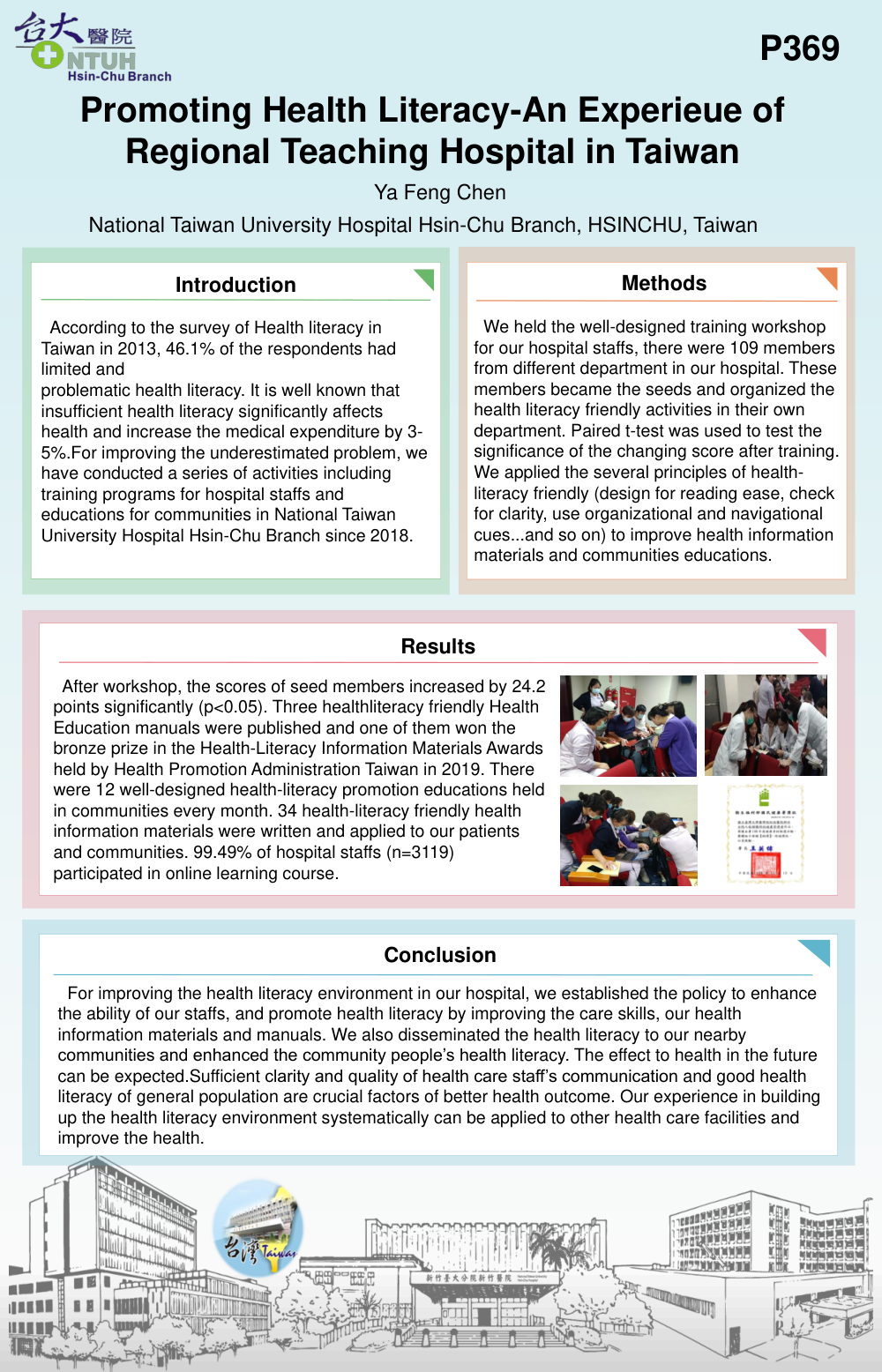
Results: After workshop, the scores of seed members increased by 24.2 points significantly (p<0.05). Three healthliteracy friendly Health Education manuals were published and one of them won the bronze prize in the Health-Literacy Information Materials Awards held by Health Promotion Administration Taiwan in 2019. There were 12 well-designed health-literacy promotion educations held in communities every month. 34 health-literacy friendly health information materials were written and applied to our patients and communities. 99.49% of hospital staffs (n=3119) participated in online learning course.
Conclusion: For improving the health literacy environment in our hospital, we established the policy to enhance the ability of our staffs, and promote health literacy by improving the care skills, our health information materials and manuals. We also disseminated the health literacy to our nearby communities and enhanced the community people’s health literacy. The effect to health in the future can be expected.Sufficient clarity and quality of health care staff’s communication and good health literacy of general population are crucial factors of better health outcome. Our experience in building up the health literacy environment systematically can be applied to other health care facilities and improve the health.