586 posters, 8 topics, 23 sessions, 1,077 authors, 622 institutions
ePostersLive by SciGen Technologies S.A. All rights reserved.
ISQua's 40th International Conference 2024
24th - 27th September 2024 | Istanbul, Türkiye

P355
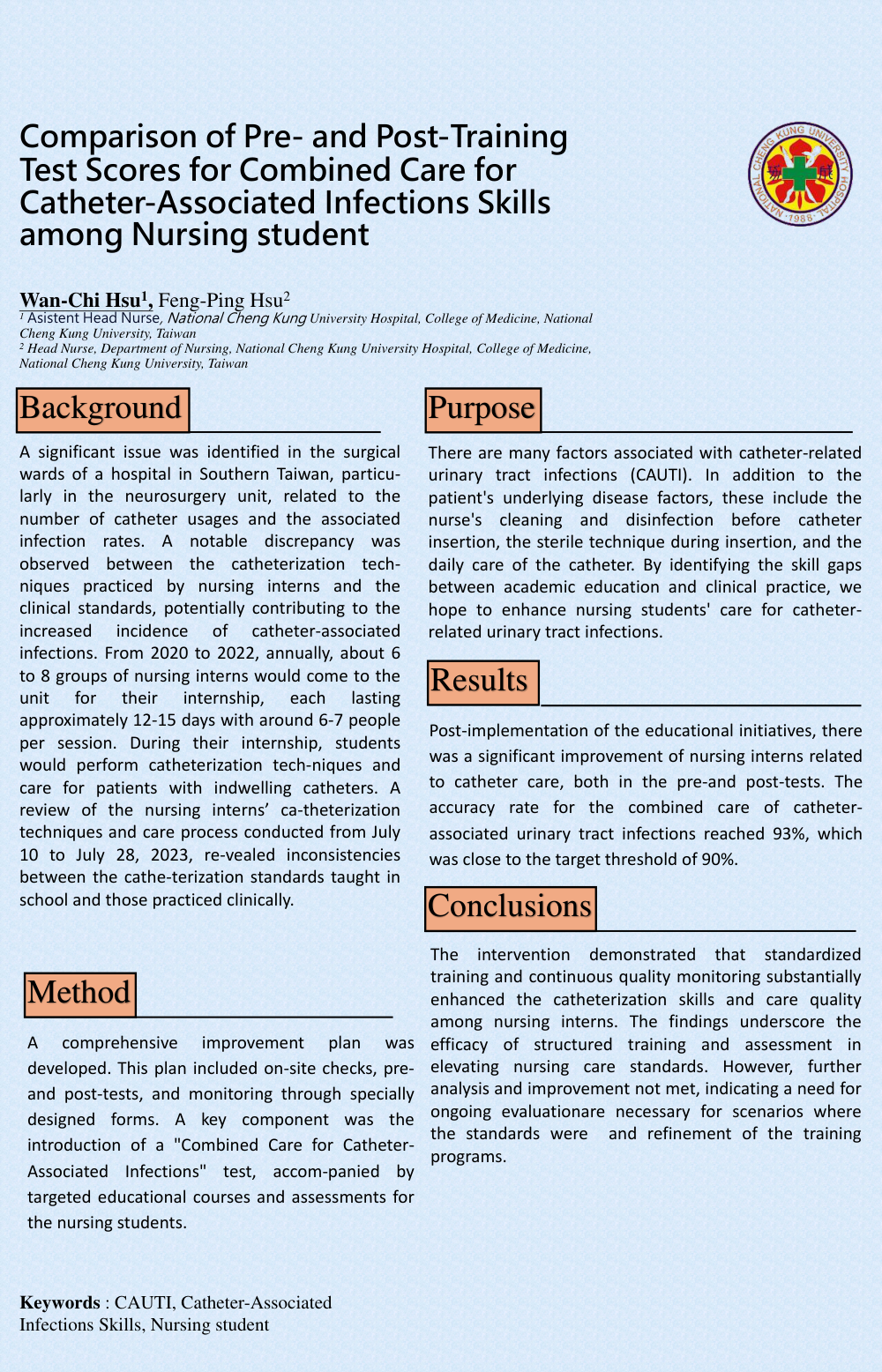
Comparison of Pre- and Post-Training Test Scores for Combined Care for Catheter-Associated Infections Skills among Nursing student
Poster Presenter
Authors
Affiliations
Part of Topic
Patient Safety & Quality Improvement
Comparison of Pre- and Post-Training Test Scores for Combined Care for Catheter-Associated Infections Skills among Nursing student
Background:
A significant issue was identified in the surgical wards of a hospital in Southern Taiwan, particularly in the neurosurgery unit, related to the number of catheter usages and the associated infection rates. A notable discrepancy was observed between the catheterization techniques practiced by nursing interns and the clinical standards, potentially contributing to the increased incidence of catheter-associated infections. From 2020 to 2022, annually, about 6 to 8 groups of nursing interns would come to the unit for their internship, each lasting approximately 12-15 days with around 6-7 people per session. During their internship, students would perform catheterization techniques and care for patients with indwelling catheters. A review of the nursing interns' catheterization techniques and care process conducted from July 10 to July 28, 2023, revealed inconsistencies between the catheterization standards taught in school and those practiced clinically.
Summary of Work:
A comprehensive improvement plan was developed. This plan included on-site checks, pre-and post-tests, and monitoring through specially designed forms. A key component was the introduction of a "Combined Care for Catheter-Associated Infections" test, accompanied by targeted educational courses and assessments for the nursing students.
Summary of Results:
Post-implementation of the educational initiatives, there was a significant improvement of nursing interns related to catheter care, both in the pre-and post-tests. The accuracy rate for the combined care of catheter-associated urinary tract infections reached 93%, which was close to the target threshold of 90%.
Discussion and Conclusion:
The intervention demonstrated that standardized training and continuous quality monitoring substantially enhanced the catheterization skills and care quality among nursing interns. The findings underscore the efficacy of structured training and assessment in elevating nursing care standards. However, further analysis and improvement are necessary for scenarios where the standards were not met, indicating a need for ongoing evaluation and refinement of the training programs.
Take-home Message:
The PDCA (Plan-Do-Check-Act) cycle proves to be an effective methodology for enhancing nursing quality and patient safety,in medical care processes can be achieved, ensuring optimal patient care. This approach highlights the importance of a systematic and iterative process in clinical quality improvement, emphasizing the value of education, monitoring, and adaptation in healthcare practices.