586 posters, 8 topics, 23 sessions, 1,077 authors, 622 institutions
ePostersLive by SciGen Technologies S.A. All rights reserved.
ISQua's 40th International Conference 2024
24th - 27th September 2024 | Istanbul, Türkiye

P262
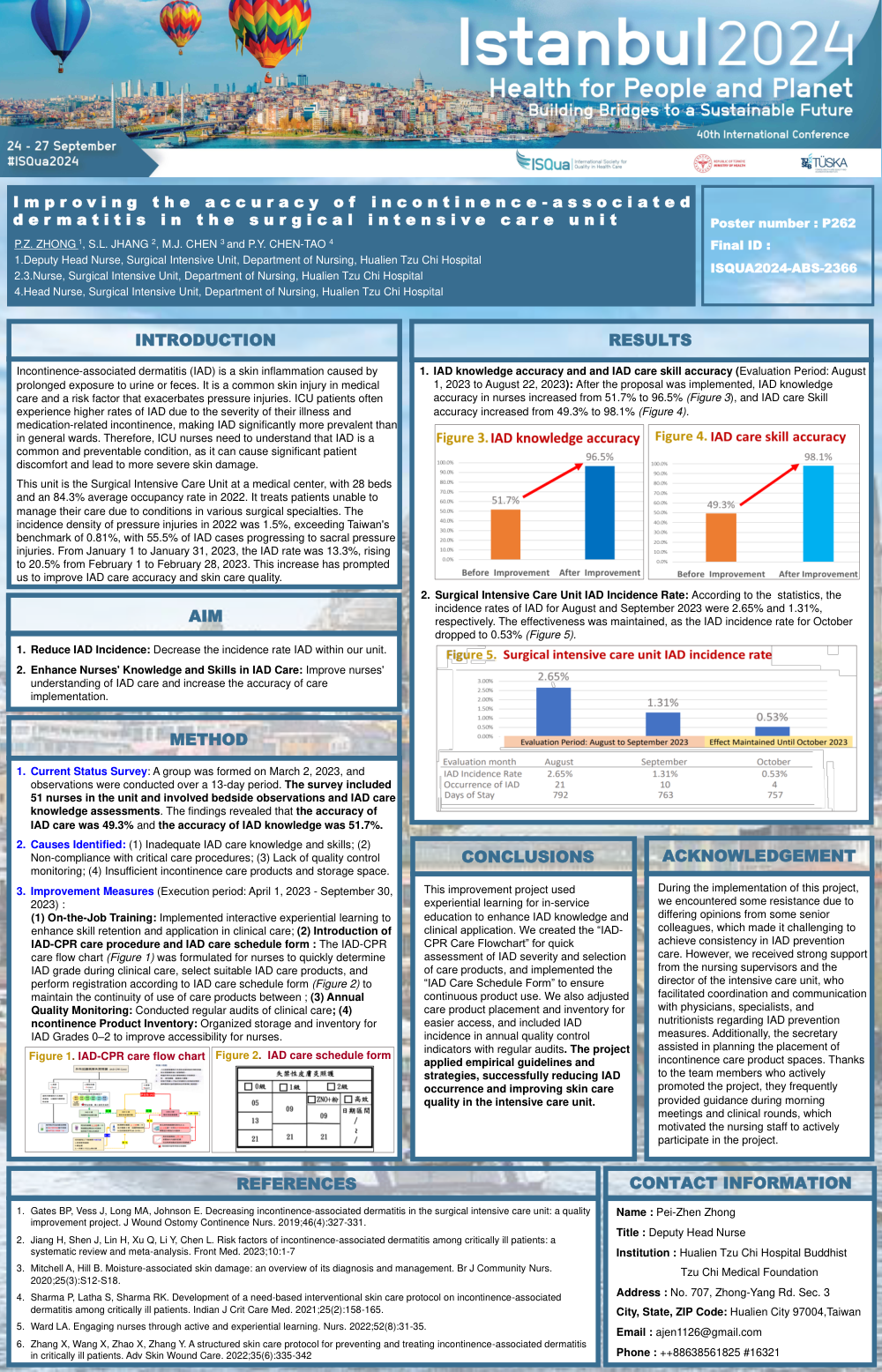
Improving the accuracy of incontinence-associated dermatitis in the surgical intensive care unit
Poster Presenter
Part of Topic
Patient Safety & Quality Improvement
Improving the accuracy of incontinence-associated dermatitis in the surgical intensive care unit
P.Z. ZHONG1, S.L. JHANG 2, M.J. CHEN 3 and P.Y. CHEN-TAO 4
1.Deputy Head Nurse, Surgical Intensive Unit, Department of Nursing, Hualien Tzu Chi Hospital
2.3.Nurse, Surgical Intensive Unit, Department of Nursing, Hualien Tzu Chi Hospital
4.Head Nurse, Surgical Intensive Unit, Department of Nursing, Hualien Tzu Chi Hospital
Poster number : P262
Final ID :ISQUA2024-ABS-2366
INTRODUCTION
Incontinence-associated dermatitis (IAD) is a skin inflammation caused by prolonged exposure to urine or feces. It is a common skin injury in medical care and a risk factor that exacerbates pressure injuries. ICU patients often experience higher rates of IAD due to the severity of their illness and medication-related incontinence, making IAD significantly more prevalent than in general wards. Therefore, ICU nurses need to understand that IAD is a common and preventable condition, as it can cause significant patient discomfort and lead to more severe skin damage.
This unit is the Surgical Intensive Care Unit at a medical center, with 28 beds and an 84.3% average occupancy rate in 2022. It treats patients unable to manage their care due to conditions in various surgical specialties. The incidence density of pressure injuries in 2022 was 1.5%, exceeding Taiwan's benchmark of 0.81%, with 55.5% of IAD cases progressing to sacral pressure injuries. From January 1 to January 31, 2023, the IAD rate was 13.3%, rising to 20.5% from February 1 to February 28, 2023. This increase has prompted us to improve IAD care accuracy and skin care quality.
AIM
1.Reduce IAD Incidence: Decrease the incidence rate IAD within our unit.
METHOD
RESULTS
CONCLUSIONS
This improvement project used experiential learning for in-service education to enhance IAD knowledge and clinical application. We created the “IAD-CPR Care Flowchart” for quick assessment of IAD severity and selection of care products, and implemented the “IAD Care Schedule Form” to ensure continuous product use. We also adjusted care product placement and inventory for easier access, and included IAD incidence in annual quality control indicators with regular audits. The project applied empirical guidelines and strategies, successfully reducing IAD occurrence and improving skin care quality in the intensive care unit.
ACKNOWLEDGEMENT
During the implementation of this project, we encountered some resistance due to differing opinions from some senior colleagues, which made it challenging to achieve consistency in IAD prevention care. However, we received strong support from the nursing supervisors and the director of the intensive care unit, who facilitated coordination and communication with physicians, specialists, and nutritionists regarding IAD prevention measures. Additionally, the secretary assisted in planning the placement of incontinence care product spaces. Thanks to the team members who actively promoted the project, they frequently provided guidance during morning meetings and clinical rounds, which motivated the nursing staff to actively participate in the project.
REFERENCES
Name : Pei-Zhen Zhong
Title : Deputy Head Nurse
Institution : Hualien Tzu Chi Hospital Buddhist Tzu Chi Medical Foundation
Address : No. 707, Zhong-Yang Rd. Sec. 3
City, State, ZIP Code: Hualien City 97004,Taiwan
Email : ajen1126@gmail.com
Phone : ++88638561825 #16321