586 posters, 8 topics, 23 sessions, 1,077 authors, 622 institutions
ePostersLive by SciGen Technologies S.A. All rights reserved.
ISQua's 40th International Conference 2024
24th - 27th September 2024 | Istanbul, Türkiye

ISQUA2024-ABS-1879
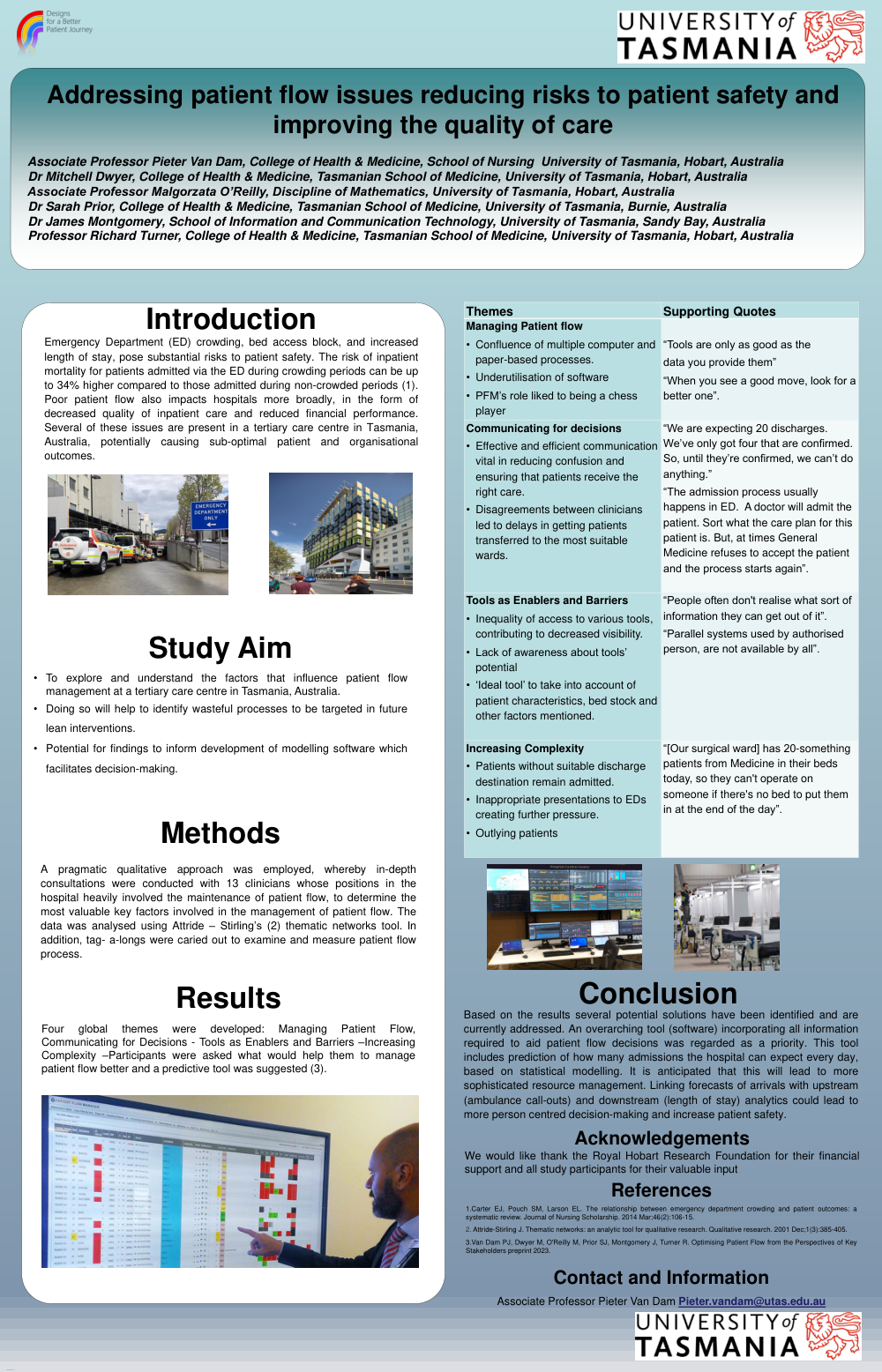
Addressing patient flow issues reducing risks to patient safety and improving the quality of care
Poster Presenter
Authors
Pieter Jan Van Dam, Mitchell Dwyer, Malgorzata O'Reilly, Sarah Prior, James Montgomery, Richard Turner
Affiliations
Part of Topic
Patient Safety & Quality Improvement
Addressing patient flow issues reducing risks to patient safety and improving the quality of care
Associate Professor Pieter Van Dam, College of Health & Medicine, School of Nursing University of Tasmania, Hobart, Australia
Dr Mitchell Dwyer, College of Health & Medicine, Tasmanian School of Medicine, University of Tasmania, Hobart, Australia
Associate Professor Malgorzata O’Reilly, Discipline of Mathematics, University of Tasmania, Hobart, Australia
Dr Sarah Prior, College of Health & Medicine, Tasmanian School of Medicine, University of Tasmania, Burnie, Australia
Dr James Montgomery, School of Information and Communication Technology, University of Tasmania, Sandy Bay, Australia
Professor Richard Turner, College of Health & Medicine, Tasmanian School of Medicine, University of Tasmania, Hobart, Australia
Introduction
Emergency Department (ED) crowding, bed access block, and increased length of stay, pose substantial risks to patient safety. The risk of inpatient mortality for patients admitted via the ED during crowding periods can be up to 34% higher compared to those admitted during non-crowded periods (1). Poor patient flow also impacts hospitals more broadly, in the form of decreased quality of inpatient care and reduced financial performance. Several of these issues are present in a tertiary care centre in Tasmania, Australia, potentially causing sub-optimal patient and organisational outcomes.
Study Aim
Methods
A pragmatic qualitative approach was employed, whereby in-depth consultations were conducted with 13 clinicians whose positions in the hospital heavily involved the maintenance of patient flow, to determine the most valuable key factors involved in the management of patient flow. The data was analysed using Attride – Stirling’s (2) thematic networks tool. In addition, tag- a-longs were caried out to examine and measure patient flow process.
Results
Four global themes were developed: Managing Patient Flow, Communicating for Decisions - Tools as Enablers and Barriers –Increasing Complexity –Participants were asked what would help them to manage patient flow better and a predictive tool was suggested (3).
Conclusion
Based on the results severalpotential solutions have been identified and are currently addressed.An overarching tool(software)incorporatingallinformation required to aid patient flow decisions was regarded as a priority. This tool includes prediction ofhow manyadmissions the hospitalcan expect every day, based on statistical modelling. It is anticipated that this will lead to more sophisticated resource management.Linking forecasts of arrivals with upstream (ambulance call-outs) and downstream (length of stay) analytics could lead to more person centred decision-making and increase patient safety
Acknowledgements
We would like thank the Royal Hobart Research Foundation for their financial support and all study participants for their valuable input.
References
1.Carter EJ, Pouch SM, Larson EL. The relationship between emergency department crowding and patient outcomes: a systematic review. Journal of Nursing Scholarship. 2014 Mar;46(2):106-15.
2. Attride-Stirling J. Thematic networks: an analytic tool for qualitative research. Qualitative research. 2001 Dec;1(3):385-405.
3.Van Dam PJ, Dwyer M, O'Reilly M, Prior SJ, Montgomery J, Turner R. Optimising Patient Flow from the Perspectives of Key Stakeholders preprint 2023.
Contact and Information
Associate Professor Pieter Van Dam Pieter.vandam@utas.edu.au