586 posters, 8 topics, 23 sessions, 1,077 authors, 622 institutions
ePostersLive by SciGen Technologies S.A. All rights reserved.
ISQua's 40th International Conference 2024
24th - 27th September 2024 | Istanbul, Türkiye

P388
Improving the Accuracy of Urinary Catheter Care Caregivers in Neurological Ward
Poster Presenter
Authors
Affiliations
Part of Topic
Patient Safety & Quality Improvement
Improving the Accuracy of Urinary Catheter Care Caregivers in Neurological Ward
YI-LING HUANG * 1 , TIng-I HE 1 , WEI - CHUN YEH 1 , Yl-CI HUANG 1
Nursing Department, Shin Kong Wu Ho-Su Memorial Hospital , Taipei, Taiwan
Introduction: Implemention of infection control is one of the goals for patient safety in our country. Urinary tract infections
rank second among healthcare-associated urinary tract infections (HAUTIs), with catheter-associated UTIs(CAUTIs) being
the most common cause of HAUTIs. Studies have found that approximately 12-16% of hospitalized patients undergo
urinary catheterization. Catheterization increases the risk of catheter-associated UTIs by 3-7%, leading to increased
patient complications, and length of hospital stay. Therefore, early removal of urinary catheters and proper catheter care
are crucial. In our neurology ward, the infection rate of urinary tract infections was as high as 1.9‰ in the healthcare-
associated infection report from May to August 2021. This rate exceeds the hospital's overall average urinary tract
infection rate of 0.8‰ over the past three years. Analysis of 16 urinary tract infection cases revealed that 12 involved
catheterization. This prompted the establishment of a task force to identify reasons, and consequently reduce the urinary
tract infection rate, thereby maintaining patient safety and care quality.
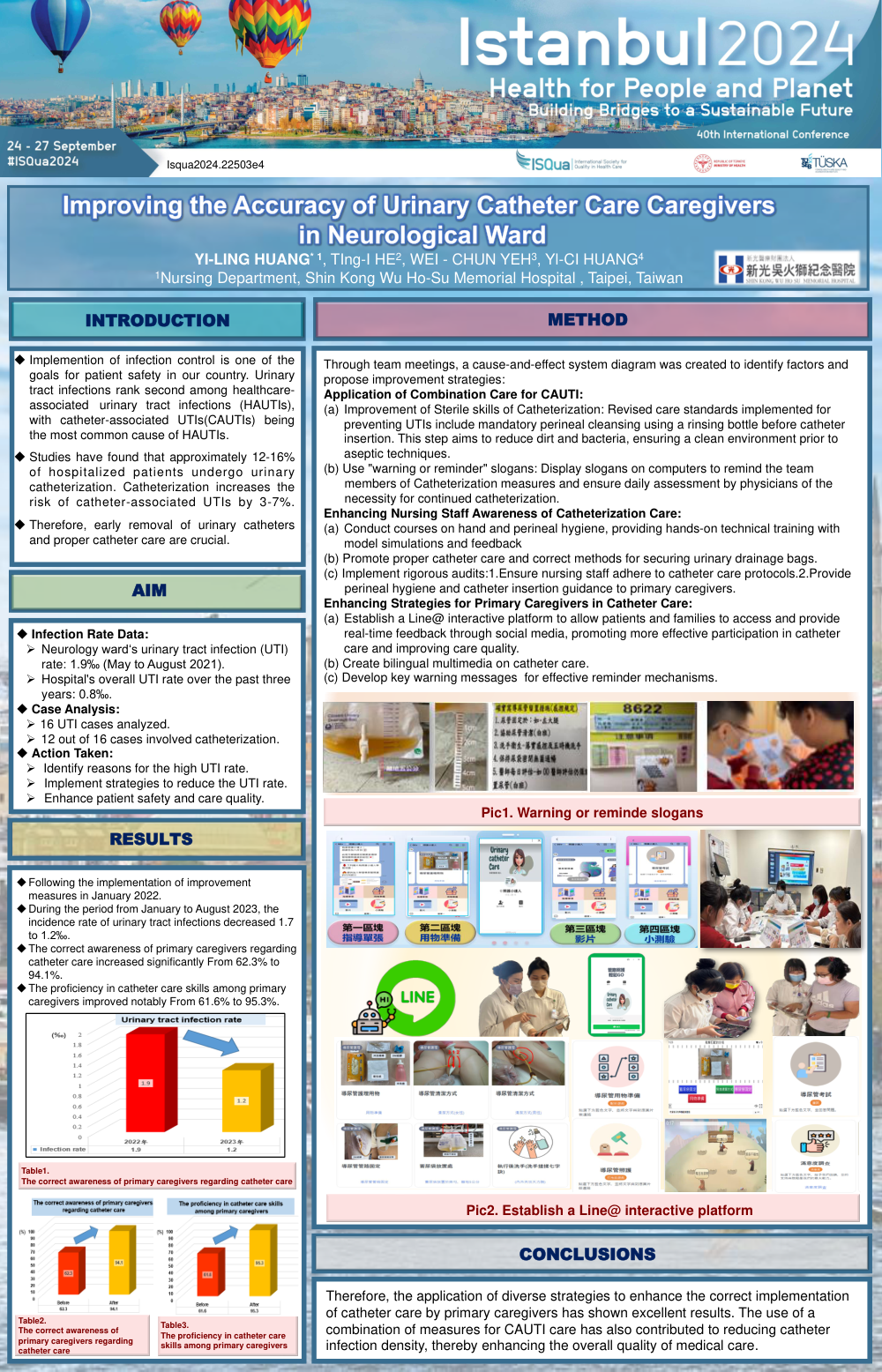
Methods: Through team meetings, a cause-and-effect system diagram was created to identify factors and propose
improvement strategies:
Application of Combination Care for CAUTI:(a) Improvement of Sterile skills of Catheterization: Revised care standards
implemented for preventing UTIs include mandatory perineal cleansing using a rinsing bottle before catheter insertion.
This step aims to reduce dirt and bacteria, ensuring a clean environment prior to aseptic techniques.(b) Use "warning or
reminder" slogans: Display slogans on computers to remind the team members of Catheterization measures and ensure
daily assessment by physicians of the necessity for continued catheterization.
Enhancing Nursing Staff Awareness of Catheterization Care:(a) Conduct courses on hand and perineal hygiene, providing
hands-on technical training with model simulations and feedback(b) Promote proper catheter care and correct methods for
securing urinary drainage bags.(c) Implement rigorous audits:1.Ensure nursing staff adhere to catheter care
protocols.2.Provide perineal hygiene and catheter insertion guidance to primary caregivers.
Enhancing Strategies for Primary Caregivers in Catheter Care:(a) Establish a Line@ interactive platform to allow patients
and families to access and provide real-time feedback through social media, promoting more effective participation in
catheter care and improving care quality.(b) Create bilingual multimedia on catheter care.(c) Develop key warning
messages for effective reminder mechanisms.
Results: Following the implementation of improvement measures in January 2022, the assessment unit achieved a 100%
effectiveness rate in catheter care evaluations in February and August 2023. During the period from January to August
2023, the incidence rate of urinary tract infections decreased to 0.7‰. The correct awareness of primary caregivers
regarding catheter care increased significantly from 62.3% to 91.3%. Additionally, the proficiency in catheter care skills
among primary caregivers improved from 61.6% to 91.8%.
Conclusion: Therefore, the application of diverse strategies to enhance the correct implementation of catheter care by
primary caregivers has shown excellent results. The use of a combination of measures for CAUTI care has also
contributed to reducing catheter infection density, thereby enhancing the overall quality of medical care.