586 posters, 8 topics, 23 sessions, 1,077 authors, 622 institutions
ePostersLive by SciGen Technologies S.A. All rights reserved.
ISQua's 40th International Conference 2024
24th - 27th September 2024 | Istanbul, Türkiye

P393
The exploration of factors related to postoperative pressure injuries in neurosurgical patients
Poster Presenter
Authors
Affiliations
Part of Topic
Patient Safety & Quality Improvement
The exploration of factors related to postoperative pressure injuries in neurosurgical patients
INTRODUCTION
Neurosurgical patients undergoing prolonged surgery may require postoperative bed rest and the use of sedative medications to prevent rapid increases in blood pressure, intracranial pressure, and other drastic changes. As a result, patients need to maintain immobility for a period after surgery to avoid postoperative restlessness, as these factors may increase the risk of developing pressure injuries during the postoperative bed rest period.( pressure injury; PI). Among them, intraoperatively acquired pressure injuries (IAPIs) directly associated with surgery have been proven to be related to prolonged surgical duration. (Grap et al., 2019). Pressure injuries caused by surgery are one of the contributing factors to the occurrence of hospital-acquired pressure injuries. The occurrence of IAPIs may become apparent immediately after surgery or within 2-4 hours to 3 days postoperatively. These injuries commonly manifest as stage I and stage II pressure injuries. (Grap et al., 2019; Sengul et al., 2022; Tang et al., 2021). In addition to prolonged surgical duration, factors such as age, gender, severity of illness, history of cardio-vascular diseases, diabetes, and other systemic conditions can also increase the risk of intraoperatively acquired pressure injuries (IAPIs).
Furthermore, anesthesia drugs, by rendering patients unable to sense numbness or pain and alter their positions, contribute to the inability to release localized pressure, serving as another significant risk factor. The low-temperature environment in the operating room can lead to a decreased metabolic rate, serving as an intermittent risk factor for pressure injuries.
Keywords
pressure injury, intraoperatively acquired pressure injuries, intensive care, neurosurgical
RESULTS
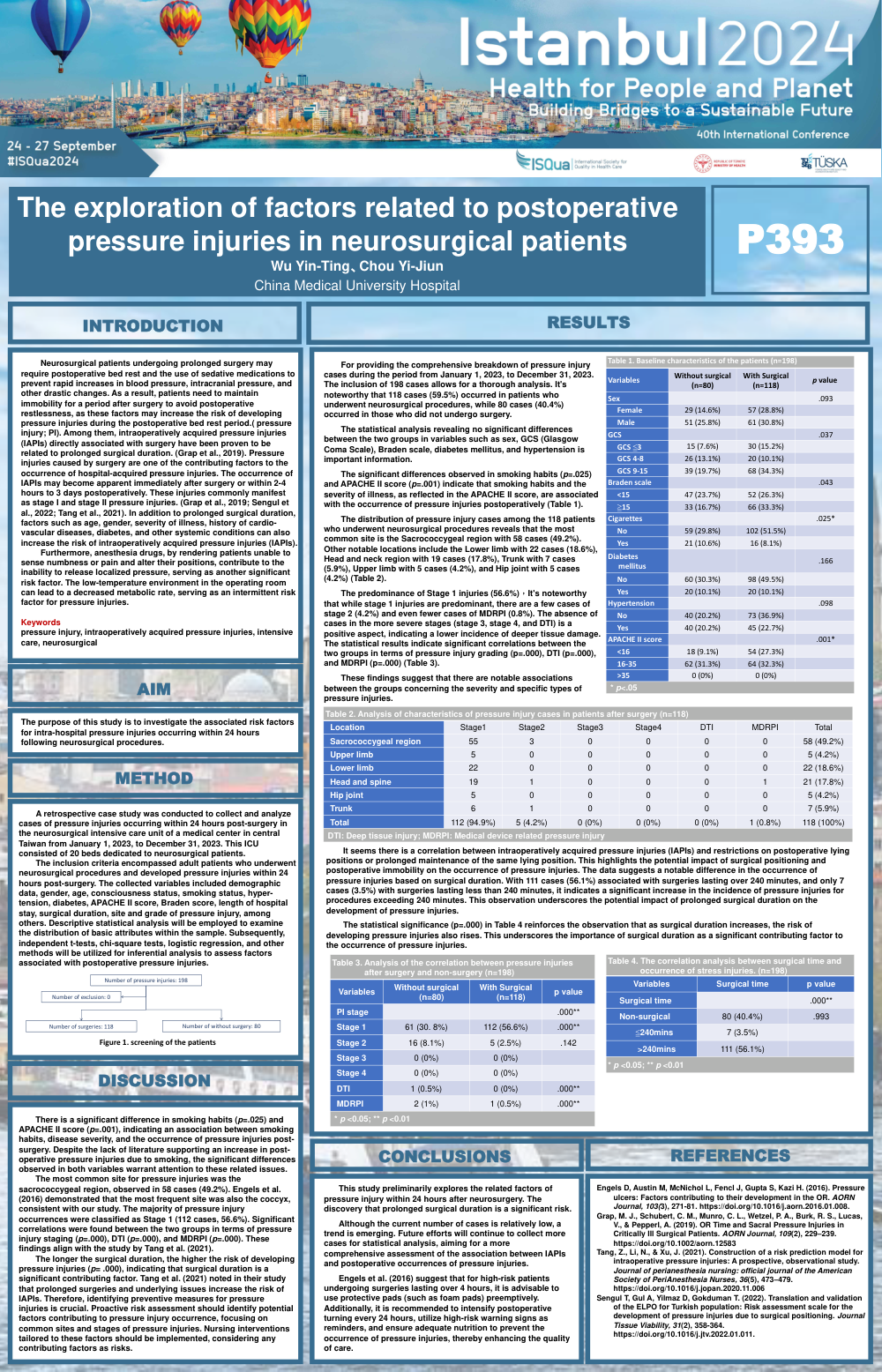
For providing the comprehensive breakdown of pressure injury cases during the period from January 1, 2023, to December 31, 2023. The inclusion of 198 cases allows for a thorough analysis. It's noteworthy that 118 cases (59.5%) occurred in patients who underwent neurosurgical procedures, while 80 cases (40.4%) occurred in those who did not undergo surgery.
The statistical analysis revealing no significant differences between the two groups in variables such as sex, GCS (Glasgow Coma Scale), Braden scale, diabetes mellitus, and hypertension is important information.
The significant differences observed in smoking habits (p=.025) and APACHE II score (p=.001) indicate that smoking habits and the severity of illness, as reflected in the APACHE II score, are associated with the occurrence of pressure injuries postoperatively (Table 1).
The distribution of pressure injury cases among the 118 patients who underwent neurosurgical procedures reveals that the most common site is the Sacrococcygeal region with 58 cases (49.2%). Other notable locations include the Lower limb with 22 cases (18.6%), Head and neck region with 19 cases (17.8%), Trunk with 7 cases (5.9%), Upper limb with 5 cases (4.2%), and Hip joint with 5 cases (4.2%) (Table 2).
The predominance of Stage 1 injuries (56.6%),It's noteworthy that while stage 1 injuries are predominant, there are a few cases of stage 2 (4.2%) and even fewer cases of MDRPI (0.8%). The absence of cases in the more severe stages (stage 3, stage 4, and DTI) is a positive aspect, indicating a lower incidence of deeper tissue damage. The statistical results indicate significant correlations between the two groups in terms of pressure injury grading (p=.000), DTI (p=.000), and MDRPI (p=.000) (Table 3).
These findings suggest that there are notable associations between the groups concerning the severity and specific types of pressure injuries.
It seems there is a correlation between intraoperatively acquired pressure injuries (IAPIs) and restrictions on postoperative lying positions or prolonged maintenance of the same lying position. This highlights the potential impact of surgical positioning and postoperative immobility on the occurrence of pressure injuries. The data suggests a notable difference in the occurrence of pressure injuries based on surgical duration. With 111 cases (56.1%) associated with surgeries lasting over 240 minutes, and only 7 cases (3.5%) with surgeries lasting less than 240 minutes, it indicates a significant increase in the incidence of pressure injuries for procedures exceeding 240 minutes. This observation underscores the potential impact of prolonged surgical duration on the development of pressure injuries.
The statistical significance (p=.000) in Table 4 reinforces the observation that as surgical duration increases, the risk of developing pressure injuries also rises. This underscores the importance of surgical duration as a significant contributing factor to the occurrence of pressure injuries.