586 posters, 8 topics, 23 sessions, 1,077 authors, 622 institutions
ePostersLive by SciGen Technologies S.A. All rights reserved.
ISQua's 40th International Conference 2024
24th - 27th September 2024 | Istanbul, Türkiye

P128
Introducing the balanced scorecard model to improve the timeliness of blood culture final reports
Poster Presenter
Authors
Affiliations
Part of Topic
Patient Safety & Quality Improvement
Introducing the balanced scorecard model to improve the timeliness of blood culture final reports
Yung Yu Huang 1Sung Chia-Hsing1
1Department of Laboratory Chang Bing Show Chwan Memorial Hospital Changhua,Taiwan
Introduction:
Blood culture is the gold standard for the diagnosis of bacterial sepsis. When there are any clinical symptoms of bacterial infection and blood infection is suspected, it is recommended to perform a blood culture in the hope that bacteria can be cultured for a correct diagnosis. According to CLSI guideline recommendations, the best practice should be to pay attention to the volume of blood and sets of bottles. Due to the development of information detection systems and the popularization of vacuum blood collection needles in recent years, and through the introduction of quality standards or quality improvement models, the mortality rate of positive patients is higher than that of adverse patients. Timely provision of accurate blood cultures helps physicians with effective clinical diagnosis and treatment.
Methods
Software and hardware equipment:
Use BD BACTEC FX blood culture instrument and install BD Epicenter original data software to create blood culture-related monitoring indicators (blood culture KPI) and use liquid culture-related monitoring indicators to monitor the blood culture blood volume and several sets of blood culture in the hospital's nursing units.
Management mode:
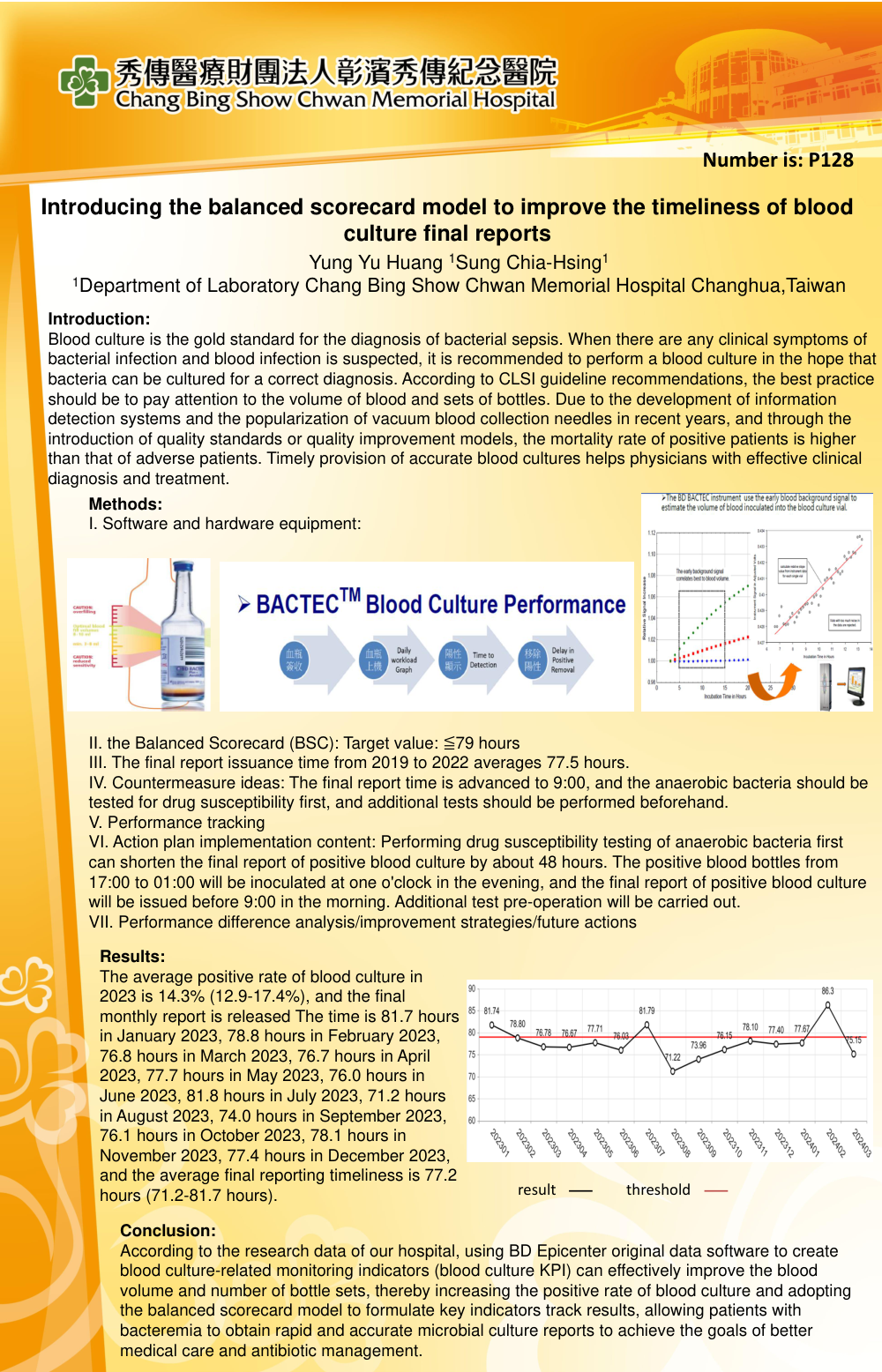
1. Establish key indicator definitions and target values for the Balanced Scorecard (BSC): Target value: ≦79 hours
2. Current situation analysis and countermeasure ideas: The final report issuance time from 2019 to 2022 averages 77.5 hours.
3. Countermeasure ideas: The final report time is advanced to 9:00, and the anaerobic bacteria should be tested for drug susceptibility first, and additional tests should be performed beforehand.
4. Performance tracking
5. Action plan implementation content: Performing drug susceptibility testing of anaerobic bacteria first can shorten the final report of positive blood culture by about 48 hours. The positive blood bottles from 17:00 to 01:00 will be inoculated at one o'clock in the evening, and the final report of positive blood culture will be issued before 9:00 in the morning. Additional test pre-operation will be carried out.
6. Performance difference analysis/improvement strategies/future actions
Results
By using BD BACTEC FX blood culture equipment, installing BD Epicenter original data software, and introducing a balanced scorecard model to track results, the average positive rate of blood culture in 2023 is 14.3% (12.9-17.4%), and the final monthly report is released The time is 81.7 hours in January 2023, 78.8 hours in February 2023, 76.8 hours in March 2023, 76.7 hours in April 2023, 77.7 hours in May 2023, 76.0 hours in June 2023, 81.8 hours in July 2023, 71.2 hours in August 2023, 74.0 hours in September 2023, 76.1 hours in October 2023, 78.1 hours in November 2023, 77.4 hours in December 2023, and the average final reporting timeliness is 77.2 hours (71.2-81.7 hours).
Conclusion
According to the research data of our hospital, using BD Epicenter original data software to create blood culture-related monitoring indicators (blood culture KPI) can effectively improve the blood volume and number of bottle sets, thereby increasing the positive rate of blood culture and adopting the balanced scorecard model to formulate key indicators track results, allowing patients with bacteremia to obtain rapid and accurate microbial culture reports to achieve the goals of better medical care and antibiotic management.
Keyword:
Blood culture, BD Epicenter