Loading...

586 posters, 8 topics, 23 sessions, 1,077 authors, 622 institutions

ePostersLive by SciGen Technologies S.A. All rights reserved.

ISQua's 40th International Conference 2024

24th - 27th September 2024 | Istanbul, Türkiye

ISQua's 40th International Conference 2024 banner

P342

Implementation of Point of Care Quality Improvement (POCQI) in top referral NICU to increase quality of care in small and sick newborn
Part of Topic

Patient Safety & Quality Improvement

IMPLEMENTATION OF POINT OF CARE QUALITY IMPROVEMENT (POCQI) IN TOP REFERRAL NICU TO INCREASE QUALITY OF CARE IN SMALL AND SICK NEWBORN

Introduction

The challenges faced by developing countries in improving Quality Improvement (QI) are the large number of patients, low quality of human resources, limited facilities, minimal financing of health services, and low levels of patient education. The Point of Care Quality Improvement (POCQI) method was introduced in the NICU RSPAD in 2022, by providing training to 35 nurses. For one year, POCQI has been used to address service-related issues and improve the quality of care, especially for small and sick newborns.

Aim

To find out whether there is an improvement in patient health services with the implementation of Point of Care Quality Improvement (POCQI) in the NICU RSPAD Gatot Soebroto.

Methode

The tools utilized in the POCQI method include the Facilitator's Manual Version 02 (Four simple steps to practice quality improvement at the health facility level) and POCQI coaching for quality improvement:coaching guide. The guidance method involved a combination of in-person sessions, conducted weekly in small groups, and online sessions, occurring one to two times per week through the WhatsApp group application (WA).

Results
 
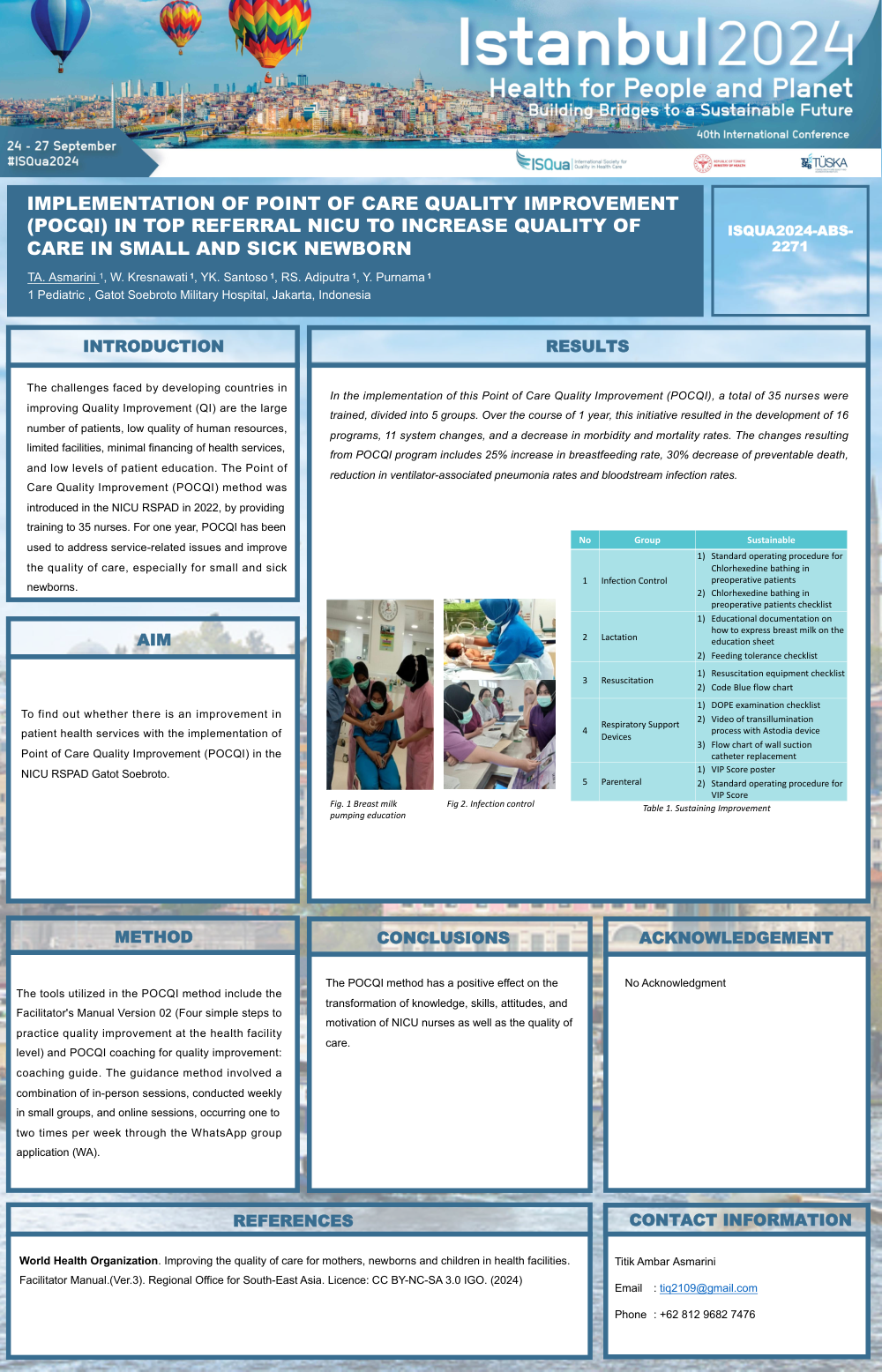
In the implementation of this Point of Care Quality Improvement (POCQI), a total of 35 nurses were trained, divided into 5 groups. Over the course of 1 year, this initiative resulted in the development of 16 programs, 11 system changes, and a decrease in morbidity and mortality rates. The changes resulting from POCQI program includes 25% increase in breastfeeding rate, 30% decrease of preventable death, reduction in ventilator-associated pneumonia rates and bloodstream infection rates.
 
Fig. 1. Breast ilk pumping education
Fig. 2. Infection control
Table 1. Sustaining Improvement
 
Group Sustainable
1. Infection Control:1) Standard operating procedure for Chlorhexedine bathing in preoperative patients, 2) Chlorhexedine bathing in preoperative patients checklist
2. Lactation: 1) Educational documentation on how to express breast milk on the education sheet, 2) Feeding tolerance checklist
3. Resuscitation: 1) Resuscitation equipment checklist, 2) Code Blue flow chart
4. Respiratory Support Devices: 1) DOPE examination checklist , 2) Video of transillumination process with Astodia device, 3) Flow diagram/Flow of wall suction catheter replacement
5. Parenteral: 1) VIP Score poster, 2) Standard operating procedure for VIP Score
 
Conclusion
The POCQI method has a positive effect on the transformation of knowledge, skills, attitudes, and motivation of NICU nurses as well as the quality of care.
 
No Acknowledgment
 
References
World Health Organization. Improving the quality of care for mothers, newborns and children in health facilities. Facilitator Manual.(Ver.3). Regional Office for South-East Asia. Licence: CC BY-NC-SA 3.0 IGO. (2024)
 
CONTACT INFORMATION
Titik Ambar Asmarini
Email : tiq2109@gmail.com
Phone : +62 812 9682 7476
 
I
ISQua's 40th International Conference 2024 » banner
Copyright © 2015-2026, ePostersLive® SciGen is a registered trademark of SciGen Technologies S.A. Patent pending.

This website and third-party tools we use rely on cookies for the best user experience. By selecting "I agree", you agree to cookie usage as described in our Privacy Policy.