586 posters, 8 topics, 23 sessions, 1,077 authors, 622 institutions
ePostersLive by SciGen Technologies S.A. All rights reserved.
ISQua's 40th International Conference 2024
24th - 27th September 2024 | Istanbul, Türkiye

P384
Promoting compliance rate of maintaining sterile areas in operating room
Poster Presenter
Authors
Affiliations
Part of Topic
Patient Safety & Quality Improvement
Improve compliance with maintaining sterile areas in operating rooms
Yi L. Chen* 1, Chien-Jou Tsou2 , Chai-Jung TSAI1
1Department of Nursing, E-DA HOSPITAL, Kaohsiung,
2Department of Anesthesia, Tzuchi Healthcare Group, Chiayi, Taiwan
Introduction:Establishing and maintaining a sterile field requires specific knowledge and skills that an indispensable role in preventing SSI. However, every member of the surgical team has responsibilities and obligations. If the sterile field is found to be damaged during the operation, they should immediately report it. Response and processing can provide a safe environment for patient surgery (AORN, 2019). Therefore, if problems such as aseptic technique or violation of the principle of maintaining a sterile area are observed during the preparation or execution of surgery, they should be raised and improved to maintain perioperative care of surgical patients and maximize the possibility of protecting patients from possible complications. The main goal is to influence the controllable factors that lead to surgical site infection.
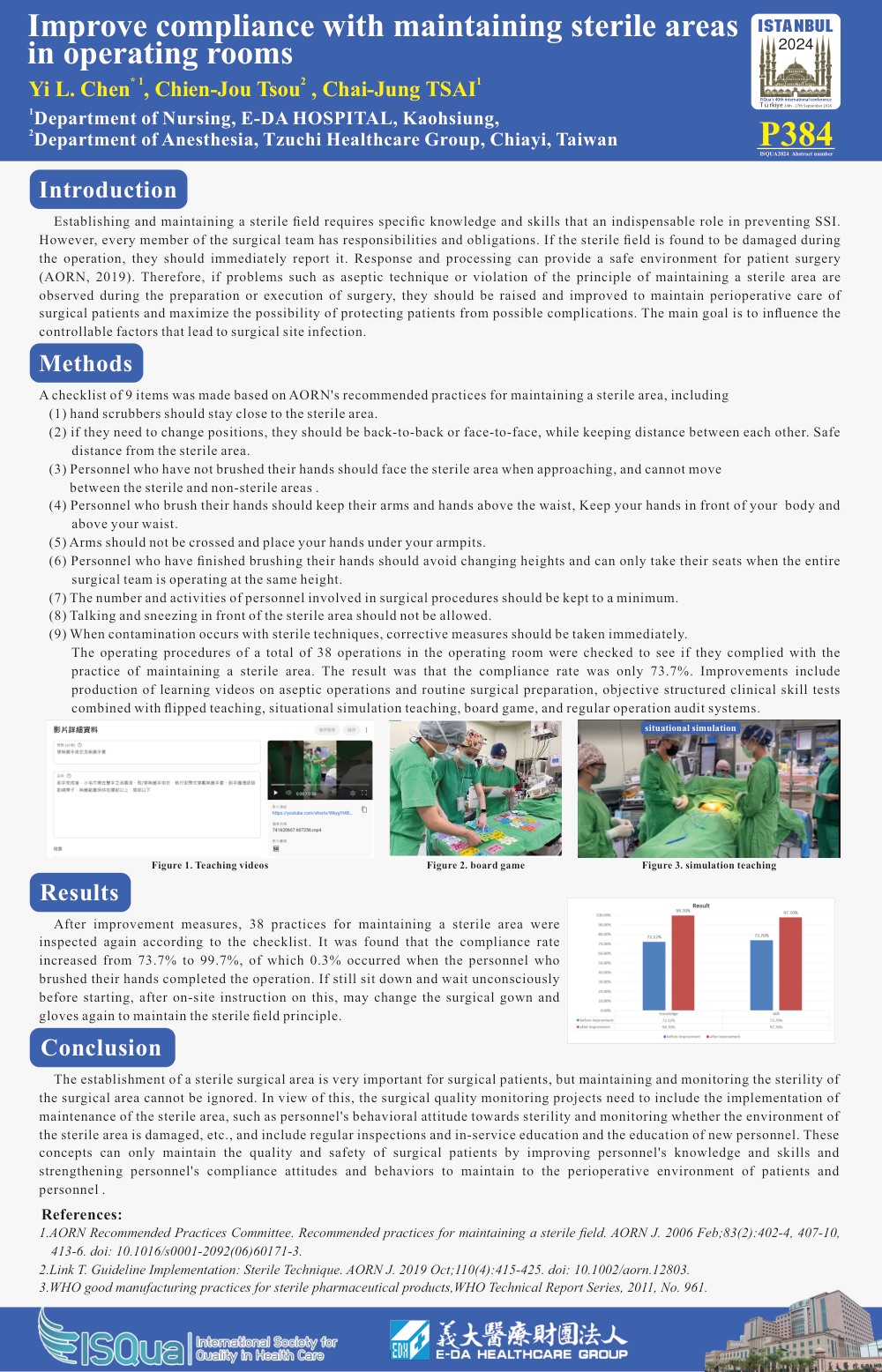
Methods:A checklist of 9 items was made based on AORN's recommended practices for maintaining a sterile area, including(1) hand scrubbers should stay close to the sterile area.(2) if they need to change positions, they should be back-to-back or face-to-face, while keeping distance between each other. Safe distance from the sterile area.(3) Personnel who have not brushed their hands should face the sterile area when approaching, and cannot move between the sterile and non-sterile areas .(4) Personnel who brush their hands should keep their arms and hands above the waist, Keep your hands in front of your body and above your waist.(5) Arms should not be crossed and place your hands under your armpits.(6) Personnel who have finished brushing their hands should avoid changing heights and can only take their seats when the entiresurgical team is operating at the same height.(7) The number and activities of personnel involved in surgical procedures should be kept to a minimum. (8) Talking and sneezing in front of the sterile area should not be allowed.(9) When contamination occurs with sterile techniques, corrective measures should be taken immediately.The operating procedures of a total of 38 operations in the operating room were checked to see if they complied with the practice of maintaining a sterile area. The result was that the compliance rate was only 73.7%. Improvements include production of learning videos on aseptic operations and routine surgical preparation, objective structured clinical skill tests combined with flipped teaching, situational simulation teaching, board game, and regular operation audit systems.
Results:After improvement measures, 38 practices for maintaining a sterile area were inspected again according to the checklist. It was found that the compliance rate increased from 73.7% to 99.7%, of which 0.3% occurred when the personnel who brushed their hands completed the operation. If still sit down and wait unconsciously before starting, after on-site instruction on this, may change the surgical gown and gloves again to maintain the sterile field principle.
Conclusion:The establishment of a sterile surgical area is very important for surgical patients, but maintaining and monitoring the sterility of the surgical area cannot be ignored. In view of this, the surgical quality monitoring projects need to include the implementation of maintenance of the sterile area, such as personnel's behavioral attitude towards sterility and monitoring whether the environment of the sterile area is damaged, etc., and include regular inspections and in-service education and the education of new personnel. These concepts can only maintain the quality and safety of surgical patients by improving personnel's knowledge and skills and strengthening personnel's compliance attitudes and behaviors to maintain to the perioperative environment of patients and personnel .
References:1.AORN Recommended Practices Committee. Recommended practices for maintaining a sterile field. AORN J. 2006 Feb;83(2):402-4, 407-10, 413-6. doi: 10.1016/s0001-2092(06)60171-3.
2.Link T. Guideline Implementation: Sterile Technique. AORN J. 2019 Oct;110(4):415-425. doi: 10.1002/aorn.12803. 3.WHO good manufacturing practices for sterile pharmaceutical products,WHO Technical Report Series, 2011, No. 961.