586 posters, 8 topics, 23 sessions, 1,077 authors, 622 institutions
ePostersLive by SciGen Technologies S.A. All rights reserved.
ISQua's 40th International Conference 2024
24th - 27th September 2024 | Istanbul, Türkiye

P216
The Quality and Safety of Care for Long-Term Care Recipients in Australia: Findings from a Pragmatic National Quality and Safety Monitoring and Benchmarking System
Poster Presenter
Authors
Tesfahun Eshetie, Gillian Caughey, Catherine Lang, Olivia Ryan, Steve Wesselingh, Maria Inacio, * on behalf of the ROSA OMS Advisory Committee
Affiliations
SOUTH AUSTRALIAN HEALTH AND MEDICAL RESEARCH INSTITUTE, Registry of Senior Australians (ROSA), South Australian Health and Medical Research Institute (SAHMRI), Australia; UniSA Clinical & Health Sciences, University of South Australia, Registry of Senior Australians (ROSA), South Australian Health and Medical Research Institute (SAHMRI), Australia, Registry of Senior Australians (ROSA), South Australian Health and Medical Research Institute (SAHMRI), Australia, South Australian Health and Medical Research Institute, Australia
Part of Topic
Patient Safety & Quality Improvement
The Quality and Safety of Care for Long-Term Care Recipients in Australia: Findings from a Pragmatic National Quality and Safety Monitoring and Benchmarking System
Eshetie T,1,2,3 Caughey G,1,3,4 Lang C,1 Ryan O,1 Wesselingh S,5 Inacio M,1,3,4, on behalf of the ROSA OMS Advisory Committee
1Registry of Senior Australians (ROSA), South Australian Health and Medical Research Institute (SAHMRI), Australia; 2UniSA Clinical & Health Sciences, University of South Australia, Australia; 3UniSA Allied Health and Human Performance, University of South Australia, Australia; 4Caring Futures Institute, College of Nursing and Health Sciences, Flinders University, Australia;5 South Australian Health and Medical Research Institute, Australia.
Introduction
Quality and safety monitoring programs for the long-term care sector vary internationally.
In Australia, the ROSA Outcome Monitoring System (OMS), is a multi-stakeholder led pragmatic (i.e., uses existing data collections) and low burden (i.e., requires no provider data input) program developed to monitor long-term aged care quality and safety.
This study showcases the ROSA OMS and examines the national 2019 prevalence and variation of the quality of care provided to older people in residential care or in the community.
Methods
Design: A cross-sectional population-based study using the ROSA National Historical Cohort was conducted.
Cohort: All individuals nationally who received long-term care in a residential aged care facility or in the community with home care packages in 2019.
Measures: Quality and safety indicators of care for residential (N=12) and home care (N=15) services examined included: antipsychotic use, chronic opioid use, high sedative load, antibiotic use, fractures, emergency department (ED) presentations, premature mortality, hospitalisations for falls, medication-related events, weight loss/malnutrition, pressure injury or delirium/dementia, chronic disease management plan, home medicines review and wait-times.
Analysis: Indicator estimates were risk-adjusted for age, sex, and health conditions, and when appropriate additional covariates (e.g. dementia). Prevalence estimates, with 95% confidence intervals (CI) are presented.
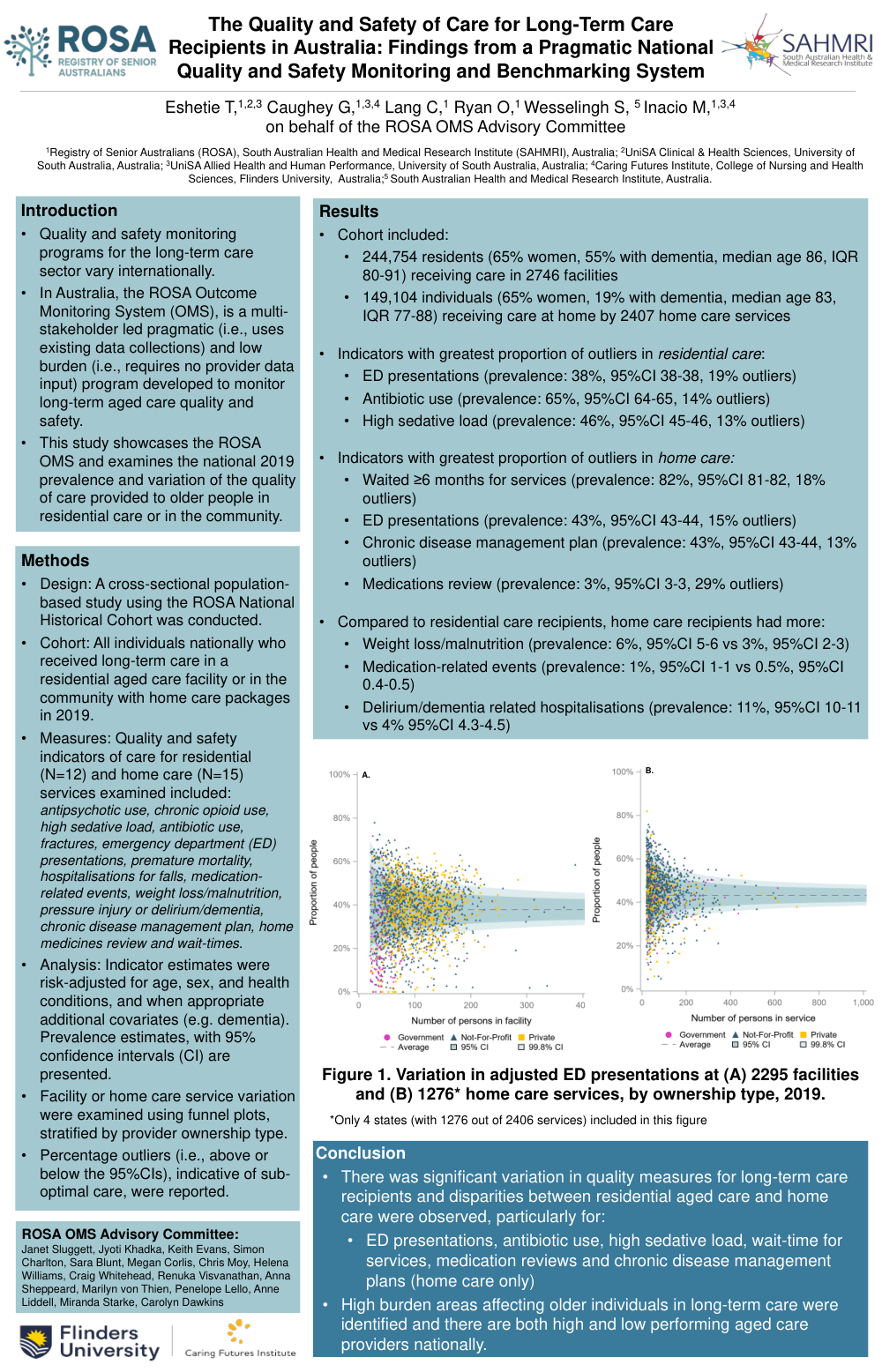
Facility or home care service variation were examined using funnel plots, stratified by provider ownership type.
Percentage outliers (i.e., above or below the 95%CIs), indicative of sub-optimal care, were reported.
Results
Cohort included:
- 244,754 residents (65% women, 55% with dementia, median age 86, IQR 80-91) receiving care in 2746 facilities.
- 149,104 individuals (65% women, 19% with dementia, median age 83, IQR 77-88) receiving care at home by 2407 home care services.
Indicators with greatest proportion of outliers in residential care:
- ED presentations (prevalence: 38%, 95%CI 38-38, 19% outliers)
- Antibiotic use (prevalence: 65%, 95%CI 64-65, 14% outliers)
- High sedative load (prevalence: 46%, 95%CI 45-46, 13% outliers)
Indicators with greatest proportion of outliers in home care:
- Waited ≥6 months for services (prevalence: 82%, 95%CI 81-82, 18% outliers)
- ED presentations (prevalence: 43%, 95%CI 43-44, 15% outliers)
- Chronic disease management plan (prevalence: 43%, 95%CI 43-44, 13% outliers)
- Medications review (prevalence: 3%, 95%CI 3-3, 29% outliers)
Compared to residential care recipients, home care recipients had more:
- Weight loss/malnutrition (prevalence: 6%, 95%CI 5-6 vs 3%, 95%CI 2-3)
- Medication-related events (prevalence: 1%, 95%CI 1-1 vs 0.5%, 95%CI 0.4-0.5)
- Delirium/dementia-related hospitalisations (prevalence: 11%, 95%CI 10-11 vs 4% 95%CI 4.3-4.5)
Conclusion
There was significant variation in quality measures for long-term care recipients and disparities between residential aged care and home care were observed, particularly for:
- ED presentations, antibiotic use, high sedative load, wait-time for services, medication reviews and chronic disease management plans (home care only)
- High burden areas affecting older individuals in long-term care were identified and there are both high and low performing aged care providers nationally.
High burden areas affecting older individuals in long-term care were identified and there are both high and low performing aged care providers nationally.