586 posters, 8 topics, 23 sessions, 1,077 authors, 622 institutions
ePostersLive by SciGen Technologies S.A. All rights reserved.
ISQua's 40th International Conference 2024
24th - 27th September 2024 | Istanbul, Türkiye

P341
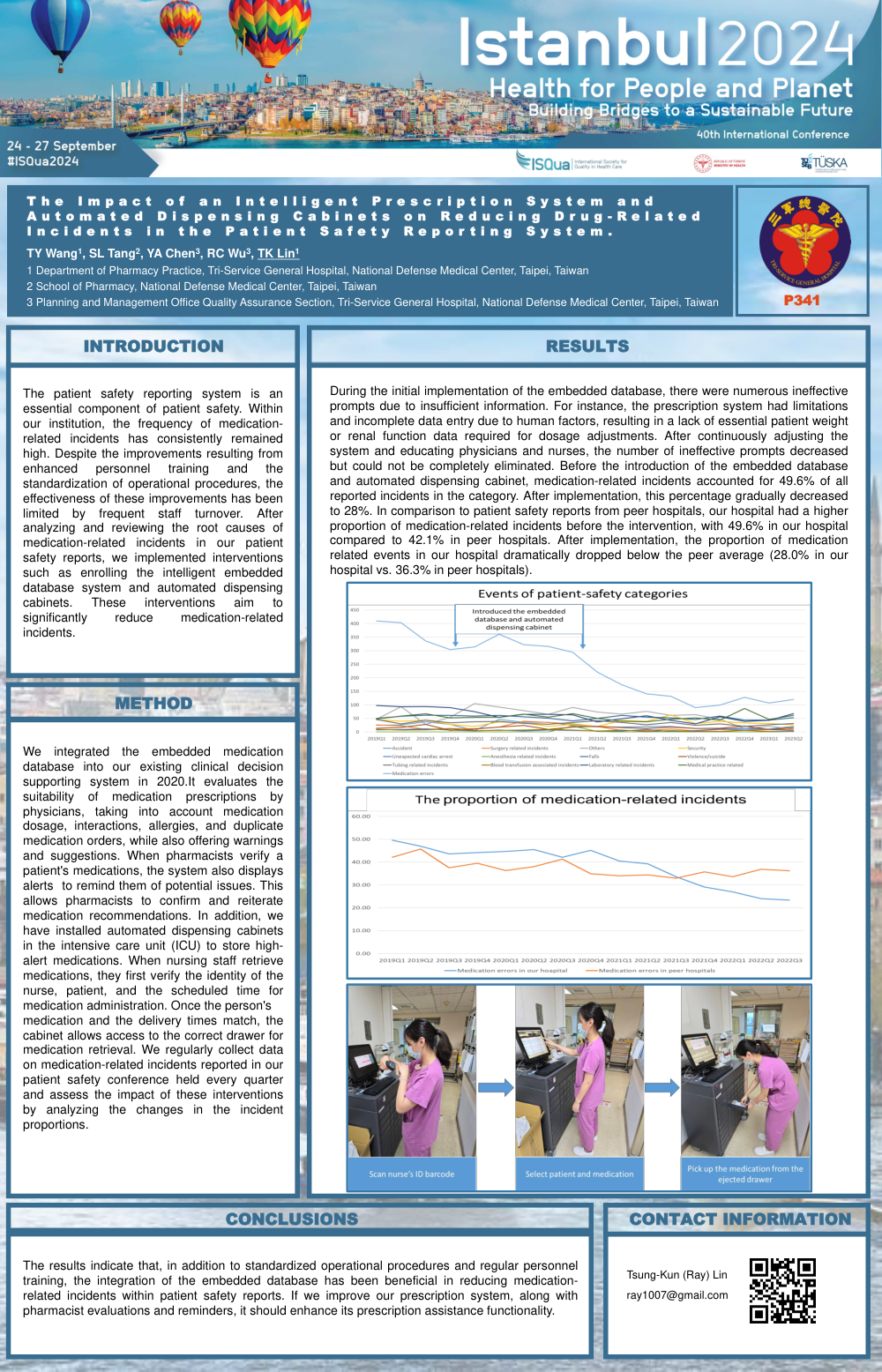
The Impact of an Intelligent Prescription System and Automated Dispensing Cabinets on Reducing Drug-Related Incidents in the Patient Safety Reporting System.
Poster Presenter
Authors
Ting-Ying Wang, Sung-Ling Tang, Yih-An Chen, Rong-Chong Wu, Tsung-Kun Lin
Affiliations
Department of Pharmacy Practice, Tri-Service General Hospital, National Defense Medical Center, Taipei, Taiwan, School of Pharmacy, National Defense Medical Center, Taipei, Taiwan, Planning and Management Office Quality Assurance Section, Tri-Service General Hospital, National Defense Medical Center, Taipei, Taiwan
Part of Topic
Patient Safety & Quality Improvement
The Impact of an Intelligent Prescription System and Automated Dispensing Cabinets on Reducing Drug-Related
Incidents in the Patient Safety Reporting System.
Ting-Ying Wang, Sung-Ling Tang, Yih-An Chen, Rong-Chong Wu, Tsung-Kun Lin
1Department of Pharmacy Practice, Tri-Service General Hospital, National Defense Medical Center, 2School of
Pharmacy, National Defense Medical Center, 3Planning and Management Office Quality Assurance Section, Tri-Service
General Hospital, National Defense Medical Center, Taipei, Taiwan
Introduction: The patient safety reporting system is an essential component of patient safety. Within our institution, the
frequency of medication-related incidents has consistently remained high. Despite the improvements resulting from
enhanced personnel training and the standardization of operational procedures, the effectiveness of these improvements
has been limited by frequent staff turnover. After analyzing and reviewing the root causes of medication-related incidents
in our patient safety reports, we implemented interventions such as enrolling the intelligent embedded database system
and automated dispensing cabinets. These interventions aim to significantly reduce medication-related incidents.
Methods: We integrated the embedded medication database into our existing clinical decision supporting system in 2020.
It evaluates the suitability of medication prescriptions by physicians, taking into account medication dosage, interactions,
allergies, and duplicate medication orders, while also offering warnings and suggestions. When pharmacists verify a
patient's medications, the system also displays alerts to remind them of potential issues. This allows pharmacists to
confirm and reiterate medication recommendations. In addition, we have installed automated dispensing cabinets in the
intensive care unit (ICU) to store high-alert medications. When nursing staff retrieve medications, they first verify the
identity of the nurse, patient, and the scheduled time for medication administration. Once the person's medication and the
delivery times match, the cabinet allows access to the correct drawer for medication retrieval. We regularly collect data
on medication-related incidents reported in our patient safety conference held every quarter and assess the impact of
these interventions by analyzing the changes in the incident proportions.
Results: During the initial implementation of the embedded database, there were numerous ineffective prompts due to
insufficient information. For instance, the prescription system had limitations and incomplete data entry due to human
factors, resulting in a lack of essential patient weight or renal function data required for dosage adjustments. After
continuously adjusting the system and educating physicians and nurses, the number of ineffective prompts decreased but
could not be completely eliminated.Before the introduction of the embedded database and automated dispensing cabinet,
medication-related incidents accounted for 49.6% of all reported incidents in the category. After implementation, this
percentage gradually decreased to 28%. In comparison to patient safety reports from peer hospitals, our hospital had a
higher proportion of medication-related incidents before the intervention, with 49.6% in our hospital compared to 42.1% in
peer hospitals. After implementation, the proportion of medication related events in our hospital dramatically dropped
below the peer average (28.0% in our hospital vs. 36.3% in peer hospitals).
Conclusion: The results indicate that, in addition to standardized operational procedures and regular personnel training,
the integration of the embedded database has been beneficial in reducing medication-related incidents within patient
safety reports. If we improve our prescription system, along with pharmacist evaluations and reminders, it should
enhance its prescription assistance functionality.