586 posters, 8 topics, 23 sessions, 1,077 authors, 622 institutions
ePostersLive by SciGen Technologies S.A. All rights reserved.
ISQua's 40th International Conference 2024
24th - 27th September 2024 | Istanbul, Türkiye

P199
The Effect of Early Implementation of Choosing Wisely - A Case Study of a Regional Hospital in Northern Taiwan
Part of Topic
Patient Safety & Quality Improvement
The Effect of Early Implementation of Choosing Wisely - A Case Study of a Regional Hospital in Northern Taiwan
Li Hsuan Chen* 1, Chia Yu Chi1, Jui Chi Lin1, Yi Chieh Tsai1, Mei Yi Wu1, 2, Yih-Giun Cherng2
1Medical Quality Department, 2Superintendent Office, Taipei Medical University Shuang-Ho Hospital, New Taipei City,
Taiwan
Introduction: The global issue of excessive use of healthcare resources is prevalent, with up to 20% attributed to lowbenefit
medical practices where the risk of harm or minimal benefit may outweigh the advantages for patients. Therefore,
our institution has addressed this challenge by establishing an integrated interdisciplinary team to promote Choosing
Wisely. Since 2019, we have implemented a total of 15 topics with the aim of providing patients with evidence-based and
genuinely necessary treatments
Methods: During the initial stages of project implementation, to ensure smooth progress, our institution primarily adopts
the following strategies and principles:
1.Establishment of Project Team:To swiftly promote and implement the spirit of Choosing Wisely throughout the entire
institution, a project team was established in 2019. The Vice Dean assumed the role of the project team convener,
forming an integrated interdisciplinary team to vigorously implement this project within the institution.
2.Cultivation of Atmosphere and Culture:To minimize resistance during implementation, topics are chosen based on
their execution difficulty, prioritizing those that do not impact the clinical department's workload or performance. This
ensures that clinical departments can identify with and establish a culture aligned with the initiative.
3.Resource Integration:The Quality Improvement Department serves as a communication bridge between clinical
departments, integrating the needs and suggestions from various units. The Vice Dean conducts a comprehensive review
and decides on subsequent execution policies.
4.Software Implementation:Implementation of the Choosing Wisely online portal, encompassing an introduction to
Choosing Wisely concepts, the institution's implementation methods, and Choosing Wisely themes relevant to various
clinical departments. Simultaneously, it will provide corresponding evidence-based medical information to assist clinical
department heads in their decision-making.
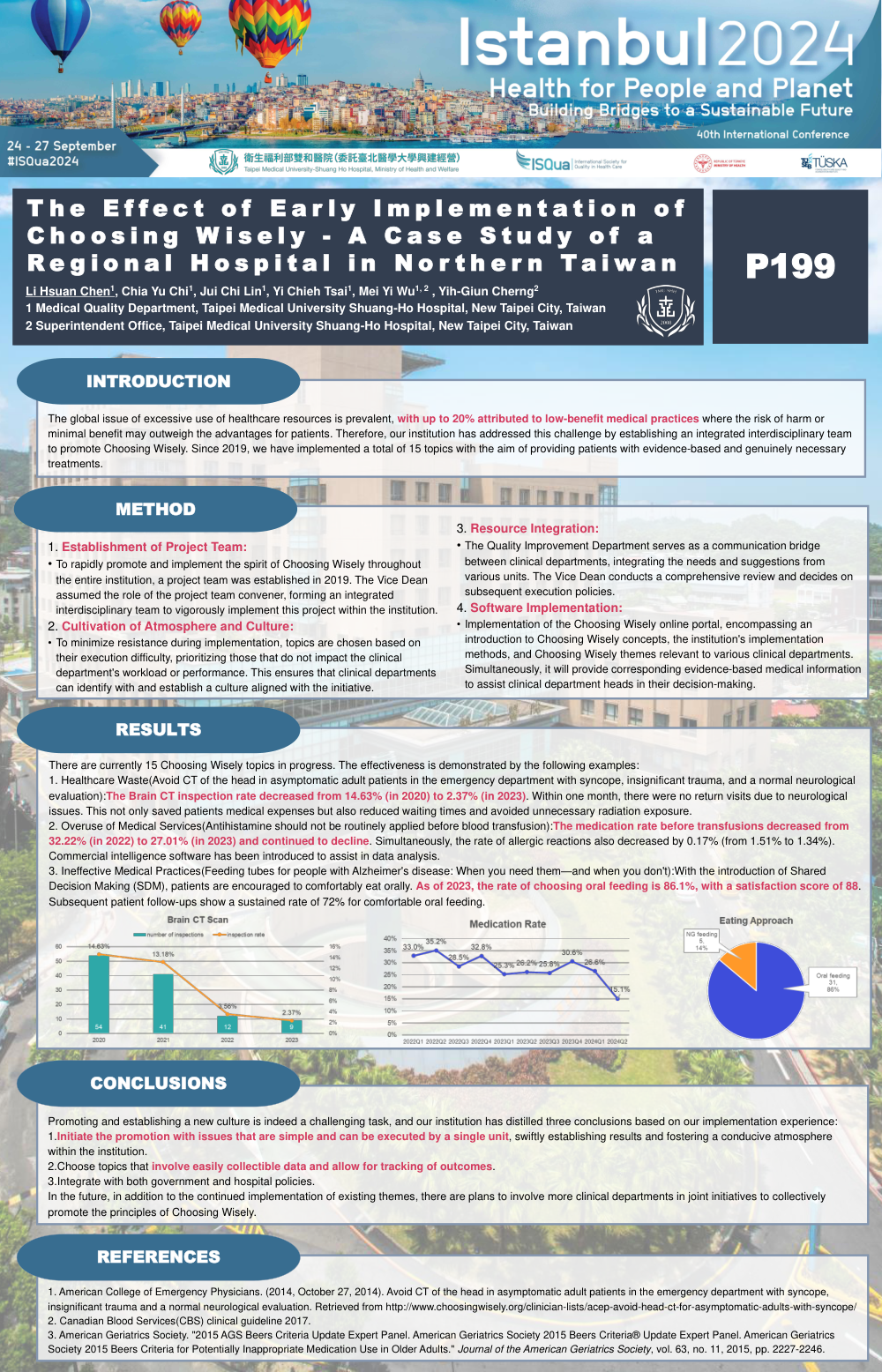
Results: After discussions with various departments and considering the evidence base behind each topic as a basis for
our institution's implementation direction, there are currently 15 Choosing Wisely topics in progress. The effectiveness is
demonstrated by the following examples:
1.Healthcare Waste(Avoid CT of the head in asymptomatic adult patients in the emergency department with
syncope, insignificant trauma, and a normal neurological evaluation):The Brain CT inspection rate decreased from
14.63% (in 2020) to 2.37% (in 2023). Within one month, there were no return visits due to neurological issues. This not
only saved patients medical expenses but also reduced waiting times and avoided unnecessary radiation exposure.
2.Overuse of Medical Services(Antihistamine should not be routinely applied before blood transfusion):The
medication rate before transfusions decreased from 32.22% (in 2022) to 27.01% (in 2023).
Simultaneously, the rate of allergic reactions also decreased by 0.17% (from 1.51% to 1.34%). Commercial intelligence
software has been introduced to assist in data analysis.
3.Ineffective Medical Practices(Feeding tubes for people with Alzheimer's disease: When you need them—and when
you don't):With the introduction of Shared Decision Making (SDM), patients are encouraged to comfortably eat orally. As
of 2023, the rate of choosing oral feeding is 86.1%, with a satisfaction score of 88. Subsequent patient follow-ups show a
sustained rate of 72% for comfortable oral feeding.
Conclusion: Promoting and establishing a new culture is indeed a challenging task, and our institution has distilled three
conclusions based on our implementation experience: (1) Initiate the promotion with issues that are simple and can be
executed by a single unit, swiftly establishing results and fostering a conducive atmosphere within the institution; (2)
Choose topics that involve easily collectible data and allow for tracking of outcomes; and (3) Integrate with both
government and hospital policies. In the future, in addition to the continued implementation of existing themes, there are
plans to involve more clinical departments in joint initiatives to collectively promote the principles of Choosing Wisely.