586 posters, 8 topics, 23 sessions, 1,077 authors, 622 institutions
ePostersLive by SciGen Technologies S.A. All rights reserved.
ISQua's 40th International Conference 2024
24th - 27th September 2024 | Istanbul, Türkiye

P031
The Effectiveness of Situational Teaching on Enhancing ED Nurses in Facing Workplace Violence
Poster Presenter
Authors
Affiliations
Part of Topic
Patient Safety & Quality Improvement
The Effectiveness of Situational Teaching on Enhancing ED Nurses in Facing Workplace Violence
Bo-Yu Wang1, Jun-Yu Fan2
1. MS.Department of Nursing, Chang Gung Memory Hospital, Linkou Branch, Taoyuan, Taiwan
2 PhD.Department of Nursing, School of Nursing, Chang Gung University of Science and Technology, Taoyuan, Taiwan
INTRODUCTION AND OBJECTIVES
Workplace violence is a major global issue for emergency departments (EDs) in hospitals that causes physical and psychological harm to individuals as well as has adverse effects on organizational functioning. The purpose of this study was to implement a "scenario-based training program on workplace violence" and provide post-training reflection using the debriefing for meaningful learning (DML) and compare the effects on cognition, attitudes, communicative competence, coping confidence, and coping strategies related to workplace violence before and after the intervention.
METHOD
This study adopts a stratified randomized experimental research design from a medical center in Taoyuan City. Both groups of participants completed a pre-test (T1) before the scenario-based training program. Then, both groups engaged in a 25-minute workplace violence course. The control group (CG) completed a post-test (T2). But the experimental group (EG) continue participated in approximately 60 minutes of DML reflection activities of three simulation training case scenarios of workplace violence and completed a post-test (T2) right after the DML debriefing. A follow-up test of two groups were conducted two weeks later (T3).
The research instruments included demographic characteristics of the subjects, a workplace violence experience survey administered at T1, and other research instruments, including the Perception of Aggression Scale, The Management of Aggression and Violence Attitude Scale, Communication Competence Scale, Confidence in Coping with Patient Aggression, and Workplace Violence Coping Strategies Scale were applied at T1, T2, and T3. Descriptive statistics and generalized estimating equations were used to analyze data, and the significance level was set at p<.05 for all results.
RESULTS
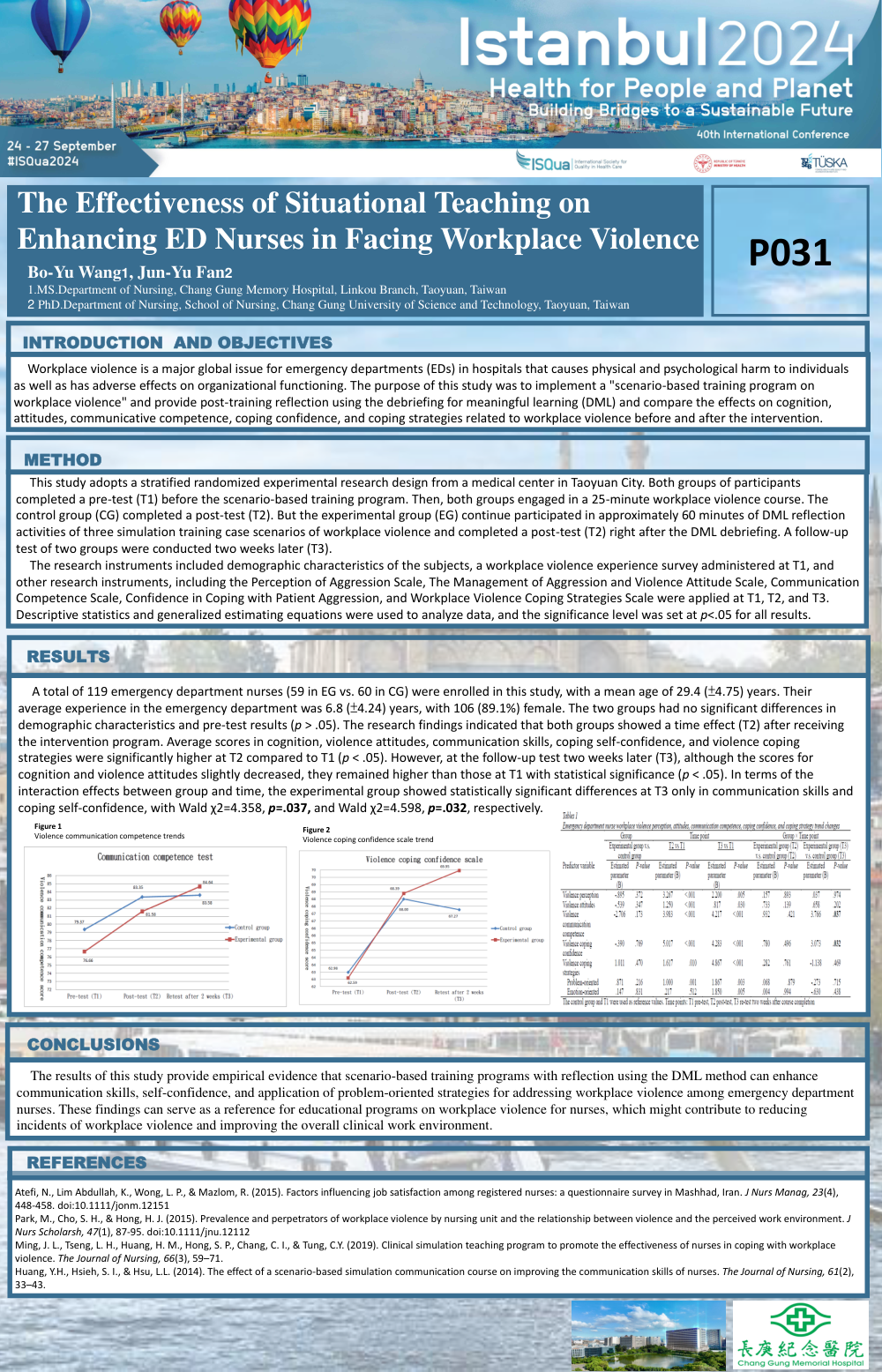
A total of 119 emergency department nurses (59 in EG vs. 60 in CG) were enrolled in this study, with a mean age of 29.4 (±4.75) years. Their average experience in the emergency department was 6.8 (±4.24) years, with 106 (89.1%) female. The two groups had no significant differences in demographic characteristics and pre-test results (p > .05). The research findings indicated that both groups showed a time effect (T2) after receiving the intervention program. Average scores in cognition, violence attitudes, communication skills, coping self-confidence, and violence coping strategies were significantly higher at T2 compared to T1 (p < .05). However, at the follow-up test two weeks later (T3), although the scores for cognition and violence attitudes slightly decreased, they remained higher than those at T1 with statistical significance (p < .05). In terms of the interaction effects between group and time, the experimental group showed statistically significant differences at T3 only in communication skills and coping self-confidence, with Wald χ2=4.358, p=.037, and Wald χ2=4.598, p=.032, respectively.
CONCLUSIONS
The results of this study provide empirical evidence that scenario-based training programs with reflection using the DML method can enhance communication skills, self-confidence, and application of problem-oriented strategies for addressing workplace violence among emergency department nurses. These findings can serve as a reference for educational programs on workplace violence for nurses, which might contribute to reducing incidents of workplace violence and improving the overall clinical work environment.