586 posters, 8 topics, 23 sessions, 1,077 authors, 622 institutions
ePostersLive by SciGen Technologies S.A. All rights reserved.
ISQua's 40th International Conference 2024
24th - 27th September 2024 | Istanbul, Türkiye

P246
2P Safety Hospital technology for Healthcare
Poster Presenter
Authors
Piyawan Limpanyalert, Bunjong Chumpa, Ake-Chittra Sukkul, Netnapa Panmon, Warunee Phanphaeng
Affiliations
CEO of the Healthcare Accreditation Institute (Public Organization), COO of the Healthcare Accreditation Institute (Public Organization), Project Manager of the Healthcare Accreditation Institute (Public Organization), Coordinator of the Healthcare Accreditation Institute (Public Organization)
Part of Topic
Patient Safety & Quality Improvement
2P Safety Hospital Technology for Healthcare
L. Piyawan1, C. Bunjong1, S. Ake-Chittra1, P. Netnapa1, P. Warunee1,
1The Healthcare Accreditation Institute (Public Organization), Nonthaburi, Thailand (www.ha.or.th)
INTRODUCTION
From 2019 to 2023, HAI implemented innovative technology projects focused on patient safety in public health. The "2P Safety Tech," in collaboration with the National Science and Technology Development Agency (NSTDA), coordinated personnel and hospitals to develop technologies aimed at preventing incidents related to hospital care processes. These innovations were designed to address the specific challenges hospitals face, with a focus on achieving patient and personnel safety goals (SIMPLE) in 12 key areas.
Human error is inevitable because everyone has the potential to make mistakes." HAI (Healthcare Accreditation Institute) in Thailand emphasizes solving problems to support system development. Technology and innovation play a crucial role in closing gaps in safety, adhering to the principles of human factors engineering.
AIM
The development process, in collaboration with NSTDA, focused on fostering a safety culture through learning initiatives such as:
Study on Innovation Development in Hospitals
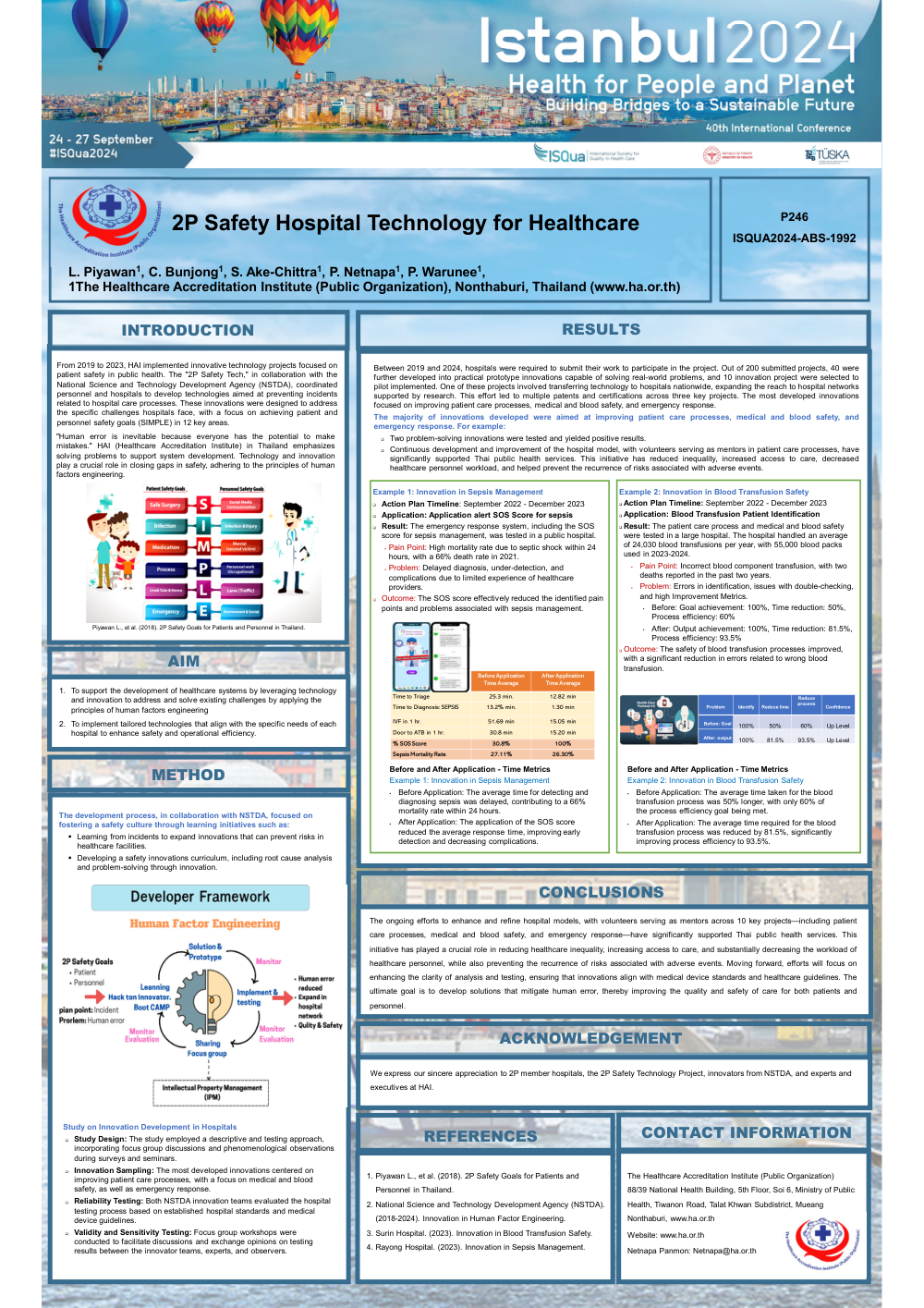
Between 2019 and 2024, hospitals were required to submit their work to participate in the project. Out of 200 submitted projects, 40 were further developed into practical prototype innovations capable of solving real-world problems, and 10 innovation project were selected to pilot implemented. One of these projects involved transferring technology to hospitals nationwide, expanding the reach to hospital networks supported by research. This effort led to multiple patents and certifications across three key projects. The most developed innovations focused on improving patient care processes, medical and blood safety, and emergency response.
The majority of innovations developed were aimed at improving patient care processes, medical and blood safety, and emergency response. For example:
Example 1: Innovation in Sepsis Management
Before and After Application - Time Metrics
Example 1: Innovation in Sepsis Management
Before and After Application - Time Metrics
Example 2: Innovation in Blood Transfusion Safety
The ongoing efforts to enhance and refine hospital models, with volunteers serving as mentors across 10 key projects including patient care processes, medical and blood safety, and emergency response—have significantly supported Thai public health services. This initiative has played a crucial role in reducing healthcare inequality, increasing access to care, and substantially decreasing the workload of healthcare personnel, while also preventing the recurrence of risks associated with adverse events. Moving forward, efforts will focus on enhancing the clarity of analysis and testing, ensuring that innovations align with medical device standards and healthcare guidelines. The ultimate goal is to develop solutions that mitigate human error, thereby improving the quality and safety of care for both patients and personnel.
ACKNOWLEDGEMENT
We express our sincere appreciation to 2P member hospitals, the 2P Safety Technology Project, innovators from NSTDA, and experts and executives at HAI.
REFERENCES
CONTACT INFORMATION
The Healthcare Accreditation Institute (Public Organization)
88/39 National Health Building, 5th Floor, Soi 6, Ministry of Public Health, Tiwanon Road, Talat Khwan Subdistrict, Mueang Nonthaburi, www.ha.or.th
Website: www.ha.or.th
Netnapa Panmon: Netnapa@ha.or.th