586 posters, 8 topics, 23 sessions, 1,077 authors, 622 institutions
ePostersLive by SciGen Technologies S.A. All rights reserved.
ISQua's 40th International Conference 2024
24th - 27th September 2024 | Istanbul, Türkiye

P002
Team Resource Management(TRM) strategy on reducing the rate of emergency department patients staying for more than 48 hours after triaging
Poster Presenter
Authors
Ai-Lun Wu, Shang-Lin Hsieh, Chih-Shang Chi, Ming-Kun Huang, Ding-Kuo Chien
Affiliations
Part of Topic
Patient Safety & Quality Improvement
Title
Team resource management(TRM) strategy on reducing the rate of emergency department patients staying for more than 48 hours after triaging
Introduction
This study used control charts to monitor the Taiwan Clinical Performance Indicator(TCPI), and found that the rate of emergency department patients staying for more than 48 hours after triaging was occasionally unstable (exceeding 2σ). The main reason patients stay in the emergency department for more than 48 hours is the necessity for hospitalization and the wait for available ward beds. For further assessment: unclear information on vacant beds, inefficient allocation of ward beds, varying shift schedules and rules among bed-allocation physicians in different clinical divisions, and limitations based on the gender and specialty of patients, resulting in some vacant beds being unusable. In response to the impact of COVID-19, it is necessary to set up special wards and adjust the hospitalization conditions for emergency patients on a rolling basis, in accordance with current policies.
Methods
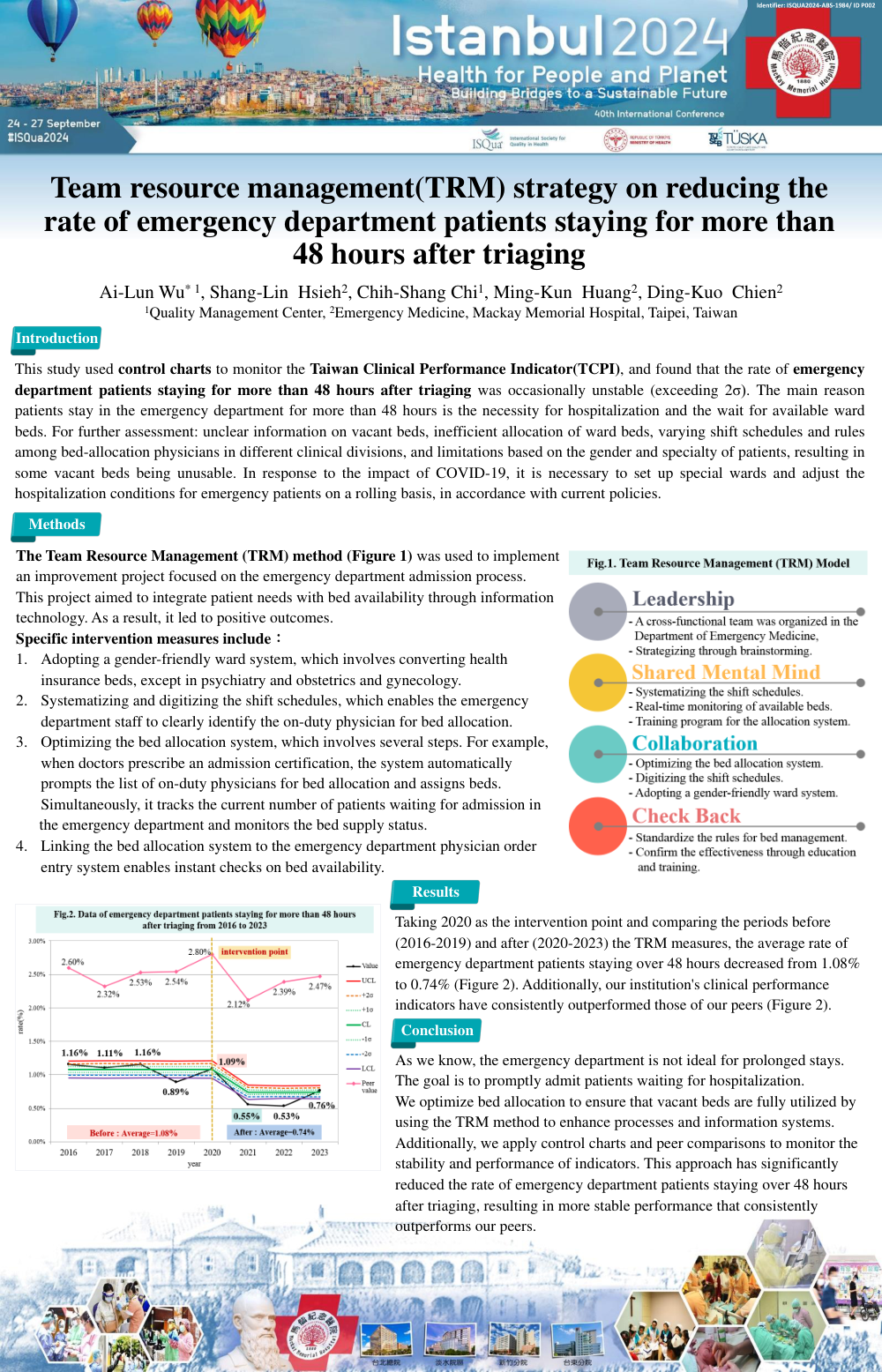
The Team Resource Management (TRM) method was used to implement an improvement project focused on the emergency department admission process.
This project aimed to integrate patient needs with bed availability through information technology. As a result, it led to positive outcomes.
Specific intervention measures include:
Results
Taking 2020 as the intervention point and comparing the periods before (2016-2019) and after (2020-2023) the TRM measures, the average rate of emergency department patients staying over 48 hours decreased from 1.08% to 0.74%. Additionally, our institution's clinical performance indicators have consistently outperformed those of our peers.
Conclusion
As we know, the emergency department is not ideal for prolonged stays. The goal is to promptly admit patients waiting for hospitalization.
We optimize bed allocation to ensure that vacant beds are fully utilized by using the TRM method to enhance processes and information systems. Additionally, we apply control charts and peer comparisons to monitor the stability and performance of indicators. This approach has significantly reduced the rate of emergency department patients staying over 48 hours after triaging, resulting in more stable performance that consistently outperforms our peers.