586 posters, 8 topics, 23 sessions, 1,077 authors, 622 institutions
ePostersLive by SciGen Technologies S.A. All rights reserved.
ISQua's 40th International Conference 2024
24th - 27th September 2024 | Istanbul, Türkiye

P030
Enhancing the Completeness of Endotracheal Intubation Procedure Preparation in the Emergency Department: A Quality Improvement Project
Poster Presenter
Authors
Affiliations
New Taipei City Municipal Tucheng Hospital (Built and Operated by Chang Gung Medical Foundation), Department of Nursing, New Taipei City Municipal Tucheng Hospital (Built and Operated by Chang Gung Medical Foundation), Taipei, Taiwan, Nursing Management Department of Administration Center, Chang Gung Medical Foundation, Taoyuan, Taiwan
Part of Topic
Patient Safety & Quality Improvement
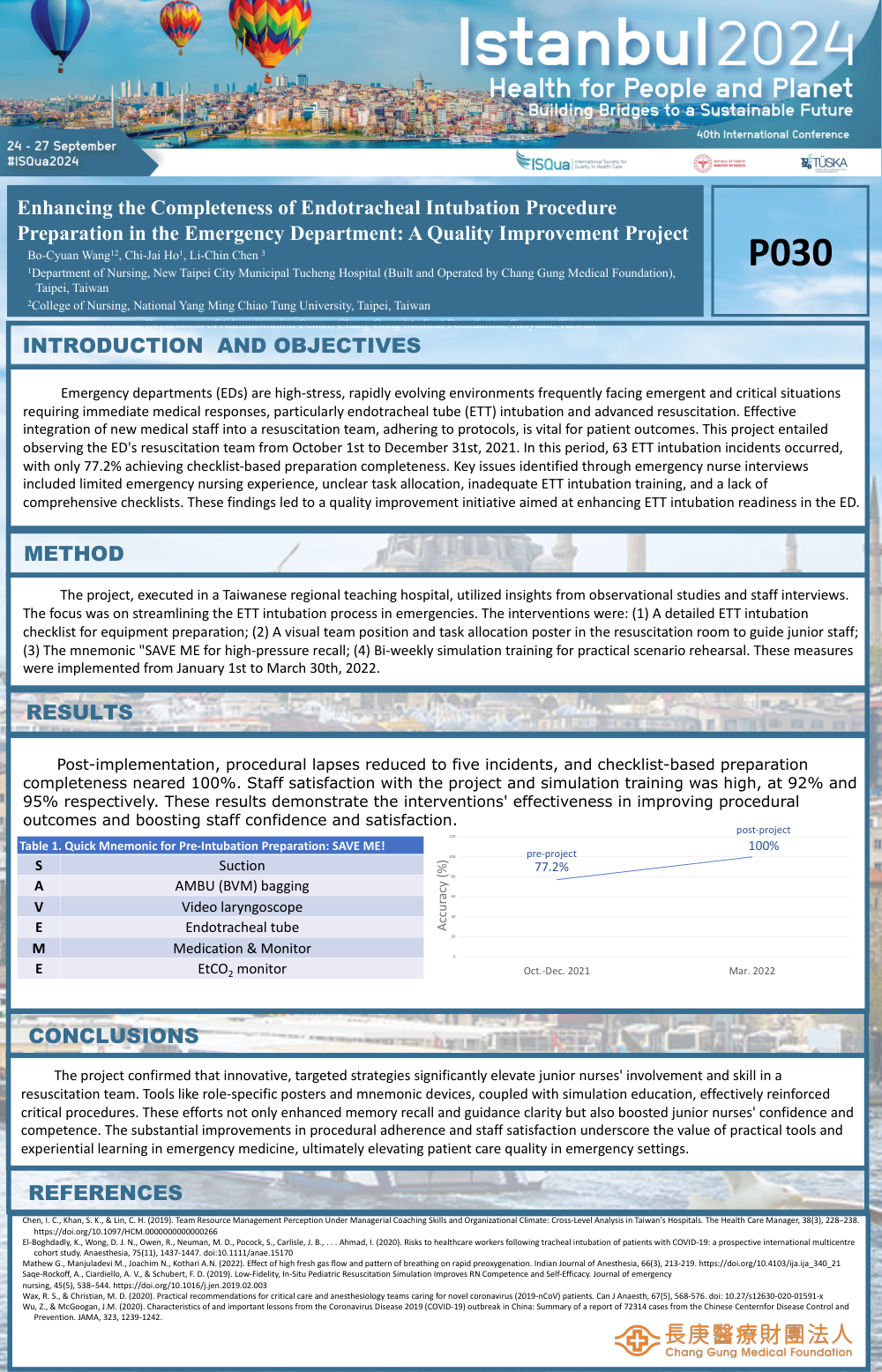
Introduction: Emergency departments (EDs) are high-stress, rapidly evolving environments frequently facing emergent and critical situations requiring immediate medical responses, particularly endotracheal tube (ETT) intubation and advanced resuscitation. Effective integration of new medical staff into a resuscitation team, adhering to protocols, is vital for patient outcomes. This project entailed observing the ED's resuscitation team from October 1st to December 31st, 2021. In this period, 63 ETT intubation incidents occurred, with only 77.2% achieving checklist-based preparation completeness. Key issues identified through emergency nurse interviews included limited emergency nursing experience, unclear task allocation, inadequate ETT intubation training, and a lack of comprehensive checklists. These findings led to a quality improvement initiative aimed at enhancing ETT intubation readiness in the ED.
Methods: The project, executed in a Taiwanese regional teaching hospital, utilized insights from observational studies and staff interviews. The focus was on streamlining the ETT intubation process in emergencies. The interventions were: (1) A detailed ETT intubation checklist for equipment preparation; (2) A visual team position and task allocation poster in the resuscitation room to guide junior staff; (3) The mnemonic "SAVE ME!" (Suction, AMBU bagging, Video laryngoscope, Endotracheal tube, Medication and Monitoring, EtCO2 monitoring) for high-pressure recall; (4) Bi-weekly simulation training for practical scenario rehearsal. These measures were implemented from January 1st to March 30th, 2022.
Results: Post-implementation, procedural lapses reduced to five incidents, and checklist-based preparation completeness neared 100%. Staff satisfaction with the project and simulation training was high, at 92% and 95% respectively. These results demonstrate the interventions' effectiveness in improving procedural outcomes and boosting staff confidence and satisfaction.
Conclusion: The project confirmed that innovative, targeted strategies significantly elevate junior nurses' involvement and skill in a resuscitation team. Tools like role-specific posters and mnemonic devices, coupled with simulation education, effectively reinforced critical procedures. These efforts not only enhanced memory recall and guidance clarity but also boosted junior nurses' confidence and competence. The substantial improvements in procedural adherence and staff satisfaction underscore the value of practical tools and experiential learning in emergency medicine, ultimately elevating patient care quality in emergency settings.
Keywords: emergency nursing, nursing education, quality improvement