586 posters, 8 topics, 23 sessions, 1,077 authors, 622 institutions
ePostersLive by SciGen Technologies S.A. All rights reserved.
ISQua's 40th International Conference 2024
24th - 27th September 2024 | Istanbul, Türkiye

P108
Unraveling Patient Safety Dynamics: Exploring Insights From Hospital Al-Sultan Abdullah's Comparative Patient Safety Culture Survey
Part of Topic
Patient Safety & Quality Improvement
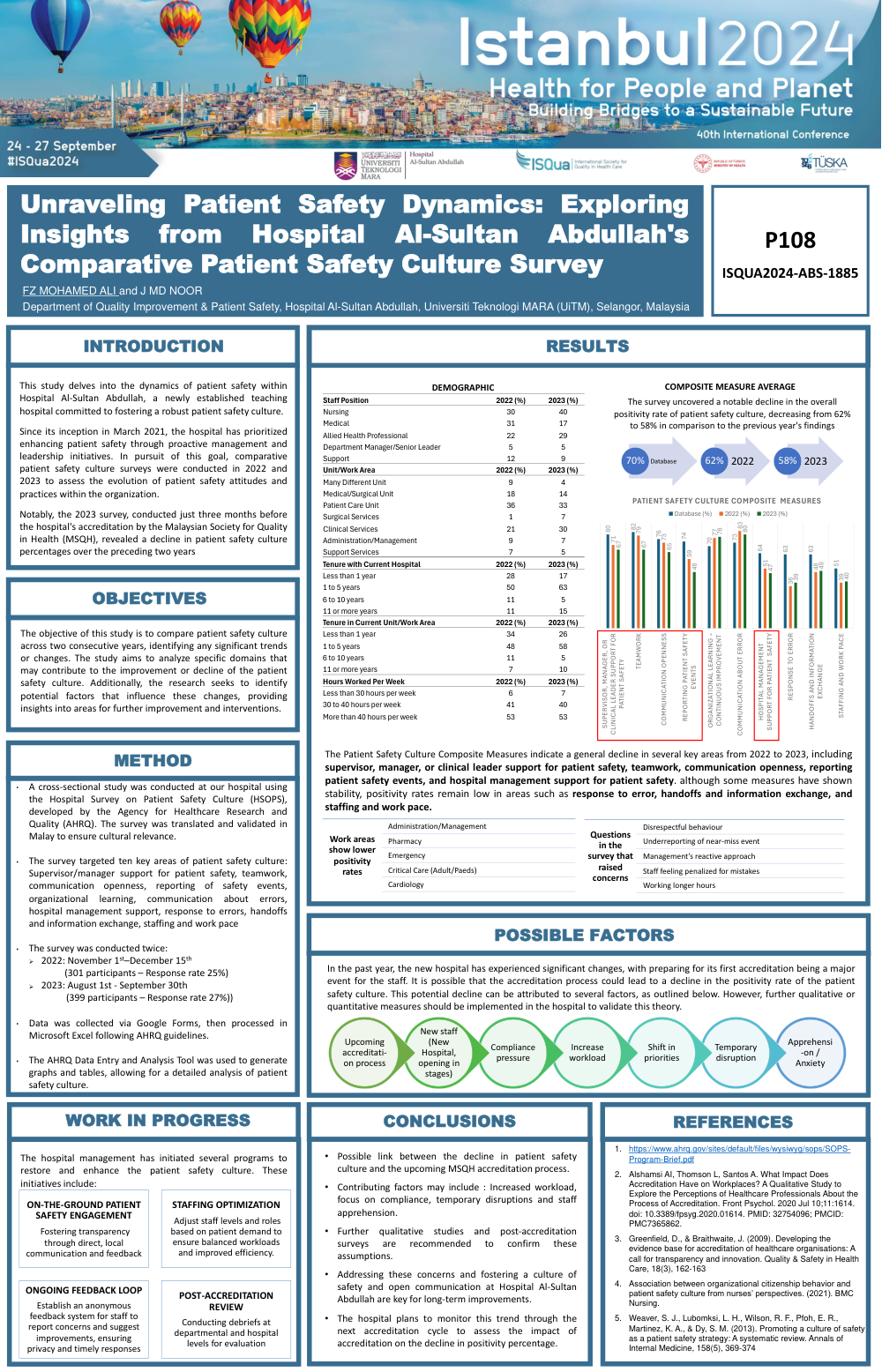
UNRAVELING PATIENT SAFETY DYNAMICS: EXPLORING INSIGHTS FROM HOSPITAL AL-SULTAN ABDULLAH'S COMPARATIVE PATIENT SAFETY CULTURE SURVEY
FZ MOHAMED ALI and J MD NOOR
Department of Quality Improvement & Patient Safety, Hospital Al-Sultan Abdullah, Universiti Teknologi MARA (UiTM), Selangor, Malaysia
INTRODUCTION
This study delves into the dynamics of patient safety within Hospital Al-Sultan Abdullah, a newly established teaching hospital committed to fostering a robust patient safety culture.
Since its inception in March 2021, the hospital has prioritized enhancing patient safety through proactive management and leadership initiatives. In pursuit of this goal, comparative patient safety culture surveys were conducted in 2022 and 2023 to assess the evolution of patient safety attitudes and practices within the organization.
Notably, the 2023 survey, conducted just three months before the hospital's accreditation by the Malaysian Society for Quality in Health (MSQH), revealed a decline in patient safety culture percentages over the preceding two years
OBJECTIVES
The objective of this study is to compare patient safety culture across two consecutive years, identifying any significant trends or changes. The study aims to analyze specific domains that may contribute to the improvement or decline of the patient safety culture. Additionally, the research seeks to identify potential factors that influence these changes, providing insights into areas for further improvement and interventions.
METHOD
- A cross-sectional study was conducted at our hospital using the Hospital Survey on Patient Safety Culture (HSOPS), developed by the Agency for Healthcare Research and Quality (AHRQ). The survey was translated and validated in Malay to ensure cultural relevance.
- The survey targeted ten key areas of patient safety culture: Supervisor/manager support for patient safety, teamwork, communication openness, reporting of safety events, organizational learning, communication about errors, hospital management support, response to errors, handoffs and information exchange, staffing and work pace
- The survey was conducted twice:
- 2022: November 1st–December 15th
(301 participants – Response rate 25%)
- 2023: August 1st - September 30th
(399 participants – Response rate 27%))
- Data was collected via Google Forms, then processed in Microsoft Excel following AHRQ guidelines.
- The AHRQ Data Entry and Analysis Tool was used to generate graphs and tables, allowing for a detailed analysis of patient safety culture.
RESULT
The survey uncovered a notable decline in the overall positivity rate of patient safety culture, decreasing from 62% to 58% in comparison to the previous year's findings
The Patient Safety Culture Composite Measures indicate a general decline in several key areas from 2022 to 2023, including supervisor, manager, or clinical leader support for patient safety, teamwork, communication openness, reporting patient safety events, and hospital management support for patient safety. although some measures have shown stability, positivity rates remain low in areas such as response to error, handoffs and information exchange, and staffing and work pace.
POSSIBLE FACTORS
In the past year, the new hospital has experienced significant changes, with preparing for its first accreditation being a major event for the staff. It is possible that the accreditation process could lead to a decline in the positivity rate of the patient safety culture. This potential decline can be attributed to several factors, as outlined below. However, further qualitative or quantitative measures should be implemented in the hospital to validate this theory.
- Upcoming accreditation
- New staff (new hospital opening in stages
- Compliance pressure
- Increase workload
- Shift in priorities
- Temporary disruption
- Apprehension/anxiety
WORK IN PROGRESS
The hospital management has initiated several programs to restore and enhance the patient safety culture. These initiatives include:
- On-the-ground patient safety engagement - Fostering transparency through direct, local communication and feedback
- Staffing optimization - Adjust staff levels and roles based on patient demand to ensure balanced workloads and improved efficiency.
- Ongoing feedback loop - Establish an anonymous feedback system for staff to report concerns and suggest improvements, ensuring privacy and timely responses
- Post-accreditation review - Conducting debriefs at departmental and hospital levels for evaluation
CONCLUSION
- Possible link between the decline in patient safety culture and the upcoming MSQH accreditation process.
- Contributing factors may include : Increased workload, focus on compliance, temporary disruptions and staff apprehension.
- Further qualitative studies and post-accreditation surveys are recommended to confirm these assumptions.
- Addressing these concerns and fostering a culture of safety and open communication at Hospital Al-Sultan Abdullah are key for long-term improvements.
- The hospital plans to monitor this trend through the next accreditation cycle to assess the impact of accreditation on the decline in positivity percentage