586 posters, 8 topics, 23 sessions, 1,077 authors, 622 institutions
ePostersLive by SciGen Technologies S.A. All rights reserved.
ISQua's 40th International Conference 2024
24th - 27th September 2024 | Istanbul, Türkiye

P001
Saudi Hospitals' Adherence to the Essential Safety Requirements
Poster Presenter
Part of Topic
Patient Safety & Quality Improvement
TITLE: Saudi Hospitals’ Adherence to the Essential Safety Requirements
INTRODUCTION:
In 2016, the Saudi Central Board for Accreditation of Healthcare Institutions (CBAHI) introduced the Essential Safety Requirements (ESRs).1 ESR is a list of 20 essential standards that hospitals must adhere to for ensuring patient safety. 1-3 Each year CBAHI conducts National Rounds to evaluate all the hospitals across Saudi Arabia for their adherence to the ESR standards. 2 Hospitals need to meet 85% or more of the standards to achieve full adherence with ESR. 3,4 Studies that have examined these National Rounds are scarce, even though a large number of hospitals have been examined during the rounds in past years. 4-6 Therefore, there is a need to examine the ESR National Rounds.
AIM:
The aim of this study was to appraise the adherence of Saudi hospitals to the ESR standards over the years and to identify the highest and lowest adherence rates.
METHOD:
Study design and setting: A retrospective secondary data analysis was done using the National Rounds data, which were retrieved from the CBAHI repository. Description of variables: The ESR contains 20 standards. CBAHI surveyors assessed each hospital against the 20 standards, then they scored each standard on a three-point scale, as follows: 0 (insufficient adherence), 1 (partial adherence), or 2 (full adherence). The sum of the scores divided by 20 showed the overall score. The scores for the standards were converted into a percentage to represent adherence.
Inclusion and exclusion criteria: Data from permanent hospitals collected during the National Rounds done by CBAHI between 2016 and 2022 were included.
Data analysis: A descriptive analysis of ESR scores was done.
RESULTS:
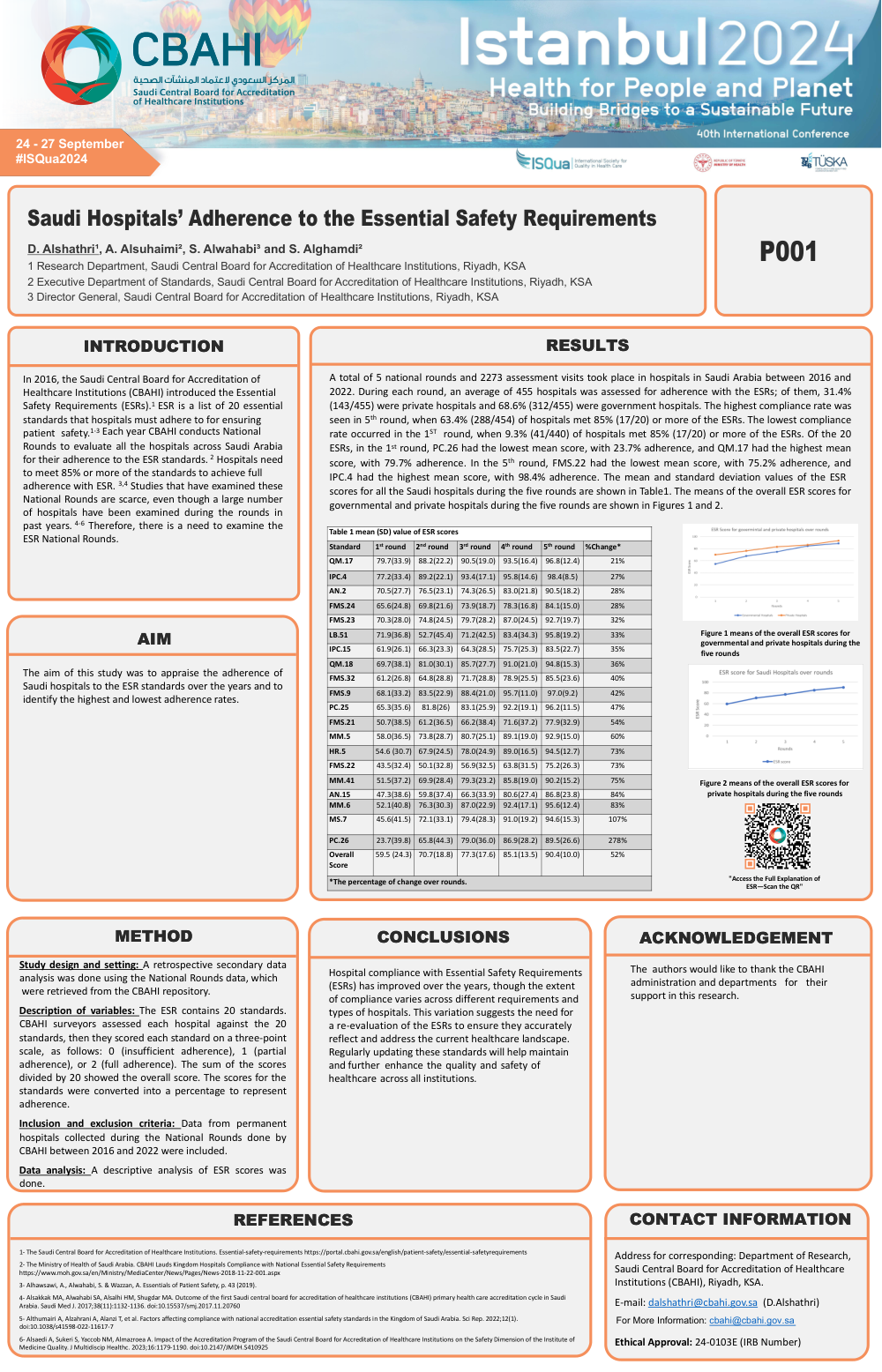
A total of 5 national rounds and 2273 assessment visits took place in hospitals in Saudi Arabia between 2016 and 2022. During each round, an average of 455 hospitals was assessed for adherence with the ESRs; of them, 31.4% (143/455) were private hospitals and 68.6% (312/455) were government hospitals. The highest compliance rate was seen in 5th round, when 63.4% (288/454) of hospitals met 85% (17/20) or more of the ESRs. The lowest compliance rate occurred in the 1ST round, when 9.3% (41/440) of hospitals met 85% (17/20) or more of the ESRs. Of the 20 ESRs, in the 1st round, PC.26 had the lowest mean score, with 23.7% adherence, and QM.17 had the highest mean score, with 79.7% adherence. In the 5th round, FMS.22 had the lowest mean score, with 75.2% adherence, and IPC.4 had the highest mean score, with 98.4% adherence. The mean and standard deviation values of the ESR scores for all the Saudi hospitals during the five rounds are shown in Table1. The means of the overall ESR scores for governmental and private hospitals during the five rounds are shown in Figures 1 and 2.
CONCLUSIONS:
Hospital compliance with Essential Safety Requirements (ESRs) has improved over the years, though the extent of compliance varies across different requirements and types of hospitals. This variation suggests the need for a re-evaluation of the ESRs to ensure they accurately reflect and address the current healthcare landscape. Regularly updating these standards will help maintain and further enhance the quality and safety of healthcare across all institutions.
ACKNOWLEDGEMENT:
The authors would like to thank the CBAHI administration and departments for their support in this research.
REFERENCES:
1- The Saudi Central Board for Accreditation of Healthcare Institutions. Essential-safety-requirements https://portal.cbahi.gov.sa/english/patient-safety/essential-safetyrequirements
2- The Ministry of Health of Saudi Arabia. CBAHI Lauds Kingdom Hospitals Compliance with National Essential Safety Requirements https://www.moh.gov.sa/en/Ministry/MediaCenter/News/Pages/News-2018-11-22-001.aspx
3- Alhawsawi, A., Alwahabi, S. & Wazzan, A. Essentials of Patient Safety, p. 43 (2019).
4- Alsakkak MA, Alwahabi SA, Alsalhi HM, Shugdar MA. Outcome of the first Saudi central board for accreditation of healthcare institutions (CBAHI) primary health care accreditation cycle in Saudi Arabia. Saudi Med J. 2017;38(11):1132-1136. doi:10.15537/smj.2017.11.20760
5- Althumairi A, Alzahrani A, Alanzi T, et al. Factors affecting compliance with national accreditation essential safety standards in the Kingdom of Saudi Arabia. Sci Rep. 2022;12(1). doi:10.1038/s41598-022-11617-7
6- Alsaedi A, Sukeri S, Yaccob NM, Almazroea A. Impact of the Accreditation Program of the Saudi Central Board for Accreditation of Healthcare Institutions on the Safety Dimension of the Institute of Medicine Quality. J Multidiscip Healthc. 2023;16:1179-1190. doi:10.2147/JMDH.S410925
CONTACT INFORMATION:
Address for corresponding: Department of Research, Saudi Central Board for Accreditation of Healthcare Institutions (CBAHI), Riyadh, KSA. E-mail: dalshathri@cbahi.gov.sa (D.Alshathri) Ethical Approval: 24-0103E (IRB Number)