586 posters, 8 topics, 23 sessions, 1,077 authors, 622 institutions
ePostersLive by SciGen Technologies S.A. All rights reserved.
ISQua's 40th International Conference 2024
24th - 27th September 2024 | Istanbul, Türkiye

P324
Using an electronic blood bank information system to increase the rate of transfusion completed within 4 hours
Poster Presenter
Authors
Affiliations
Part of Topic
Patient Safety & Quality Improvement
Using an electronic blood bank information system to increase the rate of transfusion completed within 4 hours
SUNG CHIA-HSING1, JHANG HSU- PING 1
1Department of Laboratory, Chang Bing Show Chwan Memorial Hospital , Changhua, Taiwan
Introduction:
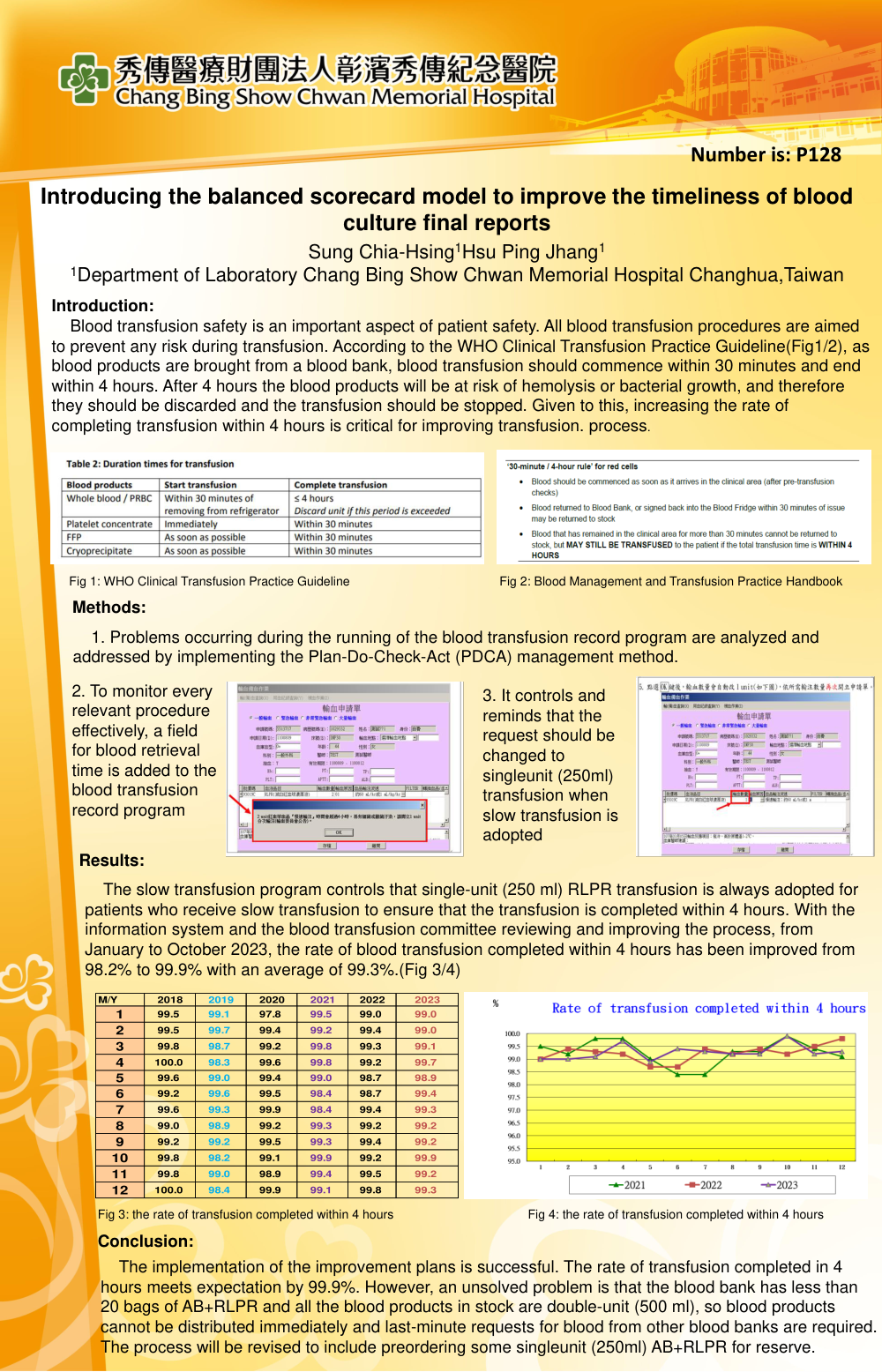
Blood transfusion safety is an important aspect of patient safety. All blood transfusion procedures are aimed to prevent any risk during transfusion. According to the WHO Clinical Transfusion Practice Guideline, as blood products are brought from a blood bank, blood transfusion should commence within 30 minutes and end within 4 hours. After 4 hours the blood products will be at risk of hemolysis or bacterial growth, and therefore they should be discarded and the transfusion should be stopped. Given to this, increasing the rate of completing transfusion within 4 hours is critical for improving transfusion process.
Methods:
Problems occurring during the running of the blood transfusion record program are analyzed and addressed by implementing the Plan-Do-Check-Act (PDCA) management method. An electronic blood transfusion system is established in place of the traditional blood transfusion reaction form. To monitor every relevant procedure effectively, a field for blood retrieval time is added to the blood transfusion record program, so that the entire blood transfusion process is clearly displayed in the system. A new program is constructed to manage the requests for RLPR and whole blood transfusion as well as obtaining blood from the bank. It controls and reminds that the request should be changed to singleunit (250ml) transfusion when slow transfusion is adopted. In addition, the infusion rate calculation program is updated with a parameter of the number of droplets for easier rate calculation. The records are analyzed using statistical forms and reviewed by the blood transfusion committee quarterly. It reviews cases in which transfusion duration exceeds 4 hours one by one to seek improvement.
Results:
The slow transfusion program controls that single-unit (250 ml) RLPR transfusion is always adopted for patients who receive slow transfusion to ensure that the transfusion is completed within 4 hours. With the information system and the blood transfusion committee reviewing and improving the process, from January to October 2023, the rate of blood transfusion completed within 4 hours has been improved from 98.2% to 99.9% with an average of 99.3%.
Conclusion:
The implementation of the improvement plans is successful. The rate of transfusion completed in 4 hours meets expectation by 99.9%. However, an unsolved problem is that the blood bank has less than 20 bags of AB+RLPR and all the blood products in stock are double-unit (500 ml), so blood products cannot be distributed immediately and last-minute requests for blood from other blood banks are required. The process will be revised to include preordering some singleunit (250ml) AB+RLPR for reserve.
References: American Association of Blood Banks Technical Manual, 15th Edition. P.525 Disclosure of Interest: None Declared
Keywords: Blood transfusion safety, electronic blood bank information system