586 posters, 8 topics, 23 sessions, 1,077 authors, 622 institutions
ePostersLive by SciGen Technologies S.A. All rights reserved.
ISQua's 40th International Conference 2024
24th - 27th September 2024 | Istanbul, Türkiye

P295
Good educational strategy can effectively reduce intensive care unit central line associated blood stream infections
Poster Presenter
Authors
Affiliations
Part of Topic
Patient Safety & Quality Improvement
Good educational strategy can effectively reduce intensive care unit central line associated blood stream infections-isqua2024.19f02ea
Sheng-Der. Hsu1,2
1 Division of Trauma tology, Department of Surgery, Tri-Service General Hospital, Taiwan, R.O.C.
2 Department of intensive care medicine, Tri-Service General Hospital, Taiwan, R.O.C
Keywords: bloodstream infections, central venous catheter, intensive care unit, education strategy
Purposes:
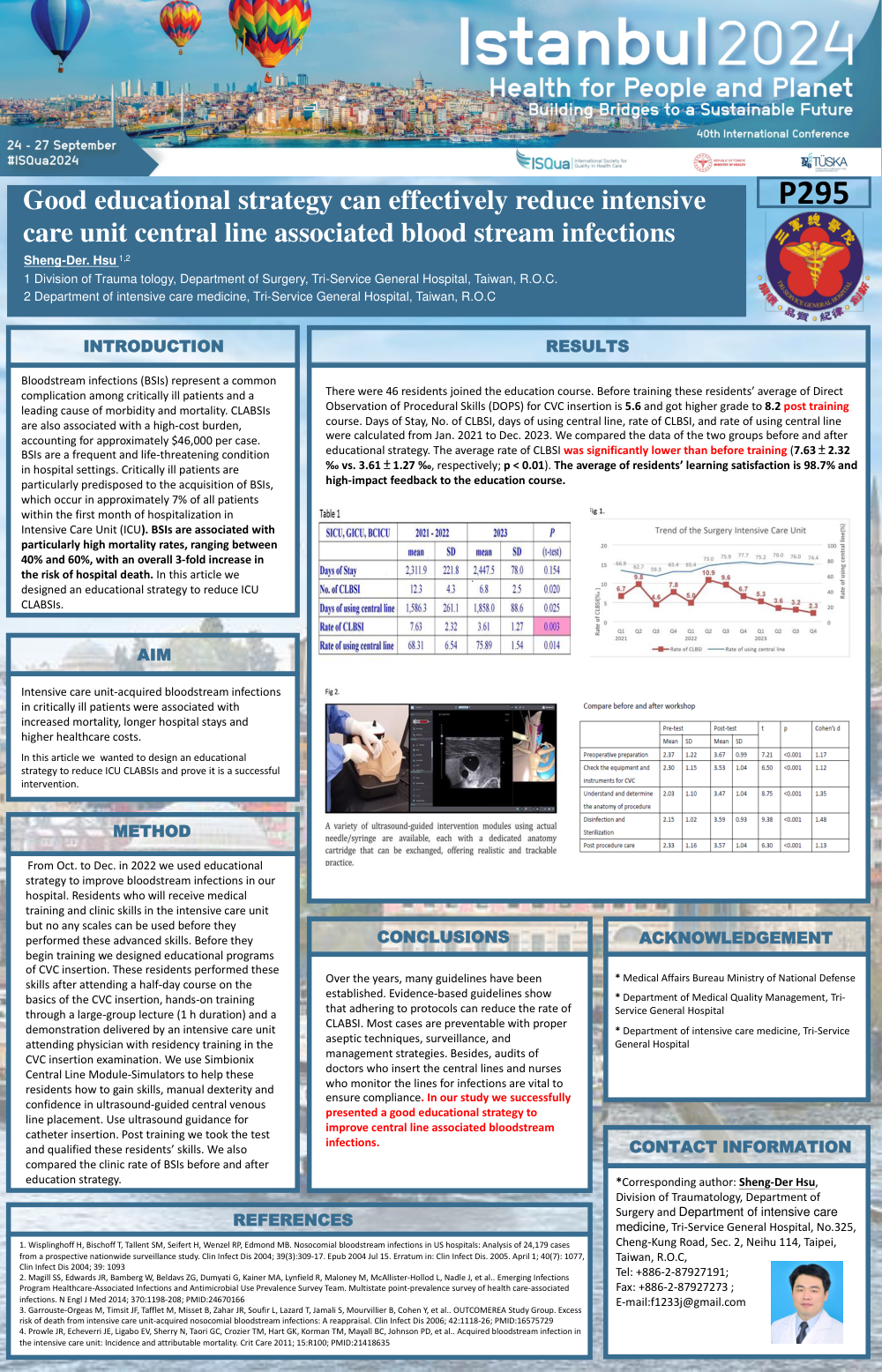
Bloodstream infections (BSIs) represent a common complication among critically ill patients and a leading cause of morbidity and mortality. CLABSIs are also associated with a high-cost burden, accounting for approximately $46,000 per case. BSIs are a frequent and life-threatening condition in hospital settings. Critically ill patients are particularly predisposed to the acquisition of BSIs, which occur in approximately 7% of all patients within the first month of hospitalization in Intensive Care Unit (ICU). BSIs are associated with particularly high mortality rates, ranging between 40% and 60%, with an overall 3-fold increase in the risk of hospital death. In this article we designed an educational strategy to reduce ICU CLABSIs.
Methods:
From Oct. to Dec. in 2022 we used educational strategy to improve bloodstream infections in our hospital. Residents who will receive medical training and clinic skills in the intensive care unit but no any scales can be used before they performed these advanced skills. Before they begin training we designed educational programs of CVC insertion. These residents performed these skills after attending a half-day course on the basics of the CVC insertion, hands-on training through a large-group lecture (1 h duration) and a demonstration delivered by an intensive care unit attending physician with residency training in the CVC insertion examination. We use Simbionix Central Line Module-Simulators to help these residents how to gain skills, manual dexterity and confidence in ultrasound-guided central venous line placement. Use ultrasound guidance for catheter insertion. Post training we took the test and qualified these residents’ skills. We also compared the clinic rate of BSIs before and after education strategy.
Results:
There were 46 residents joined the education course. Before training these residents’ average of Direct Observation of Procedural Skills (DOPS) for CVC insertion is 5.6 and got higher grade to 8.2 post training course. Days of Stay, No. of CLBSI, days of using central line, rate of CLBSI, and rate of using central line were calculated from Jan. 2021 to Dec. 2023. We compared the data of the two groups before and after educational strategy. The average rate of CLBSI was significantly lower than before training (7.63 ± 2.32 ‰ vs. 3.61 ± 1.27 ‰, respectively; p < 0.01). The average of residents’ learning satisfaction is 98.7% and high-impact feedback to the education course.
Discussions:
Over the years, many guidelines have been established. Evidence-based guidelines show that adhering to protocols can reduce the rate of CLABSI. Most cases are preventable with proper aseptic techniques, surveillance, and management strategies. Besides, audits of doctors who insert the central lines and nurses who monitor the lines for infections are vital to ensure compliance. In our study we successfully presented a good educational strategy to improve central line associated bloodstream infections.