586 posters, 8 topics, 23 sessions, 1,077 authors, 622 institutions
ePostersLive by SciGen Technologies S.A. All rights reserved.
ISQua's 40th International Conference 2024
24th - 27th September 2024 | Istanbul, Türkiye

P318
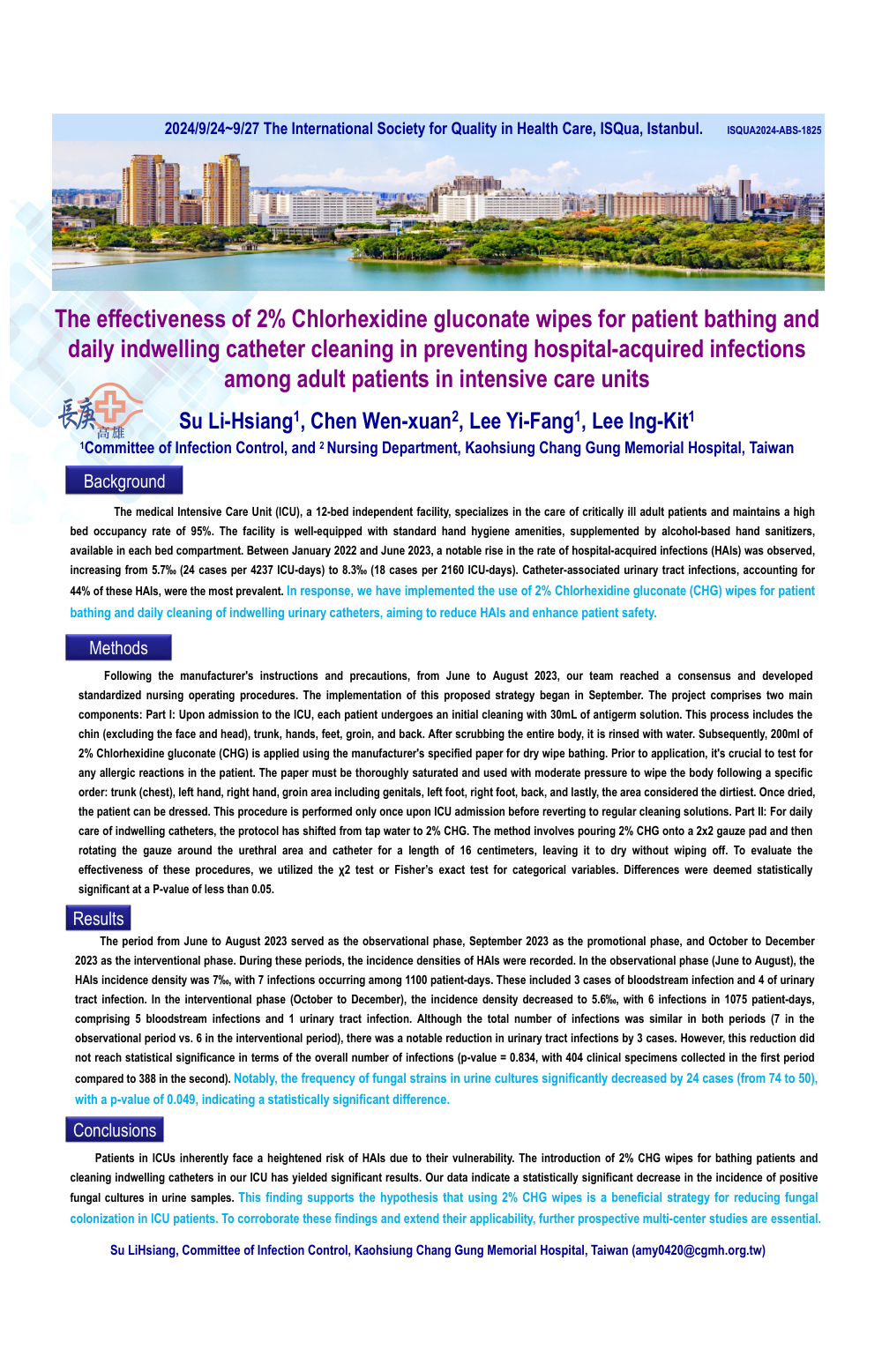
The effectiveness of 2% Chlorhexidine gluconate wipes for patient bathing and daily indwelling catheter cleaning in preventing hospital-acquired infections among adult patients in intensive care units
Poster Presenter
Authors
Part of Topic
Patient Safety & Quality Improvement
Background
The medical Intensive Care Unit (ICU), a 12-bed independent facility, specializes in the care of critically ill adult patients and maintains a high bed occupancy rate of 95%. The facility is well-equipped with standard hand hygiene amenities, supplemented by alcohol-based hand sanitizers, available in each bed compartment. Between January 2022 and June 2023, a notable rise in the rate of hospital-acquired infections (HAIs) was observed, increasing from 5.7‰ (24 cases per 4237 ICU-days) to 8.3‰ (18 cases per 2160 ICU-days). Catheter-associated urinary tract infections, accounting for 44% of these HAIs, were the most prevalent. In response, we have implemented the use of 2% Chlorhexidine gluconate (CHG) wipes for patient bathing and daily cleaning of indwelling urinary catheters, aiming to reduce HAIs and enhance patient safety.
Methods
Following the manufacturer's instructions and precautions, from June to August 2023, our team reached a consensus and developed standardized nursing operating procedures. The implementation of this proposed strategy began in September. The project comprises two main components: Part I: Upon admission to the ICU, each patient undergoes an initial cleaning with 30mL of antigerm solution. This process includes the chin (excluding the face and head), trunk, hands, feet, groin, and back. After scrubbing the entire body, it is rinsed with water. Subsequently, 200ml of 2% Chlorhexidine gluconate (CHG) is applied using the manufacturer's specified paper for dry wipe bathing. Prior to application, it's crucial to test for any allergic reactions in the patient. The paper must be thoroughly saturated and used with moderate pressure to wipe the body following a specific order: trunk (chest), left hand, right hand, groin area including genitals, left foot, right foot, back, and lastly, the area considered the dirtiest. Once dried, the patient can be dressed. This procedure is performed only once upon ICU admission before reverting to regular cleaning solutions. Part II: For daily care of indwelling catheters, the protocol has shifted from tap water to 2% CHG. The method involves pouring 2% CHG onto a 2x2 gauze pad and then rotating the gauze around the urethral area and catheter for a length of 16 centimeters, leaving it to dry without wiping off. To evaluate the effectiveness of these procedures, we utilized the χ2 test or Fisher’s exact test for categorical variables. Differences were deemed statistically significant at a P-value of less than 0.05.
Results
The period from June to August 2023 served as the observational phase, September 2023 as the promotional phase, and October to December 2023 as the interventional phase. During these periods, the incidence densities of HAIs were recorded. In the observational phase (June to August), the HAIs incidence density was 7‰, with 7 infections occurring among 1100 patient-days. These included 3 cases of bloodstream infection and 4 of urinary tract infection. In the interventional phase (October to December), the incidence density decreased to 5.6‰, with 6 infections in 1075 patient-days, comprising 5 bloodstream infections and 1 urinary tract infection. Although the total number of infections was similar in both periods (7 in the observational period vs. 6 in the interventional period), there was a notable reduction in urinary tract infections by 3 cases. However, this reduction did not reach statistical significance in terms of the overall number of infections (p-value = 0.834, with 404 clinical specimens collected in the first period compared to 388 in the second). Notably, the frequency of fungal strains in urine cultures significantly decreased by 24 cases (from 74 to 50), with a p-value of 0.049, indicating a statistically significant difference.
Conclusions
Patients in ICUs inherently face a heightened risk of HAIs due to their vulnerability. The introduction of 2% CHG wipes for bathing patients and cleaning indwelling catheters in our ICU has yielded significant results. Our data indicate a statistically significant decrease in the incidence of positive fungal cultures in urine samples. This finding supports the hypothesis that using 2% CHG wipes is a beneficial strategy for reducing fungal colonization in ICU patients. To corroborate these findings and extend their applicability, further prospective multi-center studies are essential.