586 posters, 8 topics, 23 sessions, 1,077 authors, 622 institutions
ePostersLive by SciGen Technologies S.A. All rights reserved.
ISQua's 40th International Conference 2024
24th - 27th September 2024 | Istanbul, Türkiye

P387
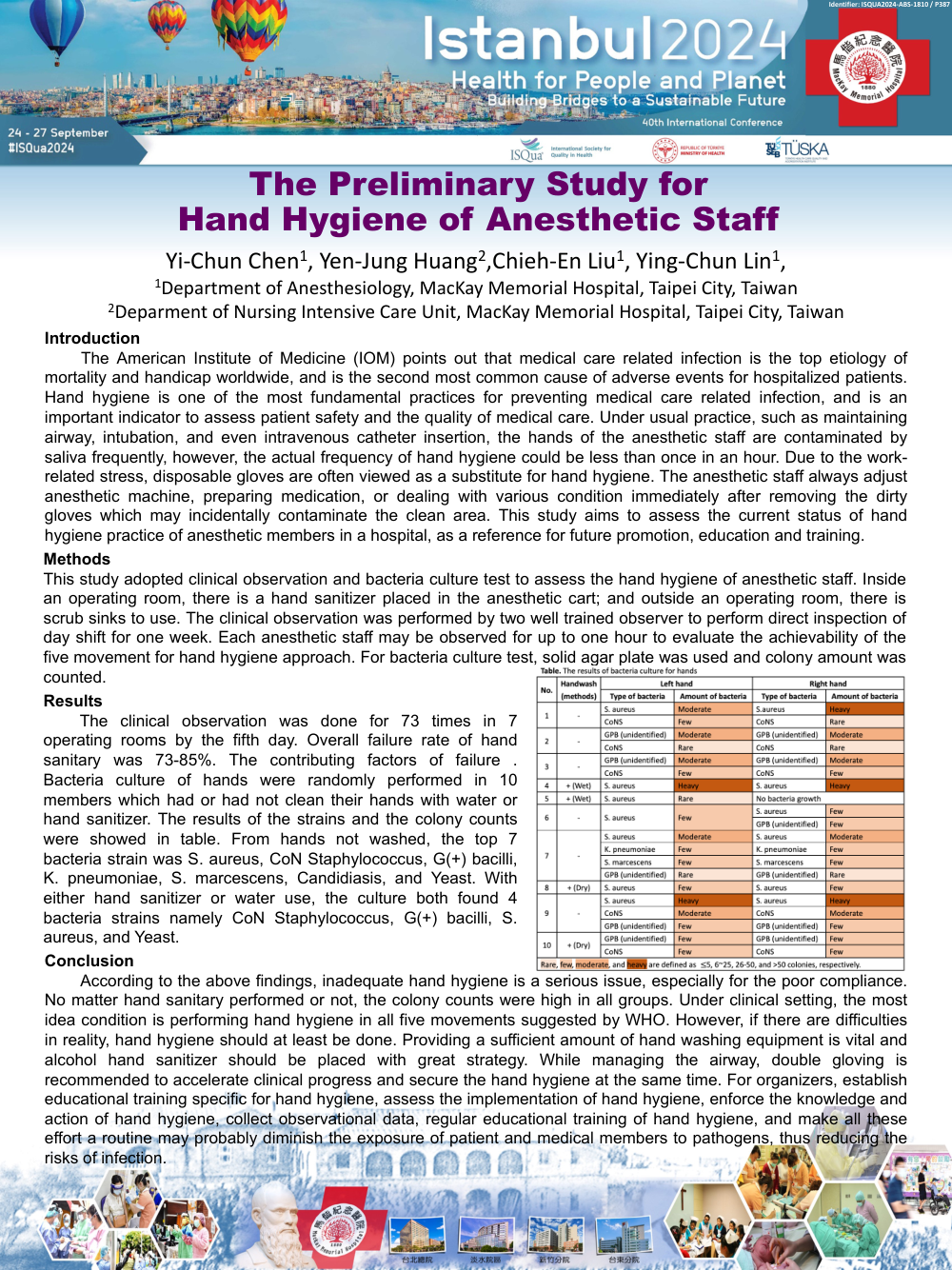
The preliminary study for hand hygiene of anesthetic staff.
Poster Presenter
Part of Topic
Patient Safety & Quality Improvement
Introduction
The American Institute of Medicine (IOM) points out that medical care related infection is the top etiology of mortality and handicap worldwide, and is the second most common cause of adverse events for hospitalized patients. Hand hygiene is one of the most fundamental practices for preventing medical care related infection, and is an important indicator to assess patient safety and the quality of medical care. Under usual practice, such as maintaining airway, intubation, and even intravenous catheter insertion, the hands of the anesthetic staff are contaminated by saliva frequently, however, the actual frequency of hand hygiene could be less than once in an hour. Due to the workrelated stress, disposable gloves are often viewed as a substitute for hand hygiene. The anesthetic staff always adjust anesthetic machine, preparing medication, or dealing with various condition immediately after removing the dirty gloves which may incidentally contaminate the clean area. This study aims to assess the current status of hand hygiene practice of anesthetic members in a hospital, as a reference for future promotion, education and training.
Methods
This study adopted clinical observation and bacteria culture test to assess the hand hygiene of anesthetic staff. Inside an operating room, there is a hand sanitizer placed in the anesthetic cart; and outside an operating room, there is scrub sinks to use. The clinical observation was performed by two well trained observer to perform direct inspection of day shift for one week. Each anesthetic staff may be observed for up to one hour to evaluate the achievability of the five movement for hand hygiene approach. For bacteria culture test, solid agar plate was used and colony amount was counted.
Results
The clinical observation was done for 73 times in 7 operating rooms by the fifth day. Overall failure rate of hand sanitary was 73-85%. The contributing factors of failure. Bacteria culture of hands were randomly performed in 10 members which had or had not clean their hands with water or hand sanitizer. The results of the strains and the colony counts were showed in table. From hands not washed, the top 7 bacteria strain was S. aureus, CoN Staphylococcus, G(+) bacilli, K. pneumoniae, S. marcescens, Candidiasis, and Yeast. With either hand sanitizer or water use, the culture both found 4 bacteria strains namely CoN Staphylococcus, G(+) bacilli, S.aureus, and Yeast.
Conclusion
According to the above findings, inadequate hand hygiene is a serious issue, especially for the poor compliance. No matter hand sanitary performed or not, the colony counts were high in all groups. Under clinical setting, the most idea condition is performing hand hygiene in all five movements suggested by WHO. However, if there are difficulties in reality, hand hygiene should at least be done. Providing a sufficient amount of hand washing equipment is vital and alcohol hand sanitizer should be placed with great strategy. While managing the airway, double gloving is recommended to accelerate clinical progress and secure the hand hygiene at the same time. For organizers, establish educational training specific for hand hygiene, assess the implementation of hand hygiene, enforce the knowledge and action of hand hygiene, collect observational data, regular educational training of hand hygiene, and make all these effort a routine may probably diminish the exposure of patient and medical members to pathogens, thus reducing the
risks of infection.