586 posters, 8 topics, 23 sessions, 1,077 authors, 622 institutions
ePostersLive by SciGen Technologies S.A. All rights reserved.
ISQua's 40th International Conference 2024
24th - 27th September 2024 | Istanbul, Türkiye

P392
Surveillance for implementation of preoperative fasting
Part of Topic
Patient Safety & Quality Improvement
Introduction
Successful operative program relies on optimal patient preparation. Preoperative fasting is one of the most important steps. For more the one century, midnight NPO are a frequent order for preoperative fasting. In 2017, the American Society of Anesthesiologists (ASA) published the latest practical guidelines for preoperative fasting to applicate on healthy patients undergoing elective procedures . The guidelines suggest fasting for 2, 4, and 6 hours for clear liquid, breast milk, and formula milk or light meal. This surveillance aimed to assess the current status of patient fasting, and to evaluate the implementation of preoperative fasting.
Methods
Last August (2019), patients with ASA I or II waiting for elective surgery in preparation area were selected randomly for face-to-face surveillance. The background information collected included age, gender, source of operation (OPD or hospitalization), time of entering the operating room. The knowledge of preoperative fasting, the time of last meal, and the time of last fluid intake were also assessed. The results were imported in google sheet simultaneously during the assessment. The results will be presented with number percentage) and mean (+/- SD).
Results
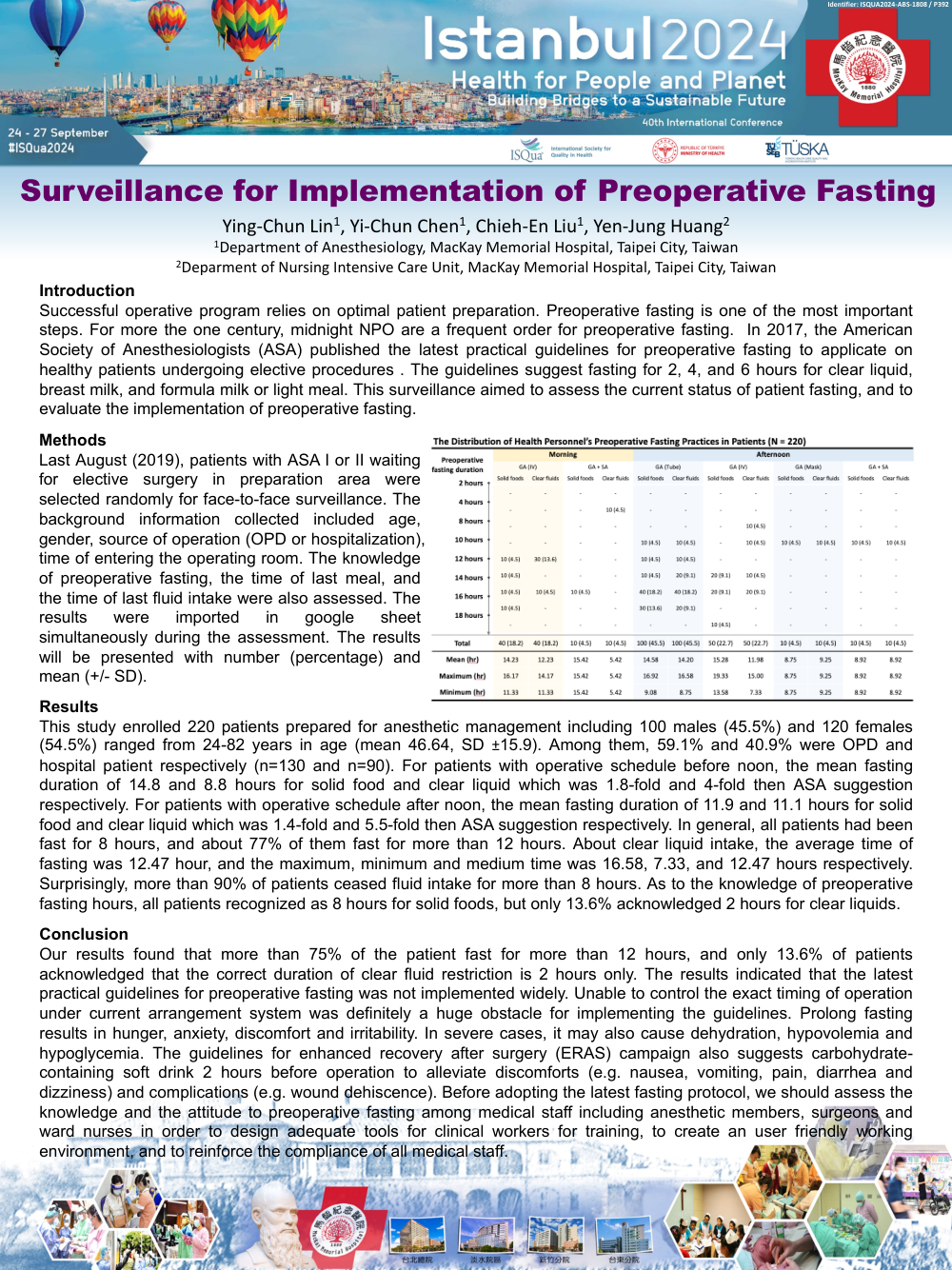
This study enrolled 220 patients prepared for anesthetic management including 100 males (45.5%) and 120 females (54.5%) ranged from 24-82 years in age (mean 46.64, SD ±15.9). Among them, 59.1% and 40.9% were OPD and hospital patient respectively (n=130 and n=90). For patients with operative schedule before noon, the mean fasting duration of 14.8 and 8.8 hours for solid food and clear liquid which was 1.8-fold and 4-fold then ASA suggestion respectively. For patients with operative schedule after noon, the mean fasting duration of 11.9 and 11.1 hours for solid food and clear liquid which was 1.4-fold and 5.5-fold then ASA suggestion respectively. In general, all patients had been fast for 8 hours, and about 77% of them fast for more than 12 hours. About clear liquid intake, the average time of fasting was 12.47 hour, and the maximum, minimum and medium time was 16.58, 7.33, and 12.47 hours respectively. Surprisingly, more than 90% of patients ceased fluid intake for more than 8 hours. As to the knowledge of preoperative fasting hours, all patients recognized as 8 hours for solid foods, but only 13.6% acknowledged 2 hours for clear liquids.
Conclusion
Our results found that more than 75% of the patient fast for more than 12 hours, and only 13.6% of patients acknowledged that the correct duration of clear fluid restriction is 2 hours only. The results indicated that the latest practical guidelines for preoperative fasting was not implemented widely. Unable to control the exact timing of operation under current arrangement system was definitely a huge obstacle for implementing the guidelines. Prolong fasting results in hunger, anxiety, discomfort and irritability. In severe cases, it may also cause dehydration, hypovolemia and hypoglycemia. The guidelines for enhanced recovery after surgery (ERAS) campaign also suggests carbohydratecontaining soft drink 2 hours before operation to alleviate discomforts (e.g. nausea, vomiting, pain, diarrhea and dizziness) and complications (e.g. wound dehiscence). Before adopting the latest fasting protocol, we should assess the knowledge and the attitude to preoperative fasting among medical staff including anesthetic members, surgeons and ward nurses in order to design adequate tools for clinical workers for training, to create an user friendly working environment, and to reinforce the compliance of all medical staff.