586 posters, 8 topics, 23 sessions, 1,077 authors, 622 institutions
ePostersLive by SciGen Technologies S.A. All rights reserved.
ISQua's 40th International Conference 2024
24th - 27th September 2024 | Istanbul, Türkiye

P090
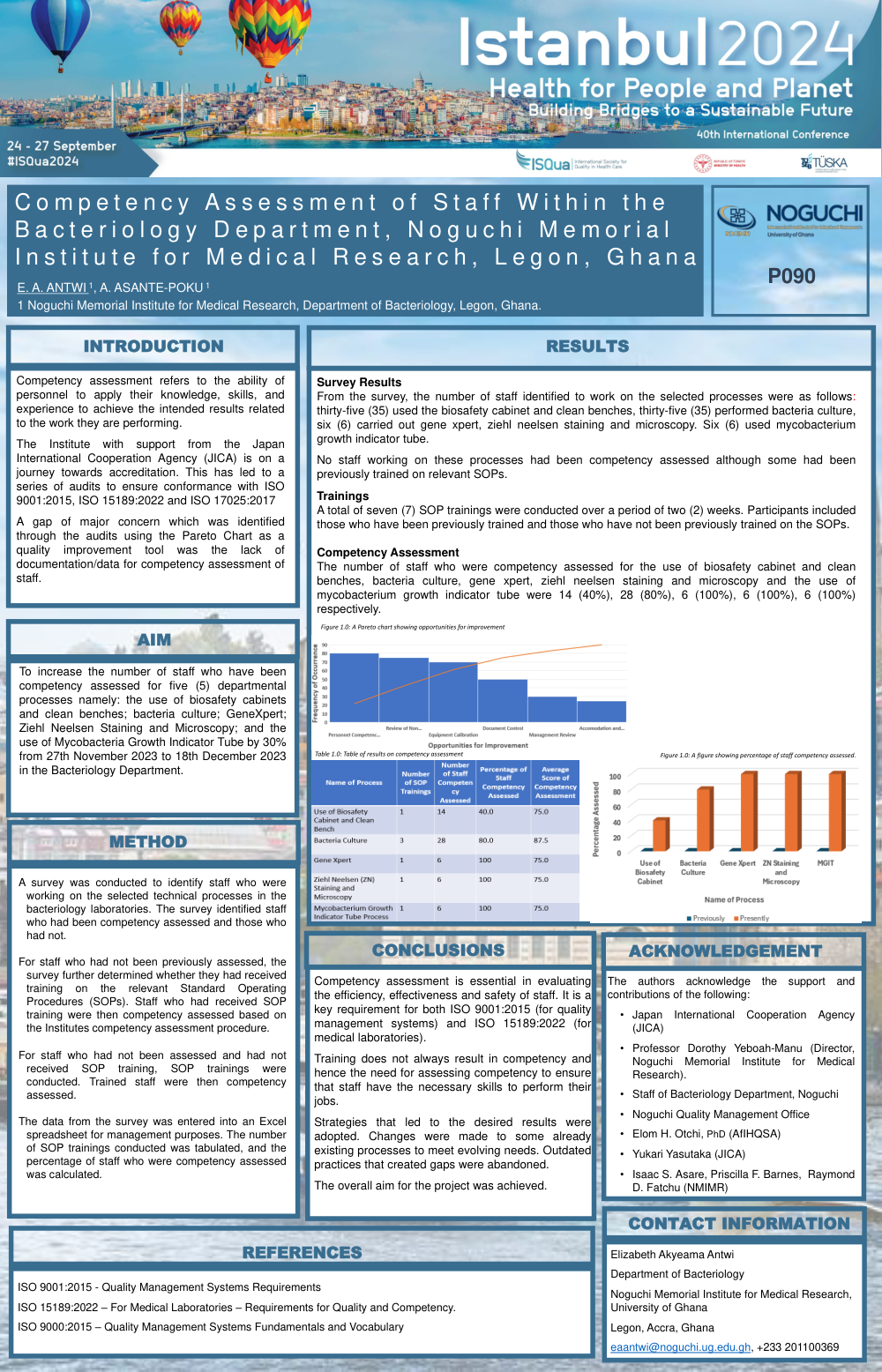
Competency Assessment of Staff Within the Bacteriology Department, Noguchi Memorial Institute for Medical Research, Legon, Ghana.
Poster Presenter
Authors
Affiliations
Part of Topic
Patient Safety & Quality Improvement
Competency Assessment of Staff Within the Bacteriology Department, Noguchi Memorial Institute for Medical Research, Legon, Ghana
Introduction
Competency assessment refers to the ability of personnel to apply their knowledge, skills, and experience to achieve the intended results related to the work they are performing.
The Institute with support from the Japan International Cooperation Agency (JICA) is on a journey towards accreditation. This has led to a series of audits to ensure conformance with ISO 9001:2015, ISO 15189:2022 and ISO 17025:2017
A gap of major concern which was identified through the audits using the Pareto Chart as a quality improvement tool was the lack of documentation/data for competency assessment of staff.
Aim
To increase the number of staff who have been competency assessed for five (5) departmental processes namely: the use of biosafety cabinets and clean benches; bacteria culture; GeneXpert; Ziehl Neelsen Staining and Microscopy; and the use of Mycobacteria Growth Indicator Tube by 30% from 27th November 2023 to 18th December 2023 in the Bacteriology Department.
Method
A survey was conducted to identify staff who were working on the selected technical processes in the bacteriology laboratories. The survey identified staff who had been competency assessed and those who had not.
For staff who had not been previously assessed, the survey further determined whether they had received training on the relevant Standard Operating Procedures (SOPs). Staff who had received SOP training were then competency assessed based on the Institutes competency assessment procedure.
For staff who had not been assessed and had not received SOP training, SOP trainings were conducted. Trained staff were then competency assessed.
The data from the survey was entered into an Excel spreadsheet for management purposes. The number of SOP trainings conducted was tabulated, and the percentage of staff who were competency assessed was calculated.
Results
Survey Results
From the survey, the number of staff identified to work on the selected processes were as follows: thirty-five (35) used the biosafety cabinet and clean benches, thirty-five (35) performed bacteria culture, six (6) carried out gene xpert, ziehl neelsen staining and microscopy. Six (6) used mycobacterium growth indicator tube.
No staff working on these processes had been competency assessed although some had been previously trained on relevant SOPs.
Trainings
A total of seven (7) SOP trainings were conducted over a period of two (2) weeks. Participants included those who have been previously trained and those who have not been previously trained on the SOPs.
Competency Assessment
The number of staff who were competency assessed for the use of biosafety cabinet and clean benches, bacteria culture, gene xpert, ziehl neelsen staining and microscopy and the use of mycobacterium growth indicator tube were 14 (40%), 28 (80%), 6 (100%), 6 (100%), 6 (100%) respectively.
Conclusion
Competency assessment is essential in evaluating the efficiency, effectiveness and safety of staff. It is a key requirement for both ISO 9001:2015 (for quality management systems) and ISO 15189:2022 (for medical laboratories).
Training does not always result in competency and hence the need for assessing competency to ensure that staff have the necessary skills to perform their jobs.
Strategies that led to the desired results were adopted. Changes were made to some already existing processes to meet evolving needs. Outdated practices that created gaps were abandoned.
The overall aim for the project was achieved.
Acknowledgement
The authors acknowledge the support and contributions of the following:
ISO 9001:2015 - Quality Management Systems Requirements
ISO 15189:2022 – For Medical Laboratories – Requirements for Quality and Competency.
ISO 9000:2015 – Quality Management Systems Fundamentals and Vocabulary
Contact Information
Elizabeth Akyeama Antwi
Department of Bacteriology
Noguchi Memorial Institute for Medical Research, University of Ghana
Legon, Accra, Ghana
eaantwi@noguchi.ug.edu.gh, +233 201100369