586 posters, 8 topics, 23 sessions, 1,077 authors, 622 institutions
ePostersLive by SciGen Technologies S.A. All rights reserved.
ISQua's 40th International Conference 2024
24th - 27th September 2024 | Istanbul, Türkiye

P048
An Interventional Research of working environment of anesthesia workers.
Poster Presenter
Part of Topic
Patient Safety & Quality Improvement
Introduction
The slogan of World Alliance for Patient Safety, launched by the World Health Organization (WHO) in Oct. 2004, is “Clean Care is Safer Care”. The aims of this study are (1) to investigate the common strains in the anaesthetic work environment and (2) to compare the effect of two disinfectant wipes.
Methods
This study adopted pre-test and post-test to evaluate the effect of environmental hygiene before and after an intervention. First, we use ATP bioluminescence assay to examine the most commonly contacted anaesthesia-related area . Then we use agar plate to culture strains from area with high ATP level. Exams are performed by single personnel before the first case entering the operating room. All operating rooms being cleaned daily at definite timing are included, and those being cleaned weekly are excluded. After establishing the standard operation procedure of cleaning, we compare the effect of two disinfectant wipes with different disinfectant.
Results
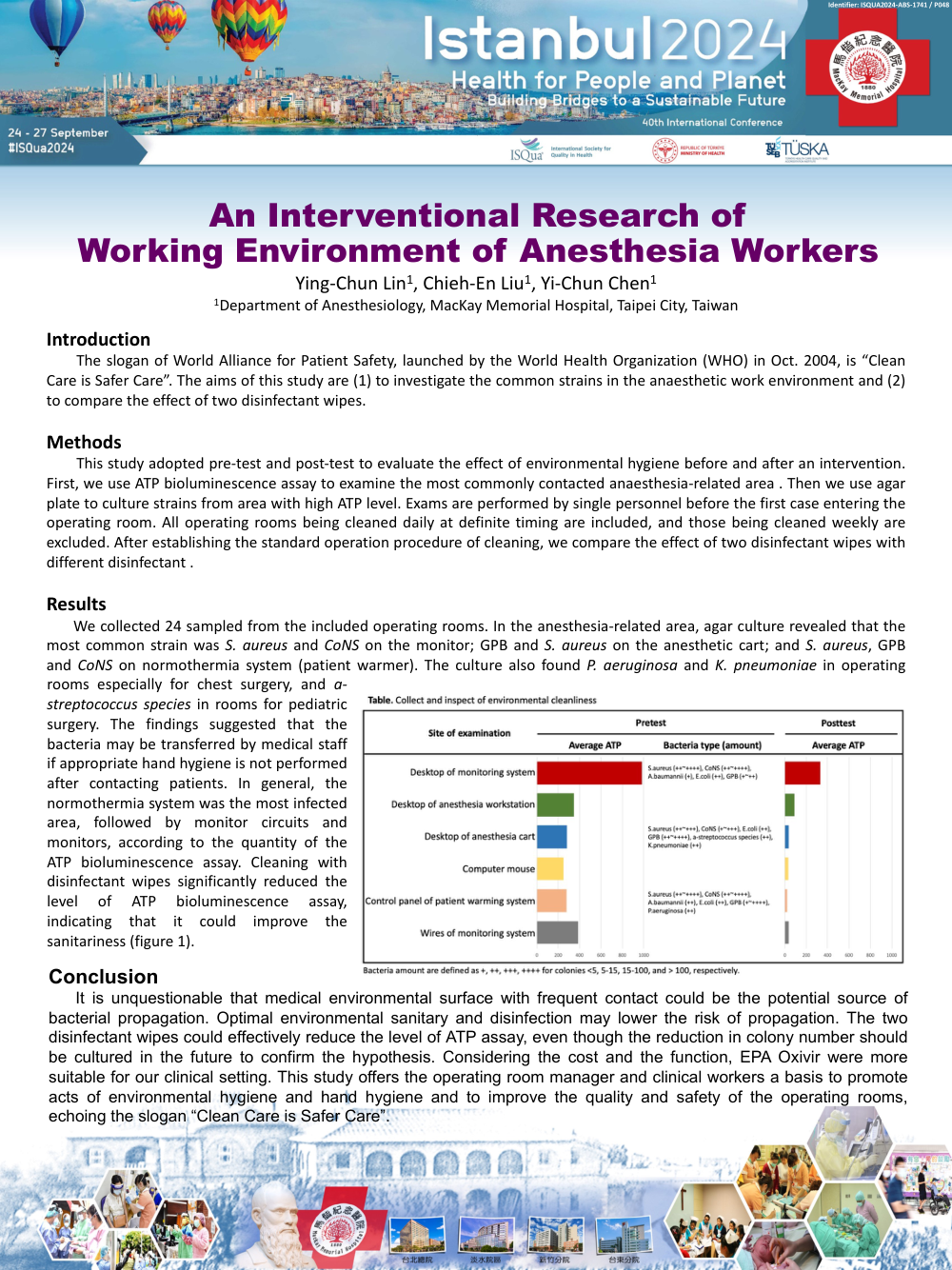
We collected 24 sampled from the included operating rooms. In the anesthesia-related area, agar culture revealed that the most common strain was S. aureus and CoNS on the monitor; GPB and S. aureus on the anesthetic cart; and S. aureus, GPB and CoNS on normothermia system (patient warmer). The culture also found P. aeruginosa and K. pneumoniae in operating rooms especially for chest surgery, and a streptococcus species in rooms for pediatric surgery. The findings suggested that the bacteria may be ransferred by medical staff if appropriate hand hygiene is not performed after contacting patients. In general, the normothermia system was the most infected area, followed by monitor circuits and monitors, according to the quantity of the ATP bioluminescence assay. Cleaning with disinfectant wipes significantly reduced the level of ATP bioluminescence assay, indicating that it could improve the sanitariness (figure 1).
Conclusion
It is unquestionable that medical environmental surface with frequent contact could be the potential source of bacterial propagation. Optimal environmental sanitary and disinfection may lower the risk of propagation. The two disinfectant wipes could effectively reduce the level of ATP assay, even though the reduction in colony number should be cultured in the future to confirm the hypothesis. Considering the cost and the function, EPA Oxivir were more suitable for our clinical setting. This study offers the operating room manager and clinical workers a basis to promote acts of environmental hygiene and hand hygiene and to improve the quality and safety of the operating rooms, echoing the slogan “Clean Care is Safer Care”.