586 posters, 8 topics, 23 sessions, 1,077 authors, 622 institutions
ePostersLive by SciGen Technologies S.A. All rights reserved.
ISQua's 40th International Conference 2024
24th - 27th September 2024 | Istanbul, Türkiye

P506
Stress Management in the Nursing Staff at Children's Hospitals
Poster Presenter
Authors
Affiliations
Part of Topic
Integrated Care Communities
Stress Management in the Nursing Staff at Children’s Hospital
What is important in nursing for pediatric patients is to give personal care to individual pediatric patients according to their developmental stages and target their parents and families as well as to deal with diseases. It is known that these characteristics of pediatric patient nursing make pediatric nurses experience greater job stress than those in adult wards.
Serious stress can not only make people hardly adapt themselves to hospitals but also result in undesirable outcome; therefore, it is essential for healthcare providers working close to patients to manage stress positively.
The Stress Management Team for the Nursing Staff at Children's Hospitals tries to diagnose job stress in the nursing staff at children's hospitals, reduce their stress and improve their resilience by running a stress management program based on their needs, and reduce their leaving hospital and create a safe hospital environment.
This activity has been performed for a year since January 2019; before and after the activity, surveys on the nursing staff's stress status at children's hospitals were conducted to compare the scores for self-measurement of stress(perceived stress scale) and resilience and analyze the effectiveness of the activity.
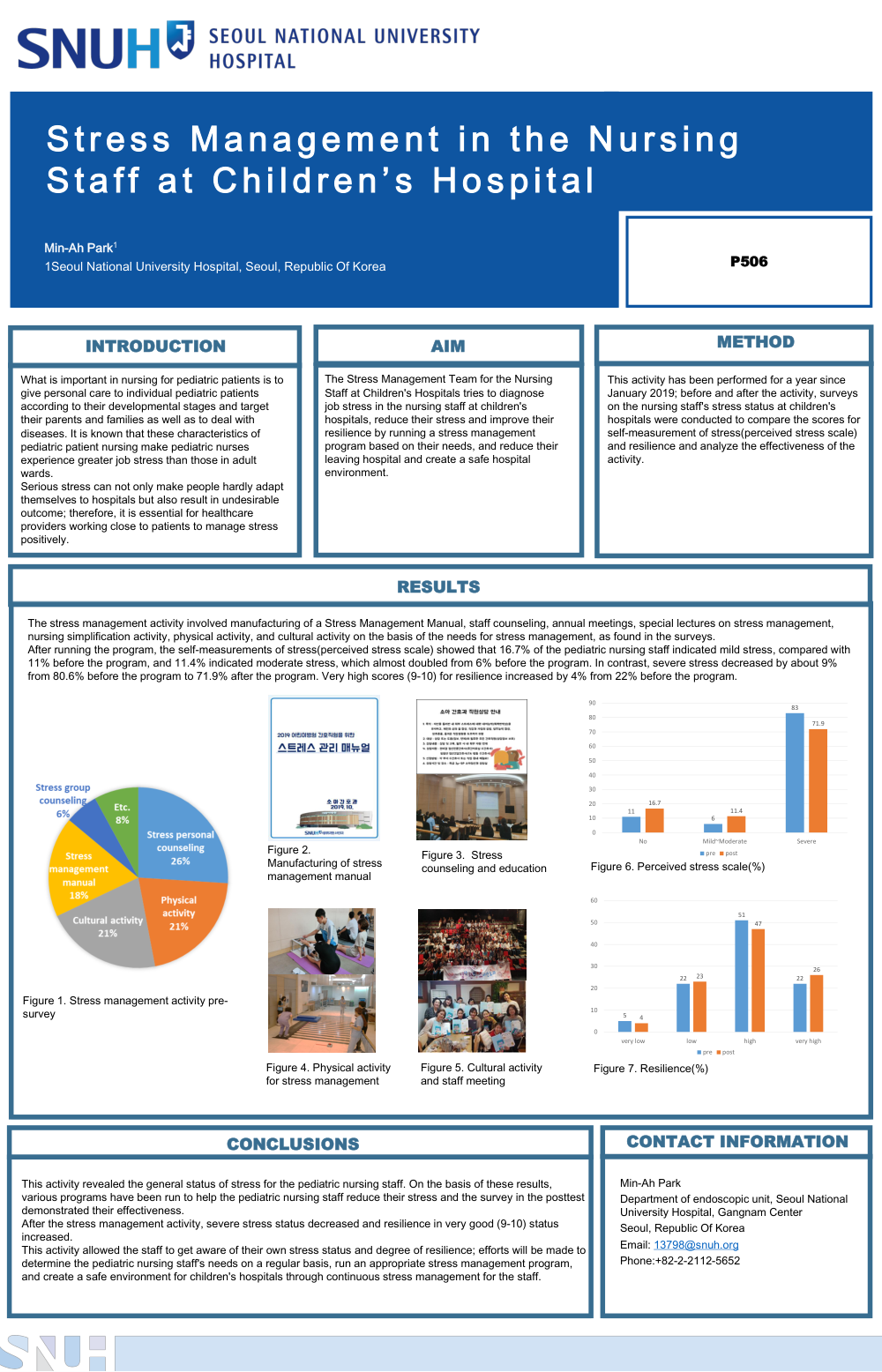
The stress management activity involved manufacturing of a Stress Management Manual, staff counseling, annual meetings, special lectures on stress management, nursing simplification activity, physical activity, and cultural activity on the basis of the needs for stress management, as found in the surveys.
After running the program, the self-measurements of stress(perceived stress scale) showed that 16.7% of the pediatric nursing staff indicated mild stress, compared with 11% before the program, and 11.4% indicated moderate stress, which almost doubled from 6% before the program. In contrast, severe stress decreased by about 9% from 80.6% before the program to 71.9% after the program. Very high scores (9-10) for resilience increased by 4% from 22% before the program.
This activity revealed the general status of stress for the pediatric nursing staff. On the basis of these results, various programs have been run to help the pediatric nursing staff reduce their stress and the survey in the posttest demonstrated their effectiveness.
After the stress management activity, severe stress status decreased and resilience in very good (9-10) status increased.
This activity allowed the staff to get aware of their own stress status and degree of resilience; efforts will be made to determine the pediatric nursing staff's needs on a regular basis, run an appropriate stress management program, and create a safe environment for children's hospitals through continuous stress management for the staff.