586 posters, 8 topics, 23 sessions, 1,077 authors, 622 institutions
ePostersLive by SciGen Technologies S.A. All rights reserved.
ISQua's 40th International Conference 2024
24th - 27th September 2024 | Istanbul, Türkiye

P164
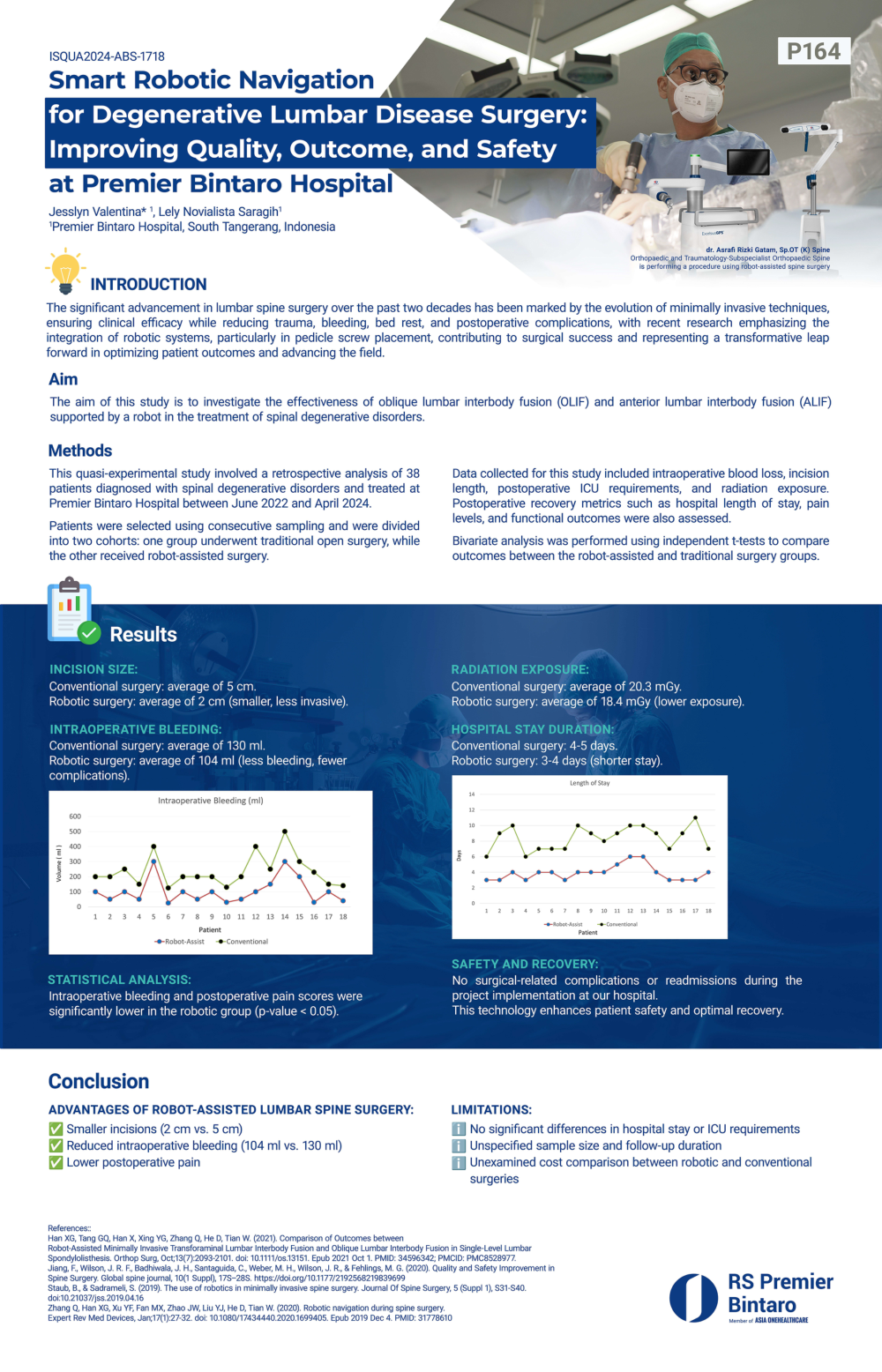
Smart Robotic Navigation for Degenerative Lumbar Disease Surgery: Improving Quality, Outcome, and Safety at Premier Bintaro Hospital
Poster Presenter
Part of Topic
Patient Safety & Quality Improvement
ISQua 2024 Abstract Submission
Patient Safety & Quality Improvement
ISQUA2024-ABS-1718
Smart Robotic Navigation for Degenerative Lumbar Disease Surgery: Improving Quality, Outcome, and Safety at Premier Bintaro Hospital
Jesslyn Valentina 1, Lely Novialista Saragih*1
1Premier Bintaro Hospital, South Tangerang, Indonesia
Introduction: The significant advancement in lumbar spine surgery over the past two decades has been marked by the
evolution of minimally invasive techniques, ensuring clinical efficacy while reducing trauma, bleeding, bed rest, and postoperative complications, with recent research emphasizing the integration of robotic systems, particularly in pedicle screw placement, contributing to surgical success and representing a transformative leap forward in optimizing patient outcomes and advancing the field.
Aim : This study aims to investigate the effectiveness of oblique lumbar interbody fusion (OLIF) and anterior lumbar interbody fusion (ALIF) supported by a robot in treating spinal degenerative disorders.
Methods: This quasi-experimental study involved a retrospective analysis of 38 patients diagnosed with spinal degenerative disorders and treated at Premier Bintaro Hospital between June 2022 and April 2024. Patients were selected using consecutive sampling and were divided into two cohorts: one group underwent traditional open surgery, while the other received robot-assisted surgery. Data collected for this study included intraoperative blood loss, incision length, postoperative ICU requirements, and radiation exposure. Postoperative recovery metrics such as hospital length of stay, pain levels, and functional outcomes were also assessed. Bivariate analysis was performed using independent t-tests to compare outcomes between the robot-assisted and traditional surgery groups.
Results: Concerning incision size, conventional surgery typically involves an average measurement of 5 cm, while robotic surgery achieves a smaller incision at 2 cm, suggesting the potential for less invasive procedures with the robotic approach. Regarding intraoperative bleeding, robotic surgery demonstrates a significant reduction, with an average bleeding amount of 104 ml compared to 130 ml in conventional procedures, indicating potential advantages in blood loss and minimizing complications related to excessive bleeding. The duration of hospital stay varies, with the robotic group averaging 3-4 days and the conventional group ranging from 4-5 days. Analysis of radiation dose data reveals differences between the two approaches, as robotic procedures exhibit a lower average radiation dose (18.4 mGy) than conventional ones (20.3 mGy), suggesting that robotic surgery may reduce radiation exposure. Bivariate analysis using independent t-tests showed statistically significant differences between the robot-assisted and conventional surgery groups. Specifically, the average intraoperative bleeding was significantly lower in the robotic group (p-value < 0.05), and postoperative pain scores were also significantly lower in the robotic group (p-value < 0.05). Throughout the implementation of this project in our hospital, no surgical-related complications or readmissions occurred, highlighting that this new technology introduces critical elements for patient safety and optimal recovery.
Conclusion :
Advantages of Robot-Assisted Lumbar Spine Surgery:
* Smaller incisions (2 cm vs. 5 cm)
* Reduced intraoperative bleeding (104 ml vs. 130 ml)
* Lower postoperative pain
Limitations:
* No significant differences in hospital stay or ICU requirements
* Unspecified sample size and follow-up duration
* Unexamined cost comparison between robotic and conventional surgeries