586 posters, 8 topics, 23 sessions, 1,077 authors, 622 institutions
ePostersLive by SciGen Technologies S.A. All rights reserved.
ISQua's 40th International Conference 2024
24th - 27th September 2024 | Istanbul, Türkiye

P093
A Retrospective Audit of Baseline Measurements used and Ratings Applied to Audits Completed in 2022 in a Dublin Teaching Hospital
Poster Presenter
Authors
Part of Topic
Patient Safety & Quality Improvement
A Retrospective Audit of Baseline Measurements Used and Ratings Applied to Audits Completed in 2022 in a Dublin Teaching Hospital
Emily M. Carey, Ian Callanan St Vincent’s University Hospital, Elm Park, Dublin 04, Ireland
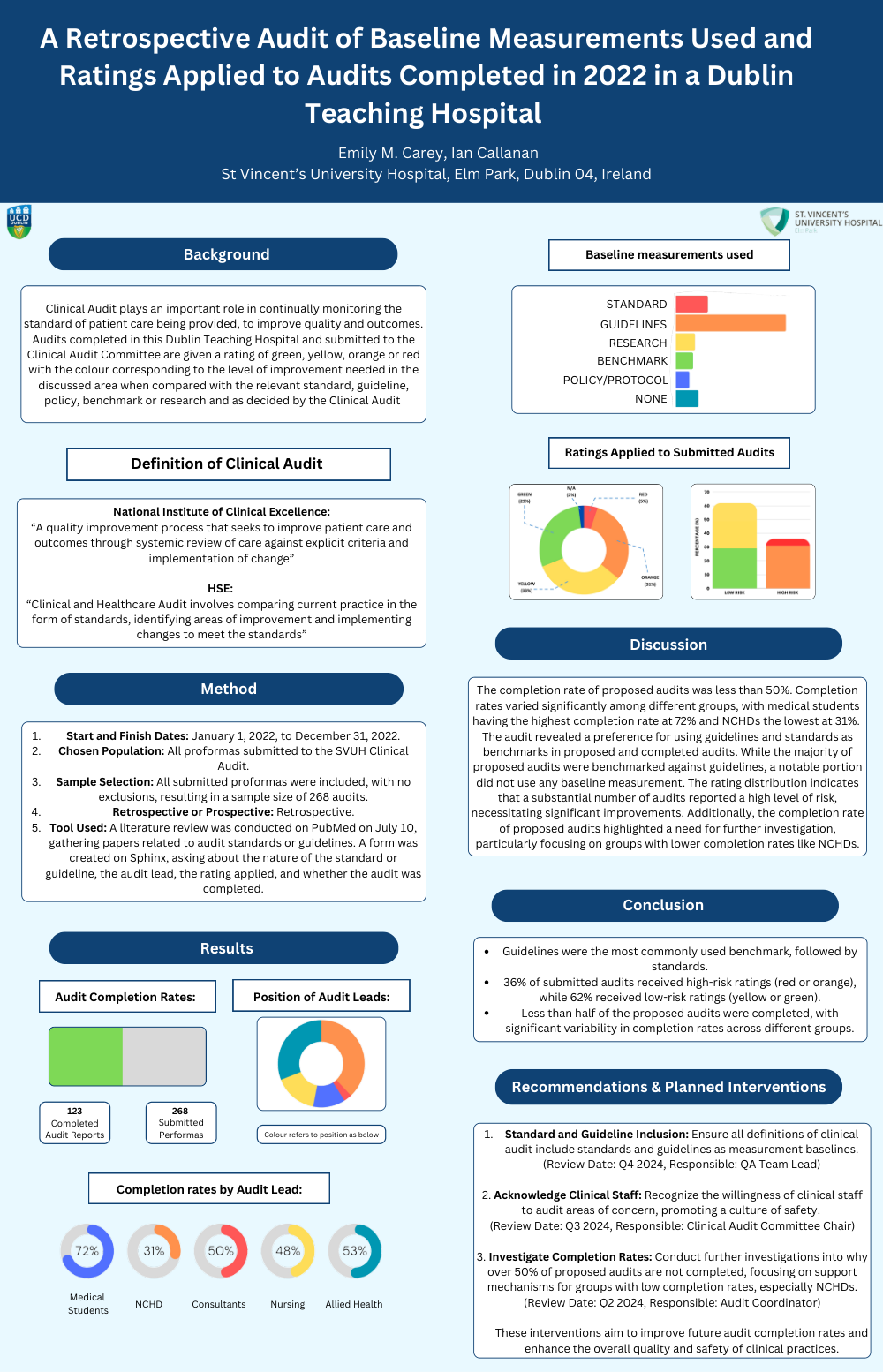
Clinical Audit plays an important role in continually monitoring the standard of patient care being provided, to improve quality and outcomes. Audits completed in this Dublin Teaching Hospital and submitted to the Clinical Audit Committee are given a rating of green, yellow, orange or red with the colour corresponding to the level of improvement needed in the discussed area when compared with the relevant standard, guideline, policy, benchmark or research and as decided by the Clinical Audit
Definition of Clinical Audit
National Institute of Clinical Excellence: “A quality improvement process that seeks to improve patient care and outcomes through systemic review of care against explicit criteria and implementation of change” HSE: “Clinical and Healthcare Audit involves comparing current practice in the form of standards, identifying areas of improvement and implementing changes to meet the standards”
Method
Start and Finish Dates: January 1, 2022, to December 31, 2022. Chosen Population: All proformas submitted to the SVUH Clinical Audit. Sample Selection: All submitted proformas were included, with no exclusions, resulting in a sample size of 268 audits. Retrospective or Prospective: Retrospective. Tool Used: A literature review was conducted on PubMed on July 10, gathering papers related to audit standards or guidelines. A form was created on Sphinx, asking about the nature of the standard or guideline, the audit lead, the rating applied, and whether the audit was completed.
Discussion
The completion rate of proposed audits was less than 50%. Completion rates varied significantly among different groups, with medical students having the highest completion rate at 72% and NCHDs the lowest at 31%. The audit revealed a preference for using guidelines and standards as benchmarks in proposed and completed audits. While the majority of proposed audits were benchmarked against guidelines, a notable portion did not use any baseline measurement. The rating distribution indicates that a substantial number of audits reported a high level of risk, necessitating significant improvements. Additionally, the completion rate of proposed audits highlighted a need for further investigation, particularly focusing on groups with lower completion rates like NCHDs.