586 posters, 8 topics, 23 sessions, 1,077 authors, 622 institutions
ePostersLive by SciGen Technologies S.A. All rights reserved.
ISQua's 40th International Conference 2024
24th - 27th September 2024 | Istanbul, Türkiye

P230
Mentored Groups to Improve Outcomes of Fluid Management in Hemodialysis Patients: A Patient-Centered Quality Improvement Program
Poster Presenter
Authors
Affiliations
Part of Topic
Patient Safety & Quality Improvement
Mentored Groups to Improve Outcomes of Fluid Management in HemodialysisPatients: A Patient-Centered Quality Improvement Program
M.Husna1 , U.Khoyrunnisa2, D.Roswiyeni3
1 Primaya Hospital Bekasi Timur, Indonesia
Introduction
Chronic Kidney Disease (CKD) is a prevalent condition leading to high morbidity and mortality rates. In Indonesia, hemodialysis patients increased by 30% from 2015 to 2016, highlighting the need for sustained renal replacement therapy. Adequate hemodialysis improves patient survival and quality of life. CKD patients must adhere to fluid restrictions to achieve a safe dry weight. Non-adherence leads to complications like oedema, hypertension, ventricular hypertrophy, and reduced lifespan. At Primaya Hospital Bekasi Timur, only 70% of hemodialysis patients met the fluid management target of <13ml/kg/hour from January to September 2023, Efforts to improve adherence include education on diet and fluid restrictions, daily weight monitoring, and medical counselling. Despite these efforts, many patients remain non-compliant. An overlooked factor is the need for effective, sustainable education methods that enhance long-term adherence. A more personal and interactive approach to patient education and monitoring is a potential answer.
Aim
To overcome the challenges we describe in Introduction, a patient support group program was developed involving intensive education and continuous monitoring via social media platforms like WhatsApp. In this program, patients receive direct guidance from nurses on fluid restriction and regular condition monitoring. The study aims to improve CKD patient adherence to fluid restrictions through the patient support group program and enhance the fluid management quality indicator of <13ml/kg/hour at PrimayaHospital Bekasi Timur. This program aims to provide patients with a better understanding of the importance of fluid restriction, reducing complications, and improving their quality of life. This study was a quality improvement project in the Hemodialysis Unit at Primaya Hospital Bekasi Timur. The primary objective is to enhance patient perceptions of the importance of controlling fluid intake to meet the fluid management indicator target for HD patients of <13ml/kgBW/hr. This study employs a qualitative case study approach to understand and improve patient perceptions and behaviours regarding fluid control during hemodialysis.
Method
Study Design The research adopts a qualitative approach with a case study design. The study was conducted at the Hemodialysis Unit of PrimayaHospital Bekasi Timur, starting on September 21, 2024. The study population comprised 101 regular hemodialysis patients at the hospital. A sample of 22 patients was selected for the first phase of the study based on predefined inclusion criteria. Data Collection Techniques Data were collected through direct observation, structured interviews, and regular monitoring via WhatsApp groups. Each patient group was guided by a nurse mentor responsible for 3 to 4 patients. Data Collection Procedure Patients meeting the inclusion criteria were identified and included in the mentoring groups. Seven nurses were appointed as mentors to guide seven mentoring groups, each nurse responsible for 3-4 patients. Standard education on fluid restrictions and individual targets was provided to patients. Monitoring was conducted via WhatsApp groups twice daily (morning and evening). Ultrafiltration rate (UFR) and Kt/V values were monitored at each routine dialysis session. Monthly evaluations were performed to monitor the achievement of fluid management indicators <13ml/kgBW/hr for mentored patients.
Results
Qualitative data analysis was conducted to identify changes in patient perceptions and behaviours regarding fluid management. Clinical outcomes such as UFR and Kt/V values were also analyzed to evaluate the effectiveness of the mentoring program. This research method is designed to provide an in-depth understanding of the effectiveness of the patient mentoring program in improving adherence to fluid restrictions. The personal and interactive approach of the program is expected to contribute significantly to the fluid management of CKD patients undergoing hemodialysis.
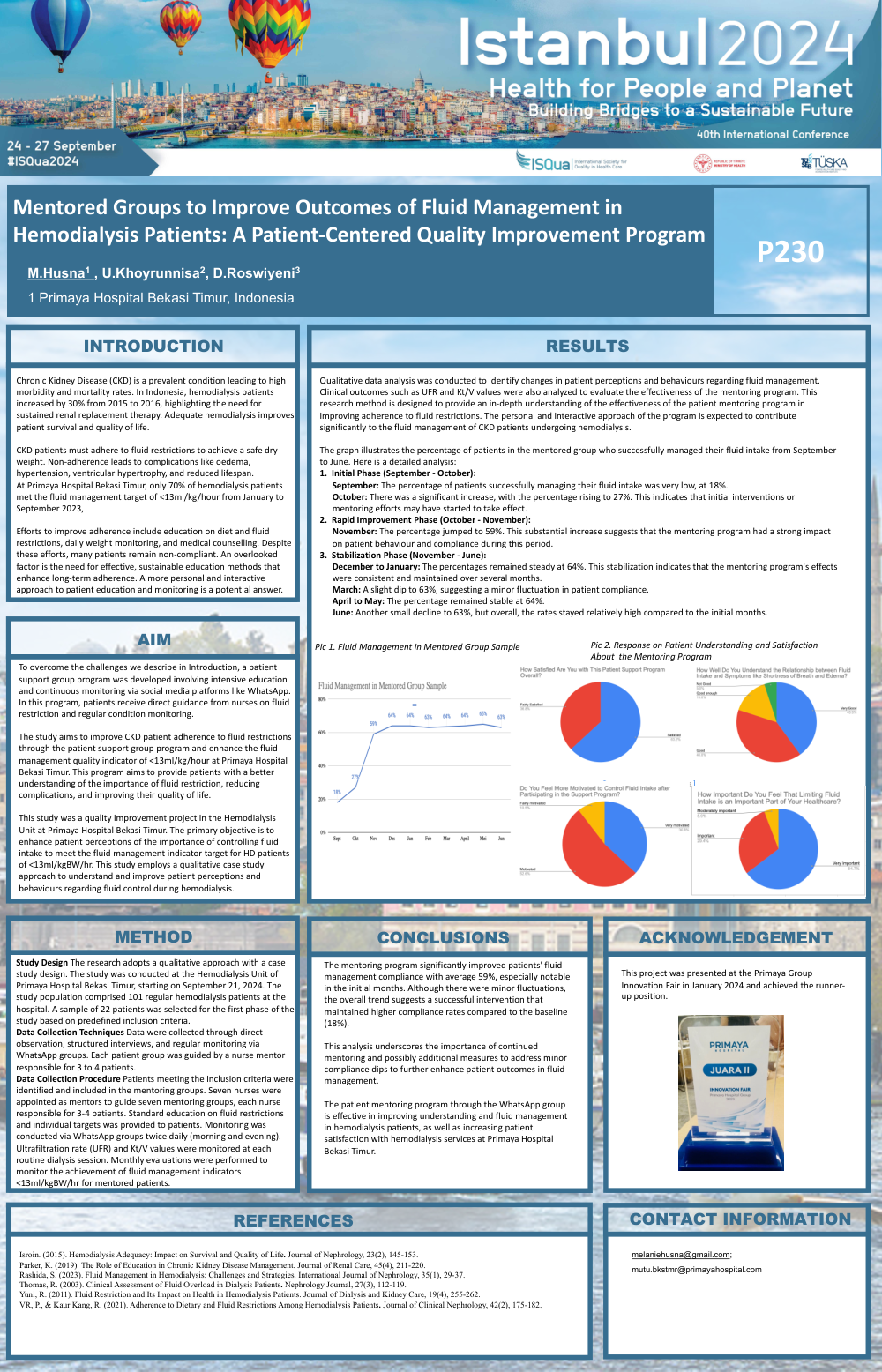
The graph illustrates the percentage of patients in the mentored group who successfully managed their fluid intake from September to June. Here is a detailed analysis:
September: The percentage of patients successfully managing their fluid intake was very low, at 18%.
October: There was a significant increase, with the percentage rising to 27%. This indicates that initial interventions or mentoring efforts may have started to take effect.
November: The percentage jumped to 59%. This substantial increase suggests that the mentoring program had a strong impact on patient behaviour and compliance during this period.
December to January: The percentages remained steady at 64%. This stabilization indicates that the mentoring program's effects were consistent and maintained over several months.
March: A slight dip to 63%, suggesting a minor fluctuation in patient compliance.
April to May: The percentage remained stable at 64%.
June: Another small decline to 63%, but overall, the rates stayed relatively high compared to the initial months.
Conclusion
The mentoring program significantly improved patients' fluid management compliance with average 59%, especially notable in the initial months. Although there were minor fluctuations, the overall trend suggests a successful intervention that maintained higher compliance rates compared to the baseline (18%). This analysis underscores the importance of continued mentoring and possibly additional measures to address minor compliance dips to further enhance patient outcomes in fluid management. The patient mentoring program through the WhatsApp group is effective in improving understanding and fluid management in hemodialysis patients, as well as increasing patient satisfaction with hemodialysis services at PrimayaHospital Bekasi Timur.
References
Isroin. (2015). Hemodialysis Adequacy: Impact on Survival and Quality of Life. Journal of Nephrology, 23(2), 145-153.
Parker, K. (2019). The Role of Education in Chronic Kidney Disease Management. Journal of Renal Care, 45(4), 211-220.
Rashida, S. (2023). Fluid Management in Hemodialysis: Challenges and Strategies. International Journal of Nephrology, 35(1), 29-37.
Thomas, R. (2003). Clinical Assessment of Fluid Overload in Dialysis Patients. Nephrology Journal, 27(3), 112-119.
Yuni, R. (2011). Fluid Restriction and Its Impact on Health in Hemodialysis Patients. Journal of Dialysis and Kidney Care, 19(4), 255-262.
VR, P., & Kaur Kang, R. (2021). Adherence to Dietary and Fluid Restrictions Among Hemodialysis Patients. Journal of Clinical Nephrology, 42(2), 175-182