586 posters, 8 topics, 23 sessions, 1,077 authors, 622 institutions
ePostersLive by SciGen Technologies S.A. All rights reserved.
ISQua's 40th International Conference 2024
24th - 27th September 2024 | Istanbul, Türkiye

P276
Real-Time Intelligence-Driven Medical Decision Making: Application of a Critical Alert System in Clinical Care
Poster Presenter
Part of Topic
Patient Safety & Quality Improvement
Title:
Real-Time Intelligence-Driven Medical Decision Making:
Application of a Critical Alert System in Clinical Care
Introduction:
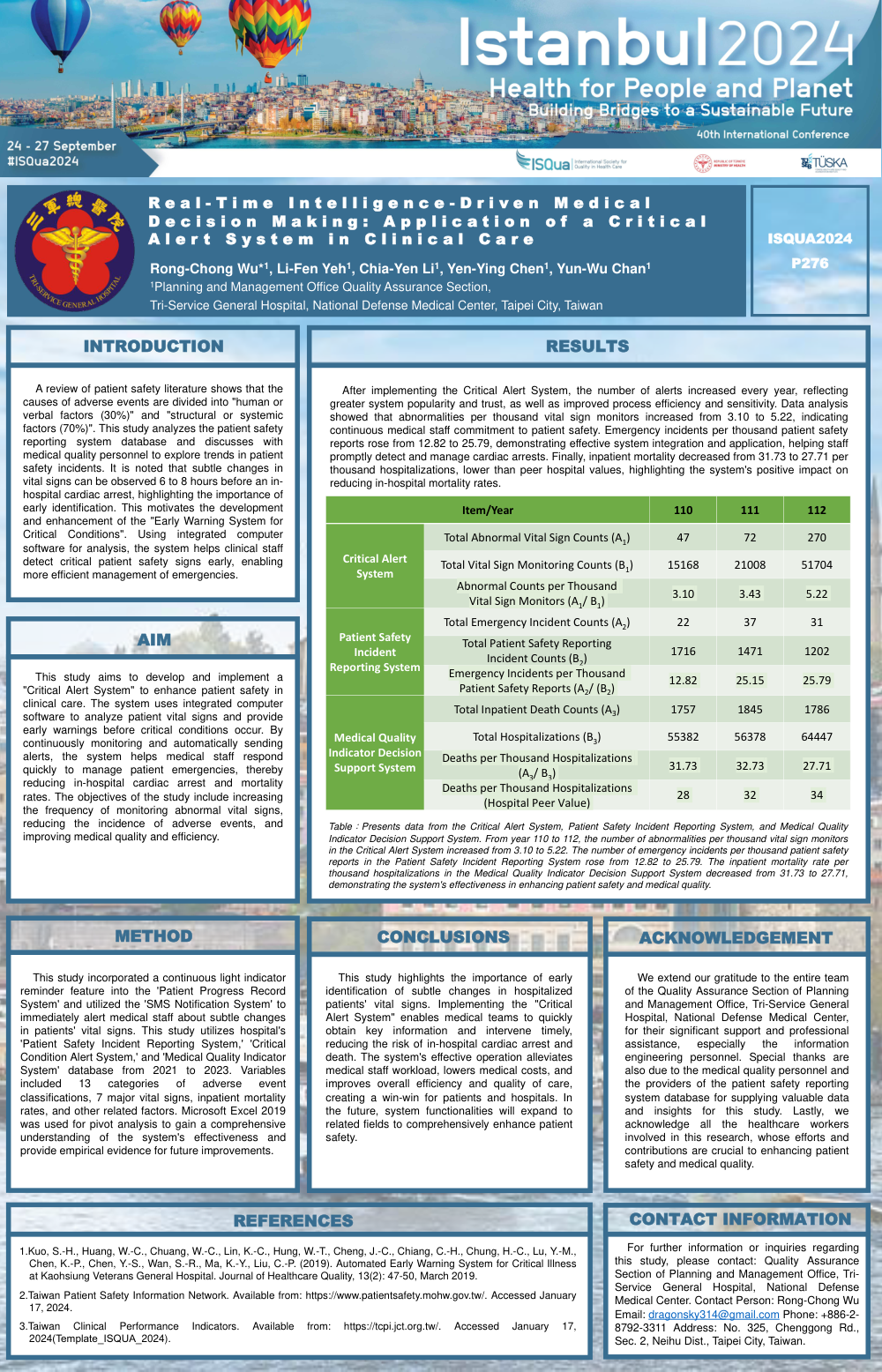
A review of patient safety literature, both domestically and internationally, shows that the causes of adverse events are divided into "human or verbal (accounting for 30%)" and "structural or systemic (accounting for 70%)", reflecting the complex etiology behind individual cases. By analyzing the patient safety reporting system database and conducting discussions with medical quality personnel, the study deeply explores the concentrated trends in patient safety incidents. It is noted that in cases of unexpected in-hospital cardiac arrest, subtle changes in vital signs can be observed 6 to 8 hours before the arrest, underscoring the importance of early identification of these changes. This also provides motivation for further development and enhancement of the "Early Warning System for Critical Conditions". Utilizing integrated computer software for computation and analysis, this system aids clinical staff in early detection of critical patient safety signs, enabling more efficient management of emergency situations.
Method:
With the professional assistance of information engineering personnel, a continuous light indicator reminder feature was incorporated into the 'Patient Progress Record System'. Additionally, the 'SMS Notification System' was utilized to immediately alert medical staff about subtle changes in the physiological signs of critical patients. This paper extracts data files from the 'Patient Safety Incident Reporting System, Critical Condition Alert System, and Medical Quality Indicator System' of the study hospital for the years 110 to 112. The variables include 13 categories of adverse event classifications, 7 major vital signs, inpatient mortality rates, and other related factors. Analysis was conducted using Microsoft Excel 2019 for pivot analysis, to facilitate a comprehensive understanding of the system's operation and effectiveness, and to provide an empirical basis for future improvements.
Results:
After the implementation of the Critical Alert System, there was a year-on-year increase in the number of alerts, reflecting a rise in the system's popularity and trust, as well as an enhancement in process efficiency and sensitivity. Data analysis showed that the number of abnormalities per thousand vital sign monitors increased from 3.10 to 5.22, indicating the medical staff's ongoing commitment to patient safety and the intensified frequency of monitoring vital signs in general patients, effectively identifying and managing potential critical conditions. Subsequently, the number of emergency incidents per thousand patient safety reports rose from 12.82 to 25.79, demonstrating the effective integration and application of these systems, which helped medical staff to detect and promptly interrupt the progression of unexpected cardiac arrests. Finally, analysis of the 'Medical Quality Indicator Decision Support System' data showed a decrease in the number of deaths per thousand hospitalizations from 31.73 to 27.71, lower than the peer values of other hospitals. This trend reflects the progress made by the study hospital in enhancing patient safety and medical quality, highlighting the system's positive impact on reducing in-hospital mortality rates.
Conclusion:
This study highlights the importance of early identification of subtle changes in the vital signs of hospitalized patients. Through the implementation of the Early Warning System for Critical Conditions, medical teams can timely receive crucial information about changes in disease states, allowing for rapid assessment and intervention. Early recognition and immediate response contribute to reducing the incidence of in-hospital cardiac arrests, thus decreasing the risk of death or patients becoming comatose. Moreover, an efficiently operating system not only alleviates the workload of the medical staff but also helps in reducing medical costs associated with long-term reliance on ventilators and tracheostomy care. It also enhances the overall operational efficiency and medical quality of the institution, creating a win-win situation for patients, medical staff, and hospitals. In the future, there will be a continued expansion of the system's functionalities and application to adjacent fields to comprehensively improve the safety of hospital inpatients.
Acknowledgement:
We extend our gratitude to the entire team of the Quality Assurance Section of Planning and Management Office, Tri-Service General Hospital, National Defense Medical Center, for their significant support and professional assistance, especially the information engineering personnel. Special thanks are also due to the medical quality personnel and the providers of the patient safety reporting system database for supplying valuable data and insights for this study. Lastly, we acknowledge all the healthcare workers involved in this research, whose efforts and contributions are crucial to enhancing patient safety and medical quality.
References:
1.Kuo, S.-H., Huang, W.-C., Chuang, W.-C., Lin, K.-C., Hung, W.-T., Cheng, J.-C., Chiang, C.-H., Chung, H.-C., Lu, Y.-M., Chen, K.-P., Chen, Y.-S., Wan, S.-R., Ma, K.-Y., Liu, C.-P. (2019). Automated Early Warning System for Critical Illness at Kaohsiung Veterans General Hospital. Journal of Healthcare Quality, 13(2): 47-50, March 2019.
2.Taiwan Patient Safety Information Network. Available from: https://www.patientsafety.mohw.gov.tw/. Accessed January 17, 2024.
3.Taiwan Clinical Performance Indicators. Available from: https://tcpi.jct.org.tw/. Accessed January 17, 2024..