586 posters, 8 topics, 23 sessions, 1,077 authors, 622 institutions
ePostersLive by SciGen Technologies S.A. All rights reserved.
ISQua's 40th International Conference 2024
24th - 27th September 2024 | Istanbul, Türkiye

P399
Effect of early rehabilitation after transaxillary robot-assisted thyroidectomy in patients with thyroid cancer
Poster Presenter
Authors
Jinyoung Park, Yongjin Ahn, Hyeok Jun Yun, Yong Sang Lee, Jae Chul Kim, Gyu Wan Lee, Kyu Wan Kwak, Jin Seok Lee, Jun Sung Lee, Yoon Ghil Park
Affiliations
Department of Rehabilitation Medicine, Gangnam Severance Hospital, Yonsei University College of Medicine, Seoul, Republic of Korea, Thyroid Cancer Center, Department of Surgery, Institute of Refractory Thyroid Cancer, Gangnam Severance Hospital, Yonsei University College of Medicine, Seoul, Republic of Korea
Part of Topic
Patient Safety & Quality Improvement
Effect of early rehabilitation after transaxillary robot-assisted thyroidectomy in patients with thyroid cancer
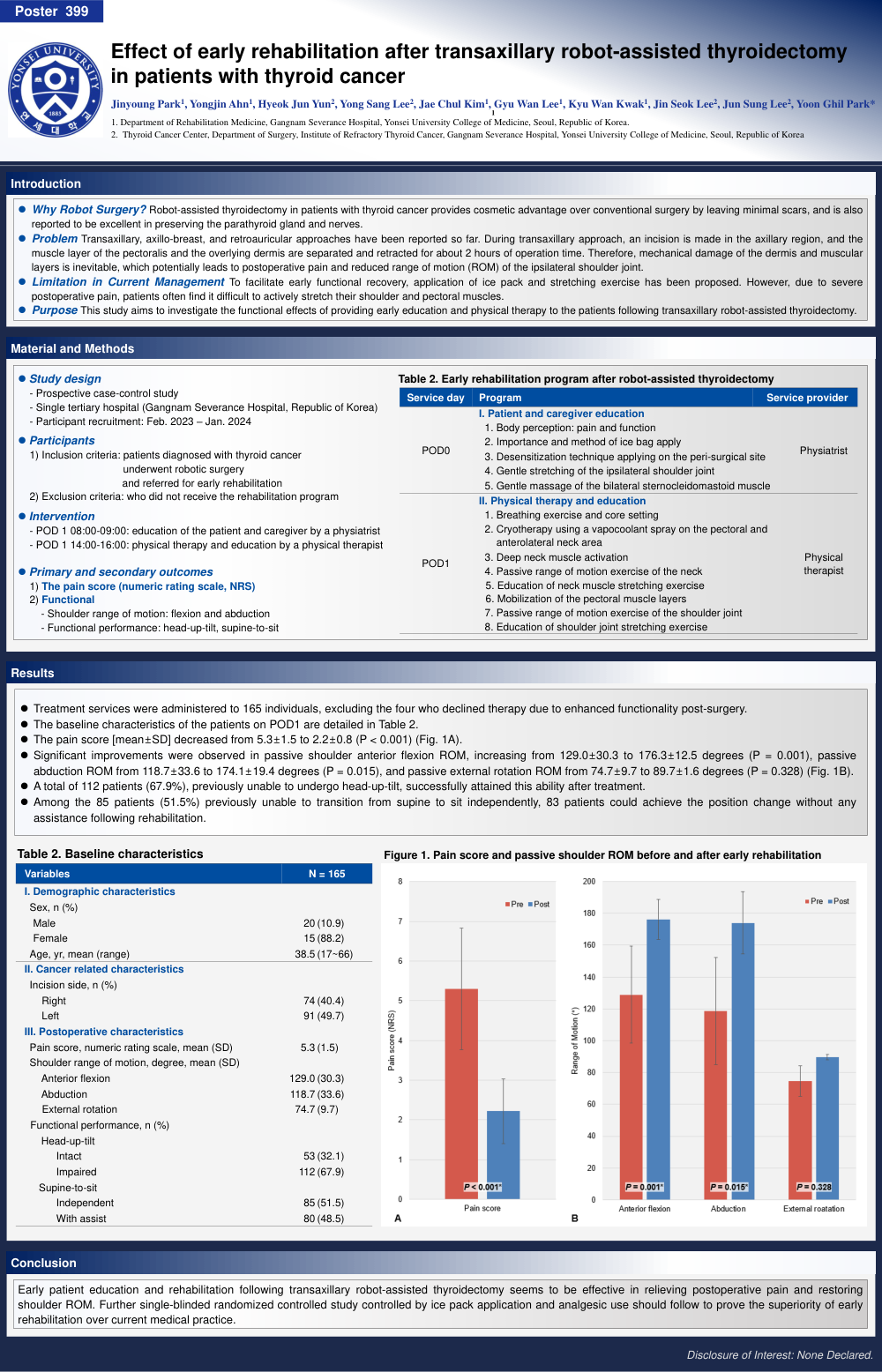
Robot-assisted thyroidectomy in patients with thyroid cancer provides cosmetic advantage over conventional surgery by leaving minimal scars, and is also reported to be excellent in preserving the parathyroid gland and nerves. Transaxillary, axillo-breast, and retroauricular approaches have been reported so far. During transaxillary approach, an incision is made in the axillary region, and the muscle layer of the pectoralis and the overlying dermis are separated and retracted for about 2 hours of operation time. Therefore, mechanical damage of the dermis and muscular layers is inevitable, which potentially leads to postoperative pain and reduced range of motion (ROM) of the ipsilateral shoulder joint. To facilitate early functional recovery, application of ice pack and stretching exercise has been proposed. However, due to severe postoperative pain, patients often find it difficult to actively stretch their shoulder and pectoral muscles. Therefore, this study aims to investigate the functional effects of providing early education and physical therapy to the patients following transaxillary robot-assisted thyroidectomy.
Materials and Methods
From February 2023 to January 2024, 169 patients diagnosed with thyroid cancer underwent transaxillary robot-assisted thyroidectomy. Subsequently, these patients were referred to the Department of Rehabilitation Medicine of a single tertiary hospital for early rehabilitation. The intervention included education provided by a physiatrist to both patients, along with physical therapy sessions administered by a physical therapist. Details of the educational program and the specific physical therapy content can be found in Table 1.
Pain score (NRS, numeric rating scale) was assessed as the primary outcome measure, while passive shoulder flexion, abduction, and external rotation ROM were assessed as secondary outcome measures. Also, the ability to sit up from supine position and perform head-up-tilt was assessed, as operation involved extended period of neck extension, which could induce stretched weakness in the neck flexors postoperatively.
The assessments were conducted on post-operative day 1 (POD1) between 08:00 and 09:00, followed by educational sessions and physical therapy from 14:00 to 16:00 on the same day. Pre and post-treatment outcome measures were compared using paired t-tests.
Results
Treatment services were administered to 165 individuals, excluding the four who declined therapy due to enhanced functionality post-surgery. The baseline characteristics of the patients on POD1 are detailed in Table 2. The pain score [mean±standard deviation] decreased from 5.3±1.5 to 2.2±0.8 (P < 0.001) (Fig. 1A). Significant improvements were observed in passive shoulder anterior flexion ROM, increasing from 129.0±30.3 to 176.3±12.5 degrees (P = 0.001), passive abduction ROM from 118.7±33.6 to 174.1±19.4 degrees (P = 0.015), and passive external rotation ROM from 74.7±9.7 to 89.7±1.6 degrees (P = 0.328) (Fig. 1B). A total of 112 patients (67.9%), previously unable to undergo head-up-tilt, successfully attained this ability after treatment. Among the 85 patients (51.5%) previously unable to transition from supine to sit independently, 83 patients could achieve the position change without any assistance following rehabilitation.
Conclusion
Early patient education and rehabilitation following transaxillary robot-assisted thyroidectomy seems to be effective in relieving postoperative pain and restoring shoulder ROM. Further single-blinded randomized controlled study controlled by ice pack application and analgesic use should follow to prove the superiority of early rehabilitation over current medical practice.
Keywords: early rehabilitation, education, physical therapy, robot surgery, thyroid cancer
Effect of early rehabilitation after transaxillary robot-assisted thyroidectomy
in patients with thyroid cancer