586 posters, 8 topics, 23 sessions, 1,077 authors, 622 institutions
ePostersLive by SciGen Technologies S.A. All rights reserved.
ISQua's 40th International Conference 2024
24th - 27th September 2024 | Istanbul, Türkiye

P383
Utilizing a combination of Non-pharmacological interventions to reduce pain during retinal examinations in premature infants.
Poster Presenter
Authors
Affiliations
Part of Topic
Patient Safety & Quality Improvement
Introduction
During their hospital stay, premature infants undergo an average of 3 to 5 retinal examinations to prevent vision impairment. But these can cause discomfort and pain, leading to unstable vital signs. Pain management for preterm infants can be categorized into pharmacological and non-pharmacological interventions. Beyond local anesthesia, intravenous sedatives and analgesics can effectively alleviate pain but may lead to adverse effects such as respiratory depression. Therefore, in clinical practice, non-pharmacological pain relief measures are frequently used as one of the most common methods to reduce heart rate and blood oxygen fluctuations caused by invasive examinations and procedures. This study evaluates the effectiveness of combination non-pharmacological interventions measures to reduce pain during ROP screenings.
Methods
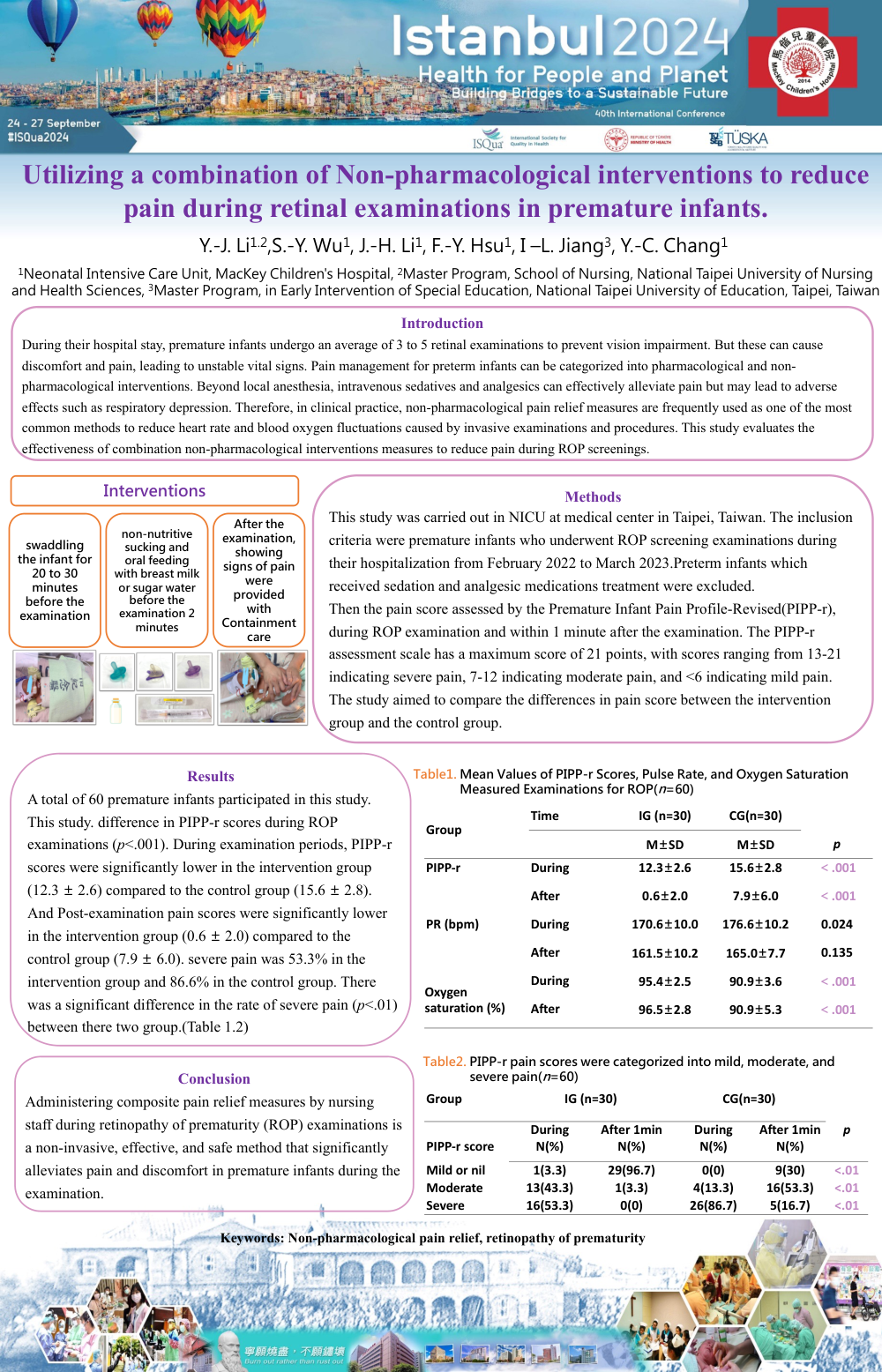
This study was carried out in NICU at medical center in Taipei, Taiwan. The inclusion criteria were premature infants who underwent ROP screening examinations during their hospitalization from February 2022 to March 2023.Preterm infants which received sedation and analgesic medications treatment were excluded. Then the pain score assessed by the Premature Infant Pain Profile-Revised(PIPP-r), during ROP examination and within 1 minute after the examination. The PIPP-r assessment scale has a maximum score of 21 points, with scores ranging from 13-21 indicating severe pain, 7-12 indicating moderate pain, and <6 indicating mild pain. The study aimed to compare the differences in pain score between the intervention group and the control group.
Results
A total of 60 premature infants participated in this study. This study. difference in PIPP-r scores during ROP examinations (p<.001). During examination periods, PIPP-r scores were significantly lower in the intervention group (12.3 ± 2.6) compared to the control group (15.6 ± 2.8). And Post-examination pain scores were significantly lower in the intervention group (0.6 ± 2.0) compared to the control group (7.9 ± 6.0). severe pain was 53.3% in the intervention group and 86.6% in the control group. There was a significant difference in the rate of severe pain (p<.01) between there two group.(Table 1.2)
Conclusion
Administering composite pain relief measures by nursing staff during retinopathy of prematurity (ROP) examinations is a non-invasive, effective, and safe method that significantly alleviates pain and discomfort in premature infants during the examination.