586 posters, 8 topics, 23 sessions, 1,077 authors, 622 institutions
ePostersLive by SciGen Technologies S.A. All rights reserved.
ISQua's 40th International Conference 2024
24th - 27th September 2024 | Istanbul, Türkiye

P084
Facing Adversity: The Resilience Enhancement of Healthcare Facilities in the Era of COVID-19
Poster Presenter
Authors
Affiliations
Part of Topic
Patient Safety & Quality Improvement
Facing Adversity: The Resilience Enhancement of Healthcare Facilities in the Era of COVID-19
Introduction:
The resilience of healthcare facilities is a crucial indicator measuring employees' perception of occupational health and their ability to manage workplace stress. In 2020, data on the resilience dimensions of the affiliated medical center was obtained through Taiwan Patient Safety Culture Survey (TPSCs) published by a health regulatory authority in Taiwan, the Joint Commission of Taiwan. The positive response score was 47.99, with a positive response percentage of 10.89%. Both of which were lower than the averages observed in other medical centers (54.02/19.75%). Moreover, with the sudden outbreak of COVID-19 in 2021, a further decline in resilience performance was anticipated facing the threat of coronavirus and a heavy workload in healthcare. Therefore, in 2021, various intervention measures were implemented to enhance the resilience of healthcare facilities, aiming to promote the mental and physical well-being of staff and ensure the continuous delivery of excellent healthcare services in the face of adversity.
Methods
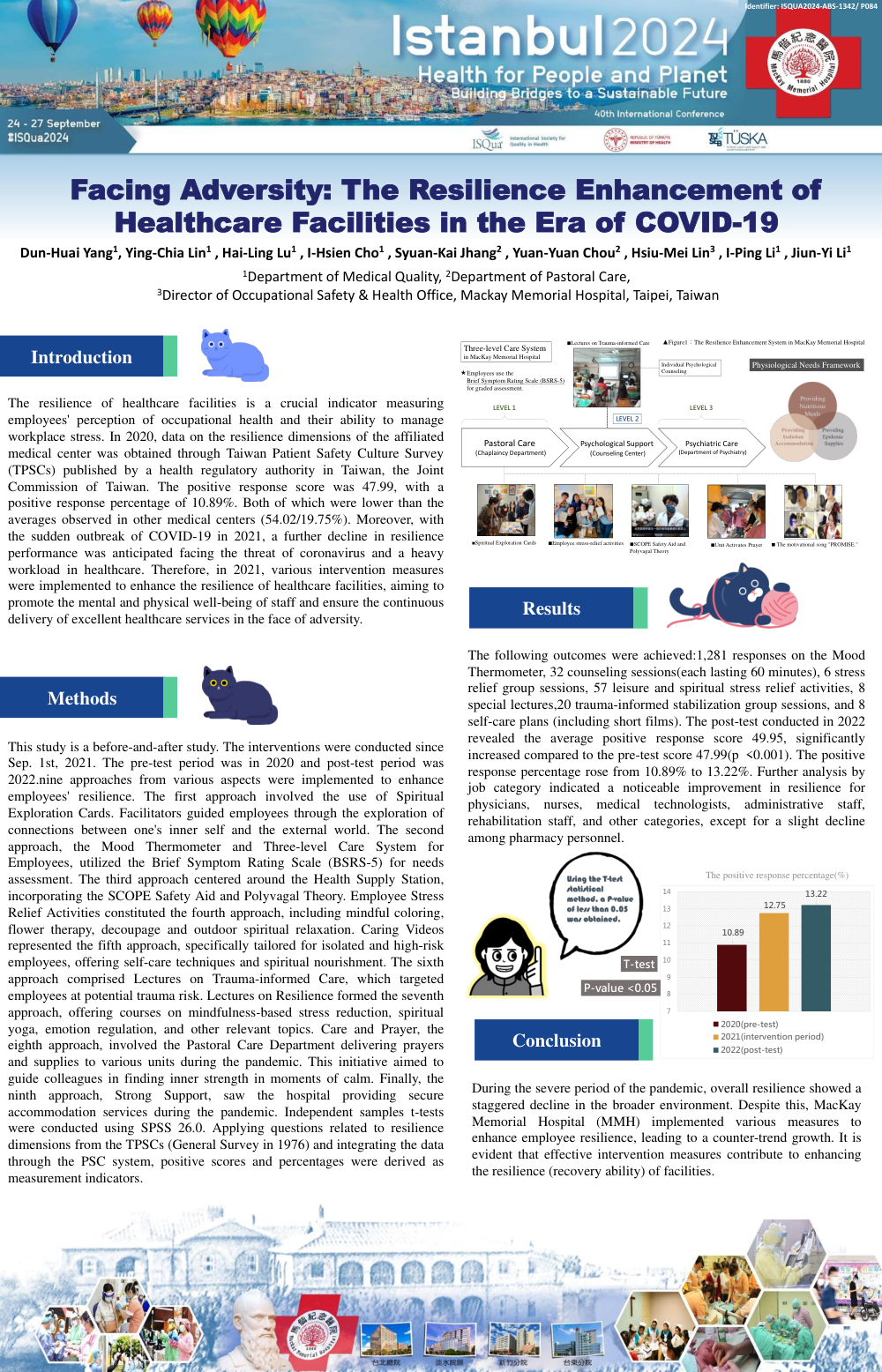
This study is a before-and-after study. The interventions were conducted since Sep. 1st, 2021. The pre-test period was in 2020 and post-test period was 2022.nine approaches from various aspects were implemented to enhance employees' resilience. The first approach involved the use of Spiritual Exploration Cards. Facilitators guided employees through the exploration of connections between one's inner self and the external world. The second approach, the Mood Thermometer and Three-level Care System for Employees, utilized the Brief Symptom Rating Scale (BSRS-5) for needs assessment. The third approach centered around the Health Supply Station, incorporating the SCOPE Safety Aid and Polyvagal Theory. Employee Stress Relief Activities constituted the fourth approach, including mindful coloring, flower therapy, decoupage and outdoor spiritual relaxation. Caring Videos represented the fifth approach, specifically tailored for isolated and high-risk employees, offering self-care techniques and spiritual nourishment. The sixth approach comprised Lectures on Trauma-informed Care, which targeted employees at potential trauma risk. Lectures on Resilience formed the seventh approach, offering courses on mindfulness-based stress reduction, spiritual yoga, emotion regulation, and other relevant topics. Care and Prayer, the eighth approach, involved the Pastoral Care Department delivering prayers and supplies to various units during the pandemic. This initiative aimed to guide colleagues in finding inner strength in moments of calm. Finally, the ninth approach, Strong Support, saw the hospital providing secure accommodation services during the pandemic. Independent samples t-tests were conducted using SPSS 26.0. Applying questions related to resilience dimensions from the TPSCs (General Survey in 1976) and integrating the data through the PSC system, positive scores and percentages were derived as measurement indicators.
Results
The following outcomes were achieved:1,281 responses on the Mood Thermometer, 32 counseling sessions(each lasting 60 minutes), 6 stress relief group sessions, 57 leisure and spiritual stress relief activities, 8 special lectures,20 trauma-informed stabilization group sessions, and 8 self-care plans (including short films). The post-test conducted in 2022 revealed the average positive response score 49.95, significantly increased compared to the pre-test score 47.99(p <0.001). The positive response percentage rose from 10.89% to 13.22%. Further analysis by job category indicated a noticeable improvement in resilience for physicians, nurses, medical technologists, administrative staff, rehabilitation staff, and other categories, except for a slight decline among pharmacy personnel.
Conclusion
During the severe period of the pandemic, overall resilience showed a staggered decline in the broader environment. Despite this, MacKay Memorial Hospital (MMH) implemented various measures to enhance employee resilience, leading to a counter-trend growth. It is evident that effective intervention measures contribute to enhancing the resilience (recovery ability) of facilities.