Loading...

586 posters, 8 topics, 23 sessions, 1,077 authors, 622 institutions

ePostersLive by SciGen Technologies S.A. All rights reserved.

ISQua's 40th International Conference 2024

24th - 27th September 2024 | Istanbul, Türkiye

ISQua's 40th International Conference 2024 banner

ISQUA2024-ABS-1505

Setting Standards in Long Term Care: Identifying Achievable Benchmarks of Care for Long Term Care Facilities
Part of Topic

Patient Safety & Quality Improvement

Setting Standards in Long Term Care: Identifying Achievable Benchmarks of Care for Long Term Care Facilities

Introduction

Benchmarks are an important aspect of quality measurement and evaluation of long-term care facility (LTCF) performance.
 
Data driven benchmarks focus on achievability and highlight real world examples.
 
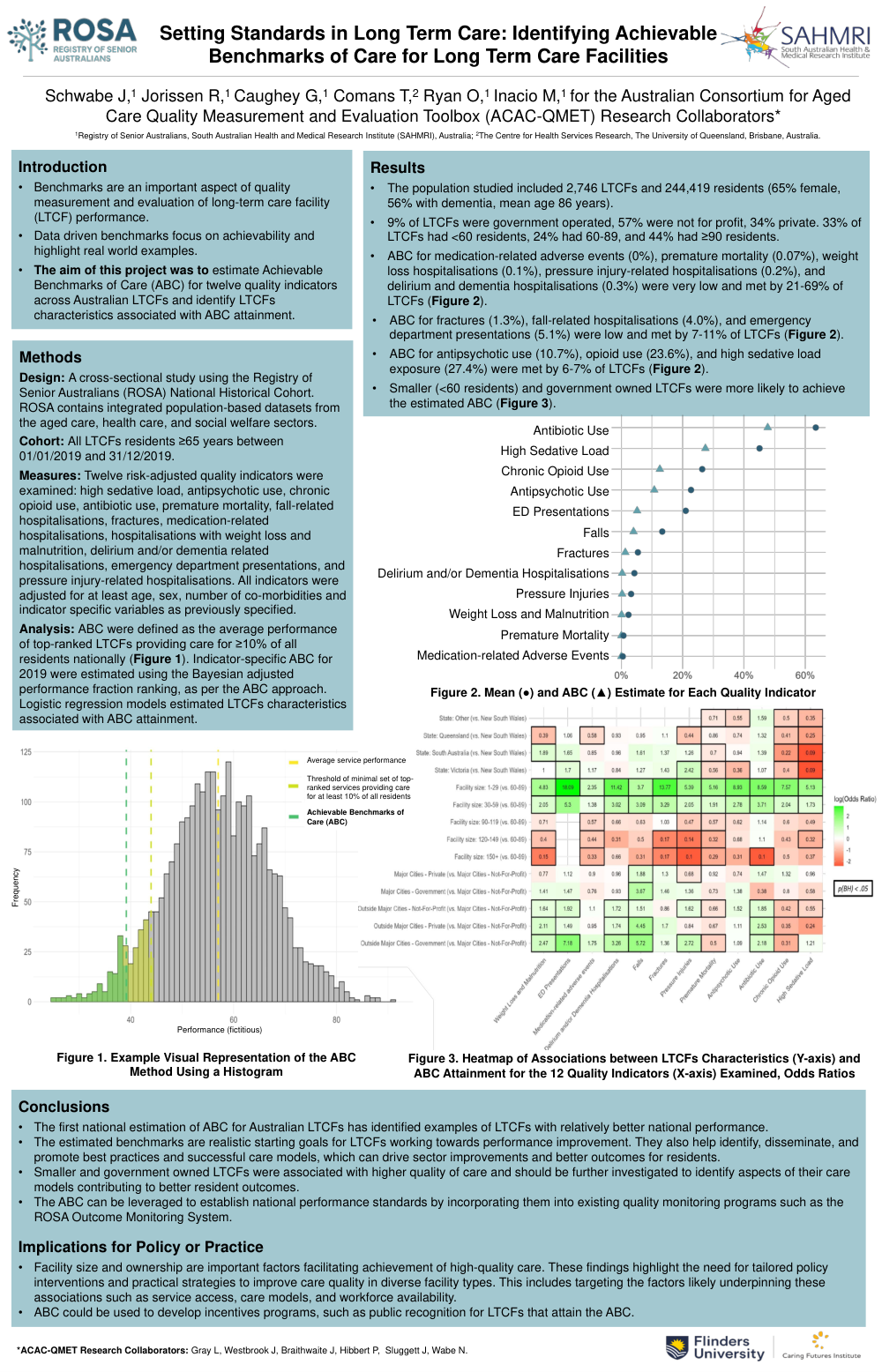
The aim of this project was to estimate Achievable Benchmarks of Care (ABC) for twelve quality indicators across Australian LTCFs and identify LTCFs characteristics associated with ABC attainment.

Methods

Design: A cross-sectional study using the Registry of Senior Australians (ROSA) National Historical Cohort. ROSA contains integrated population-based datasets from the aged care, health care, and social welfare sectors.

Cohort: All LTCFs residents ≥65 years between 01/01/2019 and 31/12/2019.

Measures: Twelve risk-adjusted quality indicators were examined: high sedative load, antipsychotic use, chronic opioid use, antibiotic use, premature mortality, fall-related hospitalisations, fractures, medication-related hospitalisations, hospitalisations with weight loss and malnutrition, delirium and/or dementia related hospitalisations, emergency department presentations, and pressure injury-related hospitalisations. All indicators were adjusted for at least age, sex, number of co-morbidities and indicator specific variables as previously specified.

Analysis: ABC were defined as the average performance of top-ranked LTCFs providing care for ≥10% of all residents nationally (Figure 1). Indicator-specific ABC for 2019 were estimated using the Bayesian adjusted performance fraction ranking, as per the ABC approach. Logistic regression models estimated LTCFs characteristics associated with ABC attainment.

Results

The population studied included 2,746 LTCFs and 244,419 residents (65% female, 56% with dementia, mean age 86 years).
 
9% of LTCFs were government operated, 57% were not for profit, 34% private. 33% of LTCFs had <60 residents, 24% had 60-89, and 44% had ≥90 residents.
 
ABC for medication-related adverse events (0%), premature mortality (0.07%), weight loss hospitalisations (0.1%), pressure injury-related hospitalisations (0.2%), and delirium and dementia hospitalisations (0.3%) were very low and met by 21-69% of LTCFs (Figure 2).
 
ABC for fractures (1.3%), fall-related hospitalisations (4.0%), and emergency department presentations (5.1%) were low and met by 7-11% of LTCFs (Figure 2).
 
ABC for antipsychotic use (10.7%), opioid use (23.6%), and high sedative load exposure (27.4%) were met by 6-7% of LTCFs (Figure 2).
 
Smaller (<60 residents) and government owned LTCFs were more likely to achieve the estimated ABC (Figure 3).

Conclusions

The first national estimation of ABC for Australian LTCFs has identified examples of LTCFs with relatively better national performance.
 
The estimated benchmarks are realistic starting goals for LTCFs working towards performance improvement. They also help identify, disseminate, and promote best practices and successful care models, which can drive sector improvements and better outcomes for residents.
 
Smaller and government owned LTCFs were associated with higher quality of care and should be further investigated to identify aspects of their care models contributing to better resident outcomes.
 
The ABC can be leveraged to establish national performance standards by incorporating them into existing quality monitoring programs such as the ROSA Outcome Monitoring System.

Implications for Policy or Practice

Facility size and ownership are important factors facilitating achievement of high-quality care. These findings highlight the need for tailored policy interventions and practical strategies to improve care quality in diverse facility types. This includes targeting the factors likely underpinning these associations such as service access, care models, and workforce availability.

ABC could be used to develop incentives programs, such as public recognition for LTCFs that attain the ABC.
ISQua's 40th International Conference 2024 » banner
Copyright © 2015-2026, ePostersLive® SciGen is a registered trademark of SciGen Technologies S.A. Patent pending.

This website and third-party tools we use rely on cookies for the best user experience. By selecting "I agree", you agree to cookie usage as described in our Privacy Policy.