586 posters, 8 topics, 23 sessions, 1,077 authors, 622 institutions
ePostersLive by SciGen Technologies S.A. All rights reserved.
ISQua's 40th International Conference 2024
24th - 27th September 2024 | Istanbul, Türkiye

P169
Evaluating the Reasons for Cancellation of Elective Otorhinolaryngology-Head and Neck Surgeries and Coping Strategies
Poster Presenter
Part of Topic
Patient Safety & Quality Improvement
Evaluating the Reasons for Cancellation of Elective Otorhinolaryngology-Head and Neck Surgeries and Coping Strategies
Jialin Liu 1,2, Jing Xue2, Mengjiao Zhang2, Siru Liu3
1. Department of Otolaryngology-Head and Neck Surgery, West China Hospital, Sichuan University, Chengdu, China
2. Information Center, West China Hospital, Sichuan University, Chengdu, China
3. Department of Biomedical Informatics, Vanderbilt University Medical Center, Nashville, TN, USA
Problem Description
The cancellation of elective surgeries is a challenge in the field of otolaryngology head and neck surgery. Not only do they signal potential quality of care issues, but they also represent a significant waste of healthcare resources.
Objectives
To comprehensively identify and analyze the factors that lead to the cancellation of elective head and neck surgery;
To develop targeted prevention strategies to reduce the impact of cancelled surgery.
Methods
Study Site
A retrospective analysis of patients aged 18 years and older discharged from the Department of Otolaryngology, Head and Neck Surgery, West China Hospital (WCH), Sichuan University, China between 2 August 2019 and 28 December 2021. It is a top hospital in China with more than 4300 beds, of which 104 inpatient beds are in the Department of Otolaryngology, Head and Neck Surgery.
To analyze the effect of cancelled surgery on 30-day planned readmissions, we selected all surgical patients with 30-day planned readmissions.
Statistics Analysis
For categorical variables in univariate analysis, the chi-square test was utilized. The statistical analyses were carried out using IBM SPSS Statistics 20, p<0.05 is statistical significance.
Ethical Considerations
This study was approved by the Bioethics Committee of West China Hospital, Sichuan University (No: 2022-174). All data were anonymized.
Results
Study Population and Surgery
The study included 7,608 adults (aged ≥ 18 years) who underwent otolaryngology-head and neck surgery between 2 August 2019 and 28 December 2021. Of these, 48.9% (3,721) underwent stage IV surgery, 47.6% (3,622) underwent stage III surgery, and 3.5% (265) underwent stage II surgery. According to the National Health Commission of China, stage IV procedures are the most complex under the Graded Management of Surgery guidelines.
Planned Readmissions
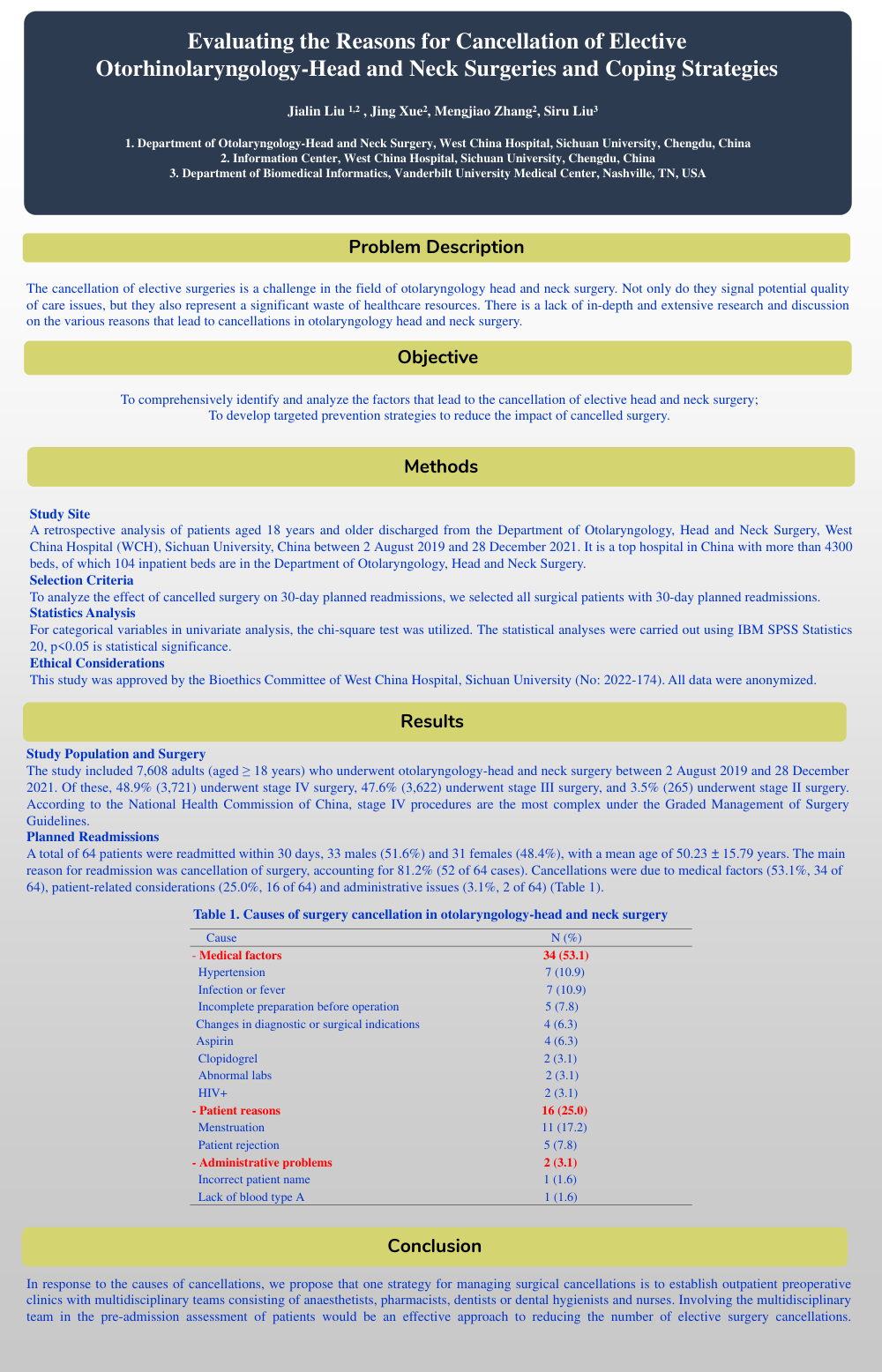
A total of 64 patients were readmitted within 30 days, 33 males (51.6%) and 31 females (48.4%), with a mean age of 50.23 ± 15.79 years. The main reason for readmission was cancellation of surgery, accounting for 81.2% (52 of 64 cases). Cancellations were due to medical factors (53.1%, 34 of 64), patient-related considerations (25.0%, 16 of 64) and administrative issues (3.1%, 2 of 64) (Table 1).
Conclusion
In response to the causes of cancellations, we propose that one strategy for managing surgical cancellations is to establish outpatient preoperative clinics with multidisciplinary teams consisting of anaesthetists, pharmacists, dentists or dental hygienists and nurses. Involving the multidisciplinary team in the pre-admission assessment of patients would be an effective approach to reducing the number of elective surgery cancellations.