586 posters, 8 topics, 23 sessions, 1,077 authors, 622 institutions
ePostersLive by SciGen Technologies S.A. All rights reserved.
ISQua's 40th International Conference 2024
24th - 27th September 2024 | Istanbul, Türkiye

P492
The concept and importance of equity in integrated care models
Poster Presenter
Authors
Affiliations
Part of Topic
Integrated Care Communities
isqua2024.1160202
The concept and importance of equity in integrated care models
ERDOGAN YAYLA¹,
¹: KARACABEY STATE HOSPITAL, CENTRAL LABORATORY, KARACABEY, BURSA, TÜRKİYE
INTRODUCTION: Integrative and collaborative care are the care a patient experiences as a result of a team of Primary Care & Behavioral Health clinicians, social services and supports working together with patients and families, using a systematic and cost-effective approach to provide patient-centered care for a defined population. The researchs on Integrated care has been primarily focus for health systems strategy and policy around the world for the past three decades, generating a large body of research on its role in health care transformation and sustainability. So, it has been an approach that promotes collaboration across organizational and professional boundaries to provide more connected care for patients, family and caregivers in their local communities. Integrated care specifically aims to redress system fragmentation and inefficiencies which often create health care inequities.
Integrated Care has been defined in many different ways that converge on a common set of shared principles and practices for care. In the broadest sense, integrated care includes changes that enhance teamwork and patient centeredness across the dimensions of policy, health systems, organizations, and health care provider practices.
AIM: Vulnerable populations, such as people with low socio-economic status, are at greater risk of experiencing care fragmentation. To reduce health inequalities, case studies such as the patient provider portal will offer its services in languages spoken by minority groups. Additionally, to reduce existing health inequalities, future studies should aim to stratify data according to vulnerable populations with findings used to adapt care to better meet the needs of these patients. More broadly, investing in health literacy programmes with a focus on vulnerable populations will help narrow existing health inequalities [1].
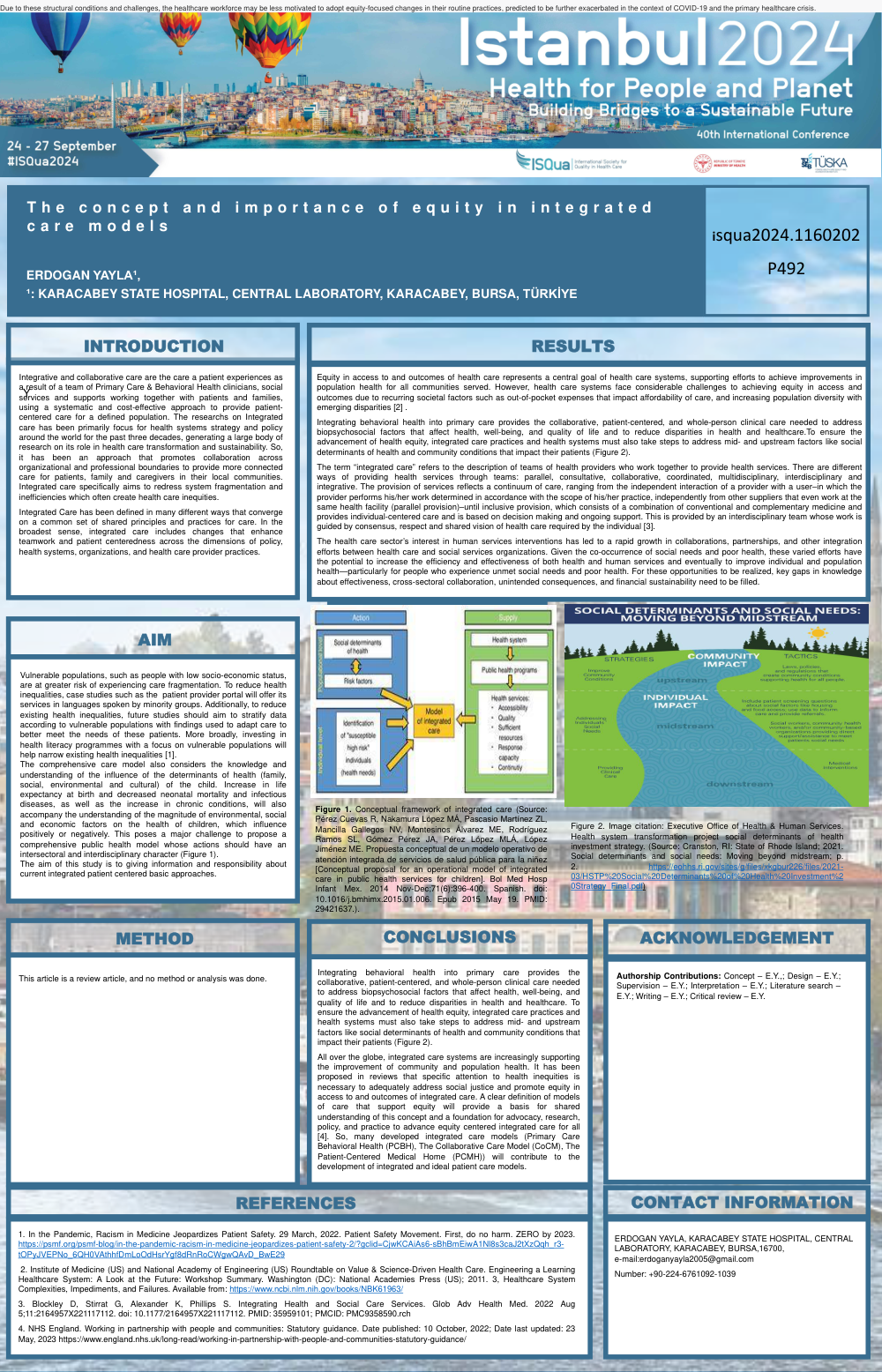
The comprehensive care model also considers the knowledge and understanding of the influence of the determinants of health (family, social, environmental and cultural) of the child. Increase in life expectancy at birth and decreased neonatal mortality and infectious diseases, as well as the increase in chronic conditions, will also accompany the understanding of the magnitude of environmental, social and economic factors on the health of children, which influence positively or negatively. This poses a major challenge to propose a comprehensive public health model whose actions should have an intersectoral and interdisciplinary character (Figure 1).
The aim of this study is to giving information and responsibility about current integrated patient centered basic approaches.
METHOD: This article is a review article, and no method or analysis was done.
RESULTS: Equity in access to and outcomes of health care represents a central goal of health care systems, supporting efforts to achieve improvements in population health for all communities served. However, health care systems face considerable challenges to achieving equity in access and outcomes due to recurring societal factors such as out-of-pocket expenses that impact affordability of care, and increasing population diversity with emerging disparities [2] .
Integrating behavioral health into primary care provides the collaborative, patient-centered, and whole-person clinical care needed to address biopsychosocial factors that affect health, well-being, and quality of life and to reduce disparities in health and healthcare.To ensure the advancement of health equity, integrated care practices and health systems must also take steps to address mid- and upstream factors like social determinants of health and community conditions that impact their patients (Figure 2).
The term “integrated care” refers to the description of teams of health providers who work together to provide health services. There are different ways of providing health services through teams: parallel, consultative, collaborative, coordinated, multidisciplinary, interdisciplinary and integrative. The provision of services reflects a continuum of care, ranging from the independent interaction of a provider with a user–in which the provider performs his/her work determined in accordance with the scope of his/her practice, independently from other suppliers that even work at the same health facility (parallel provision)–until inclusive provision, which consists of a combination of conventional and complementary medicine and provides individual-centered care and is based on decision making and ongoing support. This is provided by an interdisciplinary team whose work is guided by consensus, respect and shared vision of health care required by the individual [3].
The health care sector’s interest in human services interventions has led to a rapid growth in collaborations, partnerships, and other integration efforts between health care and social services organizations. Given the co-occurrence of social needs and poor health, these varied efforts have the potential to increase the efficiency and effectiveness of both health and human services and eventually to improve individual and population health—particularly for people who experience unmet social needs and poor health. For these opportunities to be realized, key gaps in knowledge about effectiveness, cross-sectoral collaboration, unintended consequences, and financial sustainability need to be filled.
CONCLUSIONS: Integrating behavioral health into primary care provides the collaborative, patient-centered, and whole-person clinical care needed to address biopsychosocial factors that affect health, well-being, and quality of life and to reduce disparities in health and healthcare. To ensure the advancement of health equity, integrated care practices and health systems must also take steps to address mid- and upstream factors like social determinants of health and community conditions that impact their patients (Figure 2).
All over the globe, integrated care systems are increasingly supporting the improvement of community and population health. It has been proposed in reviews that specific attention to health inequities is necessary to adequately address social justice and promote equity in access to and outcomes of integrated care. A clear definition of models of care that support equity will provide a basis for shared understanding of this concept and a foundation for advocacy, research, policy, and practice to advance equity centered integrated care for all [4]. So, many developed integrated care models (Primary Care Behavioral Health (PCBH), The Collaborative Care Model (CoCM), The Patient-Centered Medical Home (PCMH)) will contribute to the development of integrated and ideal patient care models.
ACKNOWLEDGEMENT: Authorship Contributions: Concept – E.Y.,; Design – E.Y.; Supervision – E.Y.; Interpretation – E.Y.; Literature search – E.Y.; Writing – E.Y.; Critical review – E.Y.
REFERENCES:
1. In the Pandemic, Racism in Medicine Jeopardizes Patient Safety. 29 March, 2022. Patient Safety Movement. First, do no harm. ZERO by 2023. https://psmf.org/psmf-blog/in-the-pandemic-racism-in-medicine-jeopardizes-patient-safety-2/?gclid=CjwKCAiAs6-sBhBmEiwA1Nl8s3caJ2tXzQqh_r3-tOPyJVEPNo_6QH0VAthhfDmLoOdHsrYgf8dRnRoCWgwQAvD_BwE29
2. Institute of Medicine (US) and National Academy of Engineering (US) Roundtable on Value & Science-Driven Health Care. Engineering a Learning Healthcare System: A Look at the Future: Workshop Summary. Washington (DC): National Academies Press (US); 2011. 3, Healthcare System Complexities, Impediments, and Failures. Available from: https://www.ncbi.nlm.nih.gov/books/NBK61963/
3. Blockley D, Stirrat G, Alexander K, Phillips S. Integrating Health and Social Care Services. Glob Adv Health Med. 2022 Aug 5;11:2164957X221117112. doi: 10.1177/2164957X221117112. PMID: 35959101; PMCID: PMC9358590.rch
4. NHS England. Working in partnership with people and communities: Statutory guidance. Date published: 10 October, 2022; Date last updated: 23 May, 2023 https://www.england.nhs.uk/long-read/working-in-partnership-with-people-and-communities-statutory-guidance/
CONTACT INFORMATION: ERDOGAN YAYLA, KARACABEY STATE HOSPITAL, CENTRAL LABORATORY, KARACABEY, BURSA,16700, e-mail:erdoganyayla2005@gmail.com
Number: +90-224-6761092-1039