586 posters, 8 topics, 23 sessions, 1,077 authors, 622 institutions
ePostersLive by SciGen Technologies S.A. All rights reserved.
ISQua's 40th International Conference 2024
24th - 27th September 2024 | Istanbul, Türkiye

P082
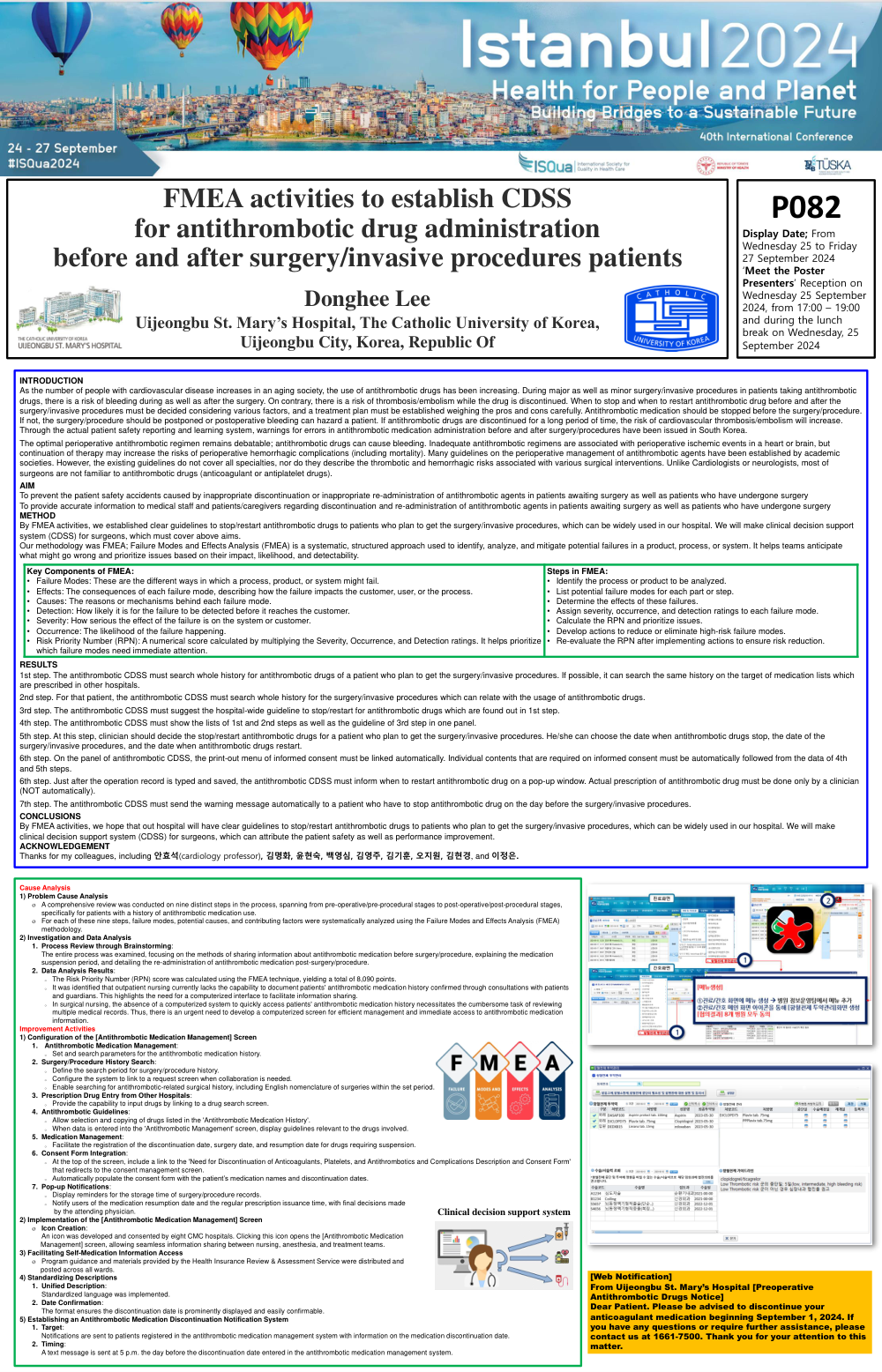
FMEA activities to establish CDSS for antithrombotic drug administration before and after surgery/invasive procedures patients
Part of Topic
Patient Safety & Quality Improvement
FMEA activities to establish CDSS for antithrombotic drug administration before and after surgery/invasive procedures patients
Donghee Lee
Uijeongbu St. Mary’s Hospital, The Catholic University of Korea, Uijeongbu City, Korea, Republic Of
INTRODUCTION
As the number of people with cardiovascular disease increases in an aging society, the use of antithrombotic drugs has been increasing. During major as well as minor surgery/invasive procedures in patients taking antithrombotic drugs, there is a risk of bleeding during as well as after the surgery. On contrary, there is a risk of thrombosis/embolism while the drug is discontinued. When to stop and when to restart antithrombotic drug before and after the surgery/invasive procedures must be decided considering various factors, and a treatment plan must be established weighing the pros and cons carefully. Antithrombotic medication should be stopped before the surgery/procedure. If not, the surgery/procedure should be postponed or postoperative bleeding can hazard a patient. If antithrombotic drugs are discontinued for a long period of time, the risk of cardiovascular thrombosis/embolism will increase. Through the actual patient safety reporting and learning system, warnings for errors in antithrombotic medication administration before and after surgery/procedures have been issued in South Korea.
The optimal perioperative antithrombotic regimen remains debatable; antithrombotic drugs can cause bleeding. Inadequate antithrombotic regimens are associated with perioperative ischemic events in a heart or brain, but continuation of therapy may increase the risks of perioperative hemorrhagic complications (including mortality). Many guidelines on the perioperative management of antithrombotic agents have been established by academic societies. However, the existing guidelines do not cover all specialties, nor do they describe the thrombotic and hemorrhagic risks associated with various surgical interventions. Unlike Cardiologists or neurologists, most of surgeons are not familiar to antithrombotic drugs (anticoagulant or antiplatelet drugs).
AIM
To prevent the patient safety accidents caused by inappropriate discontinuation or inappropriate re-administration of antithrombotic agents in patients awaiting surgery as well as patients who have undergone surgery
To provide accurate information to medical staff and patients/caregivers regarding discontinuation and re-administration of antithrombotic agents in patients awaiting surgery as well as patients who have undergone surgery
METHOD
By FMEA activities, we established clear guidelines to stop/restart antithrombotic drugs to patients who plan to get the surgery/invasive procedures, which can be widely used in our hospital. We will make clinical decision support system (CDSS) for surgeons, which must cover above aims.
Our methodology was FMEA; Failure Modes and Effects Analysis (FMEA) is a systematic, structured approach used to identify, analyze, and mitigate potential failures in a product, process, or system. It helps teams anticipate what might go wrong and prioritize issues based on their impact, likelihood, and detectability.
Key Components of FMEA:
- Failure Modes: These are the different ways in which a process, product, or system might fail.
- Effects: The consequences of each failure mode, describing how the failure impacts the customer, user, or the process.
- Causes: The reasons or mechanisms behind each failure mode.
- Detection: How likely it is for the failure to be detected before it reaches the customer.
- Severity: How serious the effect of the failure is on the system or customer.
- Occurrence: The likelihood of the failure happening.
- Risk Priority Number (RPN): A numerical score calculated by multiplying the Severity, Occurrence, and Detection ratings. It helps prioritize which failure modes need immediate attention.
Steps in FMEA:
- Identify the process or product to be analyzed.
- List potential failure modes for each part or step.
- Determine the effects of these failures.
- Assign severity, occurrence, and detection ratings to each failure mode.
- Calculate the RPN and prioritize issues.
- Develop actions to reduce or eliminate high-risk failure modes.
- Re-evaluate the RPN after implementing actions to ensure risk reduction.
Cause Analysis
1) Problem Cause Analysis
- A comprehensive review was conducted on nine distinct steps in the process, spanning from pre-operative/pre-procedural stages to post-operative/post-procedural stages, specifically for patients with a history of antithrombotic medication use.
- For each of these nine steps, failure modes, potential causes, and contributing factors were systematically analyzed using the Failure Modes and Effects Analysis (FMEA) methodology.
2) Investigation and Data Analysis
- Process Review through Brainstorming:
The entire process was examined, focusing on the methods of sharing information about antithrombotic medication before surgery/procedure, explaining the medication suspension period, and detailing the re-administration of antithrombotic medication post-surgery/procedure. - Data Analysis Results:
- The Risk Priority Number (RPN) score was calculated using the FMEA technique, yielding a total of 8,090 points.
- It was identified that outpatient nursing currently lacks the capability to document patients' antithrombotic medication history confirmed through consultations with patients and guardians. This highlights the need for a computerized interface to facilitate information sharing.
- In surgical nursing, the absence of a computerized system to quickly access patients' antithrombotic medication history necessitates the cumbersome task of reviewing multiple medical records. Thus, there is an urgent need to develop a computerized screen for efficient management and immediate access to antithrombotic medication information.
Improvement Activities
1) Configuration of the [Antithrombotic Medication Management] Screen
- Antithrombotic Medication Management:
- Set and search parameters for the antithrombotic medication history.
- Surgery/Procedure History Search:
- Define the search period for surgery/procedure history.
- Configure the system to link to a request screen when collaboration is needed.
- Enable searching for antithrombotic-related surgical history, including English nomenclature of surgeries within the set period.
- Prescription Drug Entry from Other Hospitals:
- Provide the capability to input drugs by linking to a drug search screen.
- Antithrombotic Guidelines:
- Allow selection and copying of drugs listed in the 'Antithrombotic Medication History'.
- When data is entered into the 'Antithrombotic Management' screen, display guidelines relevant to the drugs involved.
- Medication Management:
- Facilitate the registration of the discontinuation date, surgery date, and resumption date for drugs requiring suspension.
- Consent Form Integration:
- At the top of the screen, include a link to the 'Need for Discontinuation of Anticoagulants, Platelets, and Antithrombotics and Complications Description and Consent Form' that redirects to the consent management screen.
- Automatically populate the consent form with the patient’s medication names and discontinuation dates.
- Pop-up Notifications:
- Display reminders for the storage time of surgery/procedure records.
- Notify users of the medication resumption date and the regular prescription issuance time, with final decisions made by the attending physician.
2) Implementation of the [Antithrombotic Medication Management] Screen
- Icon Creation:
An icon was developed and consented by eight CMC hospitals. Clicking this icon opens the [Antithrombotic Medication Management] screen, allowing seamless information sharing between nursing, anesthesia, and treatment teams.
3) Facilitating Self-Medication Information Access
- Program guidance and materials provided by the Health Insurance Review & Assessment Service were distributed and posted across all wards.
4) Standardizing Descriptions
- Unified Description:
Standardized language was implemented. - Date Confirmation:
The format ensures the discontinuation date is prominently displayed and easily confirmable.
5) Establishing an Antithrombotic Medication Discontinuation Notification System
- Target:
Notifications are sent to patients registered in the antithrombotic medication management system with information on the medication discontinuation date. - Timing:
A text message is sent at 5 p.m. the day before the discontinuation date entered in the antithrombotic medication management system.
RESULTS
1st step. The antithrombotic CDSS must search whole history for antithrombotic drugs of a patient who plan to get the surgery/invasive procedures. If possible, it can search the same history on the target of medication lists which are prescribed in other hospitals.
2nd step. For that patient, the antithrombotic CDSS must search whole history for the surgery/invasive procedures which can relate with the usage of antithrombotic drugs.
3rd step. The antithrombotic CDSS must suggest the hospital-wide guideline to stop/restart for antithrombotic drugs which are found out in 1st step.
4th step. The antithrombotic CDSS must show the lists of 1st and 2nd steps as well as the guideline of 3rd step in one panel.
5th step. At this step, clinician should decide the stop/restart antithrombotic drugs for a patient who plan to get the surgery/invasive procedures. He/she can choose the date when antithrombotic drugs stop, the date of the surgery/invasive procedures, and the date when antithrombotic drugs restart.
6th step. On the panel of antithrombotic CDSS, the print-out menu of informed consent must be linked automatically. Individual contents that are required on informed consent must be automatically followed from the data of 4th and 5th steps.
6th step. Just after the operation record is typed and saved, the antithrombotic CDSS must inform when to restart antithrombotic drug on a pop-up window. Actual prescription of antithrombotic drug must be done only by a clinician (NOT automatically).
7th step. The antithrombotic CDSS must send the warning message automatically to a patient who have to stop antithrombotic drug on the day before the surgery/invasive procedures.
CONCLUSIONS
By FMEA activities, we hope that out hospital will have clear guidelines to stop/restart antithrombotic drugs to patients who plan to get the surgery/invasive procedures, which can be widely used in our hospital. We will make clinical decision support system (CDSS) for surgeons, which can attribute the patient safety as well as performance improvement.
ACKNOWLEDGEMENT
Thanks for my colleagues, including 안효석(cardiology professor), 김명화, 윤현숙, 백영심, 김영주, 김기훈, 오지원, 김현경, and 이정은.