586 posters, 8 topics, 23 sessions, 1,077 authors, 622 institutions
ePostersLive by SciGen Technologies S.A. All rights reserved.
ISQua's 40th International Conference 2024
24th - 27th September 2024 | Istanbul, Türkiye

P222
RISK FACTORS INFLUENCING NURSES' PERCEPTIONS OF DOCUMENTATION BURDEN IN AUSTRIAN HOSPITALS
Poster Presenter
Authors
Maximilian Anleitner, Teresa Hochstrasser, Doris Hofer, Tilman Königswieser, Renate Nobis, Gerhard Halmerbauer
Affiliations
University of Applied Sciences Upper Austria, University of Applied Sciences Upper Austria, Steyr, Austria, Konventhospital Barmherzige Brüder, Linz, Austria, Salzkammergut Klinikum, Gmunden, Austria
Part of Topic
Patient Safety & Quality Improvement
Introduction
Nursing documentation serves as an essential component of patient care, ensuring effective communication between healthcare professionals and playing a significant role in patient safety. It is important that an accurate and complete record of a patient's episode of care is made and kept. A considerable proportion of working time is spent on documentation, which often leads to complaints and dissatisfaction with working conditions among nurses. Documentation is often perceived as a severe burden that reduces direct contact with the patient. A recent study demonstrated that nurses are torn between a positive view of documentation as something essential, and a negative one of it being a meaningless burden.
Aim
This study aims to…
…measure the perceived burden of documentation in Austrian hospitals.
…identify and analyse factors contributing to the perceived burden of nursing documentation in Austrian hospitals.
Method
The BurDoNsaM survey was used to measure nurses' self-reported perceptions of the burden of clinical documentation in two Upper Austrian hospitals between March and April 2023. A translation and minor adjustments have been made to adapt to national specifics. This validated survey tool consists of 28 items and can be divided into 6 subscales (A-F), representing the key areas of documentation burden for nurses.
For this study, subscales E and F were excluded. The remaining subscales generated scores based on the number of items: A ("Views about Value of Clinical Documentation", 9 items), B ("Perceived Burden of Documentation", 7 items), C ("Hospital Leadership", 1 item), and D ("Time Taken to Complete Documentation", 2 items). Additionally, participants estimated the percentage of time they spent on documentation during an AM shift. Potential risk factors (hospital A vs. hospital B, age, department, "View on Documentation", percentage of time spent on documentation, "Hospital Leadership", "Time Taken to Complete Documentation") for the "Perceived Burden of Documentation" were analysed using linear regression analysis.
Results
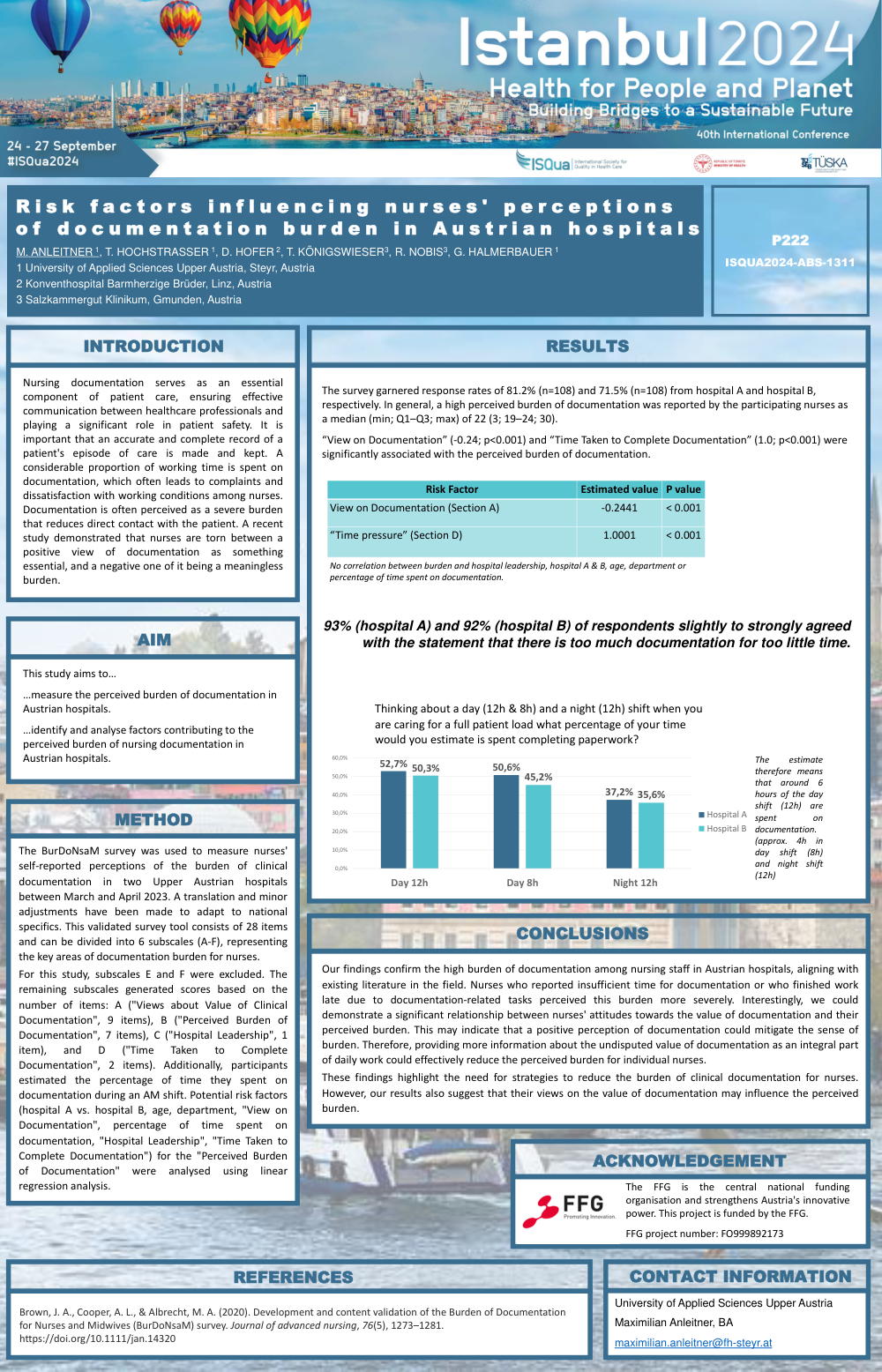
The survey garnered response rates of 81.2% (n=108) and 71.5% (n=108) from hospital A and hospital B, respectively. In general, a high perceived burden of documentation was reported by the participating nurses as a median (min; Q1–Q3; max) of 22 (3; 19–24; 30).
“View on Documentation” (-0.24; p<0.001) and “Time Taken to Complete Documentation” (1.0; p<0.001) were significantly associated with the perceived burden of documentation.
93% (hospital A) and 92% (hospital B) of respondents slightly to strongly agreed with the statement that there is too much documentation for too little time.
Conclusions
Our findings confirm the high burden of documentation among nursing staff in Austrian hospitals, aligning with existing literature in the field. Nurses who reported insufficient time for documentation or who finished work late due to documentation-related tasks perceived this burden more severely. Interestingly, we could demonstrate a significant relationship between nurses' attitudes towards the value of documentation and their perceived burden. This may indicate that a positive perception of documentation could mitigate the sense of burden. Therefore, providing more information about the undisputed value of documentation as an integral part of daily work could effectively reduce the perceived burden for individual nurses.
These findings highlight the need for strategies to reduce the burden of clinical documentation for nurses. However, our results also suggest that their views on the value of documentation may influence the perceived burden.
Acknowledgement
The FFG is the central national funding organisation and strengthens Austria's innovative power. This project is funded by the FFG.
FFG project number: FO999892173
References
Brown, J. A., Cooper, A. L., & Albrecht, M. A. (2020). Development and content validation of the Burden of Documentation for Nurses and Midwives (BurDoNsaM) survey. Journal of advanced nursing, 76(5), 1273–1281. https://doi.org/10.1111/jan.14320
Contact information
University of Applied Sciences Upper Austria
Maximilian Anleitner, BA
maximilian.anleitner@fh-steyr.at